When Faith Meets the Different Brain | Neurodiversity & Religion in South Africa | Parenting on the Spectrum
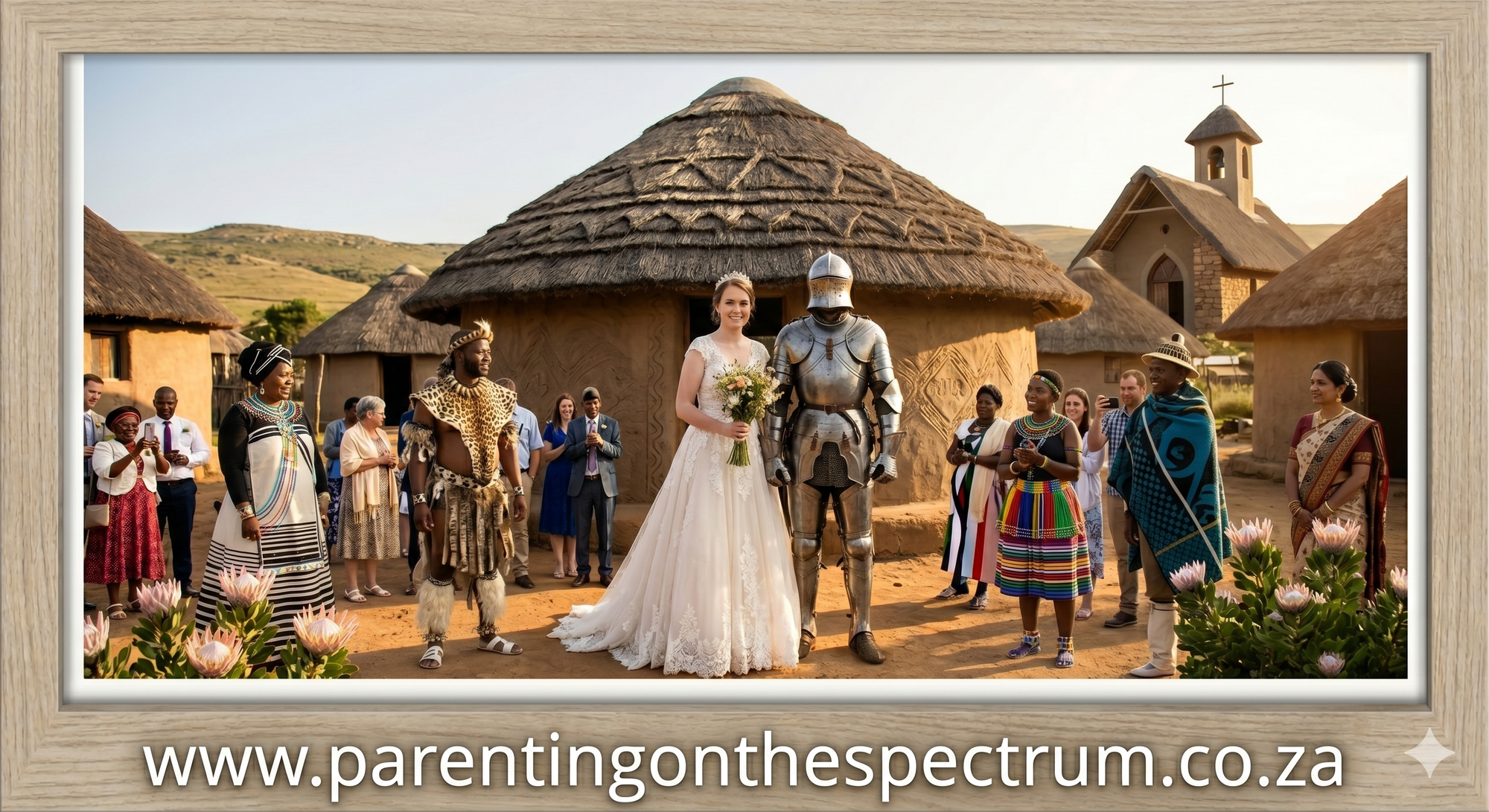
I have stood in front of hundreds of parents and educators across South Africa — in church halls, school auditoriums, and community centres — and I can tell you this with certainty: the most dangerous place for a neurodiverse child in this country is often not the classroom. It is the intersection of faith and diagnosis.
It is the moment a well-meaning dominee, a loving ouma, or a concerned tannie decides that what your child needs is not an occupational therapist or a psychologist — but prayer.
I say this not to attack anyone's faith. I was raised in a deeply traditional Afrikaans home, the kind where you greeted every oom and tannie with a hug regardless of whether you had ever laid eyes on them before in your life. Where being a girl meant looking pretty, being sweet, being agreeable. Where you thanked people who called you a pretty girl, even if you'd have preferred they hadn't said anything at all. Where you were feminine, always — and where stepping outside that was simply not a conversation anyone was having.I was lucky. I am, by my own joyful admission, very much a girly girl, and I'm at peace with that. But I am raising a child who is not. And that changes everything.
The Diagnosis That Dare Not Speak Its Name
South Africa is one of the most religiously observant nations in the world. More than 85% of South Africans identify as Christian, and faith is woven into daily life in ways that are often genuinely beautiful — community, ritual, belonging, hope. But that same religiosity can create a particular kind of cruelty for families navigating neurodevelopmental conditions. When your child melts down in church, struggles to sit still, cannot follow unspoken social rules, or refuses to conform to gender expectations, the response you too often receive is not compassion. It is implication. The implication that you have not prayed hard enough. That there is a generational curse at work. That your child is oppressed — spiritually, not neurologically.
I have sat across from parents — Zulu, Afrikaans, Xhosa, Indian South African — who delayed their children's diagnoses by years because a pastor told them a label was from the world, not from God. I have spoken to mothers who wept not because their child was struggling, but because they were too ashamed to tell their congregation.
In many traditional Black African communities, the concept of illness as spiritual or ancestral in origin means that a child's sensory processing disorder may be attributed to an unsettled ancestor, or that ADHD is read as disrespect and met with punishment rather than support.
This is not unique to any one religion or culture. It is what happens when communities that deeply value conformity encounter children who are neurologically wired to be different. The result is that some of South Africa's most extraordinary minds are being spiritually shamed into silence before they ever receive the help they deserve.
South Africa also has no national neurodiversity policy. The Schools Act makes provision for inclusive education, but implementation is wildly uneven. A psychoeducational assessment can cost between R6,000 and R12,000 — placing diagnosis entirely out of reach for the majority of families. The people who can least afford to navigate this system without support are the ones most likely to turn to their faith community as the only available resource. And when that community has no framework for neurodevelopmental difference, spiritual explanations fill the gap.
Olivia, and the Weight of Being Called 'She'
My eldest child's name is Olivia. Olivia has a diagnosis of Pervasive Demand Avoidance — PDA — a profile on the autism spectrum characterised by an extreme, anxiety-driven need to avoid demands of any kind.
And demands, it turns out, are everywhere. They are in the word "please." They are in the expectation that you will sit down when asked. They are in the shape of a school timetable, the structure of a birthday party, the invisible rules of a social greeting. And they are in gender.
Think about what we demand of children based on their perceived sex. We demand that boys be tough, competitive, emotionally sealed. We hand them particular toys and panic when they reach for others. We demand that girls be gentle, pretty, helpful, soft. I know those demands intimately — they were handed to me with love by people who genuinely believed they were preparing me for a good life. Greet the oom. Thank the tannie. Smile when someone says you're pretty. Be a good girl.
For a child with PDA, every one of those expectations is a landmine. The demand doesn't even have to be spoken. It can be implicit in a pronoun, in an outfit laid out on a bed, in an assumption made by a relative at a family braai.
Olivia has told me — clearly, consistently, with the kind of unambiguous directness that is one of the great gifts of a literal mind — that being called "she," being referred to as "a girl," being seen through the lens of female expectation, is not just uncomfortable. It is distressing. It derails a day. It damages a sense of safety that is already fragile. And so, as a family, we use they/them pronouns for Olivia. Not as a political statement. Not as a rejection of God or the Bible. Not as an act of advocacy against religion. Simply because I choose to give my child a home where they feel heard. Where they feel safe. Where the person who is supposed to love them most unconditionally — their mother — does not add to the pile of demands the world already places on them by the minute. I am not asking the world to change. I am asking that my home be a place where my child does not have to.
Gender, Neurodiversity, and Why They Travel Together
When I explain this at schools — and I do, often — I am always struck by how visceral the reaction is. The non-binary question consistently generates more heat than anything else I discuss: more than medication debates, more than discipline strategies, more than the very real failures of the South African education system.
People who are perfectly reasonable become visibly uncomfortable. Some become hostile. So let me be precise, because this is not simply my experience as one mother. The research is consistent: autistic and PDA-profile children are significantly more likely to identify as gender diverse than their neurotypical peers.
This is not a trend, a contagion, or a social media phenomenon. It is a pattern that neuroscientists and psychologists are increasingly documenting across cultures and countries. The prevailing thinking is that neurodiverse individuals, precisely because they process the world differently, are less susceptible to unconsciously absorbing and performing social norms — including gender norms.
They see the construct more clearly, perhaps, because they were never fully immersed in it to begin with. For PDA children specifically, the connection is even more direct. Gender comes with an enormous catalogue of unspoken rules, expectations, and performances. For a child whose nervous system treats demands as existential threats, the script of girlhood — or boyhood — is not a comfort. It is a cage.
In the South African context, this is further complicated by cultural frameworks around gender that are often even more rigid than religious ones. Across many traditional communities, gender roles are not social constructs open to debate — they are foundational to identity, family structure, and community belonging.
Initiation, lobola, the expectations placed on a makoti — these are structures within which there is very little room for a child who does not fit the given category. This does not make these cultures wrong. It makes them human. But it does mean that neurodiverse, gender-diverse children in these communities are navigating a profoundly isolating experience with very little language, and very little community, to support them.
'Kind of Freaky and Hard to Imagine'
There is one more part of this conversation that I raise carefully, because it generates its own particular storm. Many neurodiverse children — and I say this from direct experience with Olivia and from years of conversations with other parents — find the concept of God genuinely, sincerely confusing. Not threatening. Not offensive. Confusing.
Our children are, by neurological nature, often deeply literal. Abstract concepts require a scaffolding of concrete understanding that faith, almost by definition, does not provide. The idea of an entity who is everywhere and nowhere, who can be spoken to but does not speak back in any verifiable way, who exists in a realm we cannot see or measure — this is, in Olivia's own words, "kind of freaky and hard to imagine."I remember the first time Olivia said that. I braced myself — not because I was offended, but because I knew what it would mean if they ever said it to a grandparent, a Sunday School teacher, a dominee who had just prayed over our family.
The literalism of a neurodiverse child is not irreverence. It is not rebellion. It is simply how they process a world that was not designed with their kind of mind in mind.In many South African faith communities, a child who questions God — even gently, even innocently — is understood as spiritually troubled. The response is more prayer, more intervention, sometimes more shame. What the child actually needs is an adult who can sit with the question. Who can say: "That's a really interesting thought. Tell me more." Who can give them permission to be uncertain in a space that prizes absolute belief.
The Bravery of the Ordinary Decision
People often use the word "brave" about me. I have complicated feelings about that. What I do does not feel brave — it feels necessary.
The brave ones, I think, are the parents still inside the systems I have partially stepped outside of. The Afrikaans mother in the Boland who uses her child's correct pronouns quietly, within the walls of her home, while still attending the NG Kerk with the rest of the family every Sunday.
The Zulu father in KwaZulu-Natal who has accepted his son's ADHD diagnosis against the advice of his own father, who believes the boy simply needs stricter discipline.
The Indian South African mother in Durban who books her daughter's OT appointments and tells none of her friends while they stand baking their naan bread alongside one another.
These parents are doing the hardest kind of work: holding two worlds simultaneously. Loving their community and loving their child. Finding the narrow path between belonging and advocacy.
I have enormous respect for them. What I want to say to all of them — and to every educator, pastor, priest, imam, dominee, and family elder reading this — is something simple. You do not have to choose between your faith and your child. But you may need to choose between your community's comfort and your child's safety.
And when that moment comes, it should not be a difficult choice. Olivia is one of the most extraordinary human beings I have ever known. Clear-eyed in the way that only someone who has never performed a social script can be. Funny in ways that catch me off guard every day. Honest to a degree that is sometimes startling and always worth listening to. They are not a spiritual failing. They are not a problem to be prayed away. They are exactly who they are. And who they are is remarkable.