The System Didn't Break My Child — But It Gave It a Very Good Go. What happens when a PDA child meets a school system that wasn't built for them — and what it costs when it goes wrong.
Let me set the scene for you.My child Olivia — non-binary, brilliant, ferociously themselves — was four years old. They were sitting in a school office next to me while a principal and two teachers played CCTV footage.
On screen, small Olivia was methodically investigating other children's lockers. The adults in the room were presenting this evidence with the gravity and gravitas of a court proceeding. I sat there, watching my four-year-old on a grainy school camera, being held accountable for theft like a tiny career criminal. They were four.
This is the story of what the education system did to my child before my child even lost their belief in the tooth fairy. And before you assume this is the story of a badly behaved kid with a defensive mother — it is not. It is the story of a system that was never designed for a brain like Olivia's, and what happens when an immovable institution meets a child who simply cannot comply.
This is also, I am increasingly certain, the story of thousands of South African families who are navigating the same wreckage in silence.
First: What Is PDA, And Why Does School Break These Kids?
Pervasive Demand Avoidance — or as many researchers now prefer, the Pervasive Drive for Autonomy — is a profile most commonly found within the autism spectrum, though research has documented it across other neurodivergent profiles including selective mutism, language disorders and ADHD.
It is not a behaviour problem. It is not a parenting problem. It is a neurological profile characterised by an anxiety-driven need to be in control of one's environment and experiences in order to feel safe.
The concept of PDA was first described in the 1970s by clinician Elizabeth Newson, who found a group of children referred for autism assessment who resembled autistic children but were distinct from them. The central feature she identified was a need to avoid everyday demands in order to reduce anxiety, with social manipulation used as a key avoidance strategy.
When avoidance strategies failed, extreme emotional responses occurred — understood by clinicians as akin to a panic attack.
Now imagine designing a system specifically engineered to trigger panic attacks five days a week, for twelve years. Sit down. Line up. Be quiet. Face forward. Ask permission. Follow the schedule. Do not stim. Do not move. Do not deviate. Congratulations. You have just described a standard South African classroom.
Any external demand coming from somebody else, or that the person perceives as coming from another person, generates a lot of internal discomfort — which leads to the avoidance.
Tasks like sitting down at a table, drawing, or following a routine may all be things a PDA child has the skills to do — but the demand itself is the problem, not the capability. This is the piece that educators consistently miss. The PDA child is not choosing defiance. Their nervous system is choosing survival.
School Number One: The Aberration
Olivia started preschool not knowing how to play. Not "not enjoying" play — genuinely not understanding it. Games like dress-up and Queen of the Castle were completely befuddling. The other children had an unspoken shared language that Olivia simply hadn't downloaded. Social etiquette, requests to join in, the fluid choreography of group play — none of it made instinctive sense.The school's response to this was to label Olivia aggressive, and to isolate them from the other children.
Let me sit with that for a moment. A child who doesn't understand how to navigate social interaction is removed from social interaction as a consequence. This is the educational equivalent of telling a child with a broken leg to walk it off.
Olivia began trying to flee or elope. When fleeing wasn't permitted, they were made to sit it out in the classroom — exposed, judged, deeply aware of being different and unable to understand why.
The anxiety that PDA children carry is not abstract or vague. Maladaptive anticipatory responses to uncertainty are at the heart of PDA-related anxiety — an excessive, disproportionate response to unpredictable or uncontrollable situations, including the unpredictability of other children, social rules, and adult expectations. (South African Government)
So, Olivia started to fight. Not because they were aggressive. Because they were terrified. And when you're terrified and four years old and nobody has the language to understand you, the body does what bodies do: it fights back.We were duly expelled.
School Number Three: "Inclusive" (Terms & Conditions Apply)
School number three was the real star of the show. All the marketing material said inclusive. The meetings with teachers said inclusive. The prospectus practically had a rainbow flag and a neurodiversity logo on the cover.The classroom was less enthusiastic about this vision.
Olivia started to act out again almost immediately — because the demands were the same, and the nervous system has an excellent memory. When running away was blocked, and hiding was not permitted, Olivia became — as they now describe it themselves, with the cheerful candour of someone who has done a lot of processing — The Hulk. Desks were overturned. Scissors were brandished. Not because my child is violent, but because a PDA child who has exhausted every available avoidance strategy will escalate to whatever it takes to make the demands stop.
School distress researchers describe this as a survival mechanism — a way of responding to burnout. Children experiencing it feel it is safer to hide and dissociate from school as a strategy to protect themselves from further exposure to the root causes of their distress.
When hiding is removed as an option, the only remaining strategies are physical. Olivia had to sit still. Not move. Not stim. Not make sounds. Every one of these instructions was a demand that landed on an already-overwhelmed nervous system. And then there was the locker investigation.
The CCTV Summit of 2015
Here is what I now know about why Olivia was investigating those lockers, that a school principalship in 2015 did not know and chose not to ask:
Autonomy.
A PDA child in a high-demand environment will seek, in any way available to them, a small act of personal agency. Accessing a forbidden or private space is exactly that. When you have control over nothing, a locker becomes the last frontier of self-determination.
Curiosity as compulsion.
For a neurodivergent child with an intense internal drive, the instruction "do not look in there" is not a deterrent. It is a trigger. The mystery box must be investigated. The investigation has to be completed. This is not defiance. This is neurology.
Objects as safety anchors.
If Olivia felt overwhelmed by the sensory input of the classroom — and they were, consistently — a specific object might have registered as a regulation tool. The impulse to reach for something grounding can be so strong that it overrides the social rule of "don't touch."
Social mimicry.
At three and four, PDA children often observe other children and try to adopt their persona as a way of navigating a social landscape that makes no instinctive sense. Taking an item isn't about theft. It's about becoming the person who has the item — trying on someone else's competence when your own feels entirely inadequate.None of this was explained in that meeting. Because nobody in that room knew. And I didn't know yet either.
So I sat next to my four-year-old and watched CCTV footage of them being a PDA child in a system that had never heard of PDA, and I nodded, and I felt like the worst mother alive.
What the Research Says (While SA Schools Look Away)
The data on what happens to neurodivergent children in environments that don't understand them is not subtle. A landmark 2023 Newcastle University study surveyed 947 parents of children experiencing school distress. They found that in 94.3% of cases, school attendance problems were underpinned by significant emotional distress — with harrowing accounts from parents. While the mean age of the children was 11.6 years, parents reported school distress was first evident from as young as 7.9 years. Of these children, 92.1% were neurodivergent, 83.4% autistic, and 55% had ADHD.
The researchers concluded that school distress is "a story dominated by complex neurodivergence and a seemingly systemic failure to meet the needs of these children and young people."
A systemic failure. Not a child failure. Not a parenting failure. A systemic failure.
A 2025 qualitative study of neurodivergent adolescents currently experiencing school distress found that masking was common — but at enormous cost. Children described it as "tiring, but more simple than trying not to mask, which gets you all kinds of problems."
Sensory differences, uncertainty, social challenges and poor neurodiversity understanding commonly combined to create distress that extended far beyond school attendance. (Autistic Girls Network)
And crucially, for PDA children specifically, the structure of school is not merely difficult — it is constitutionally hostile. The first-ever survey exploring the real-world impact of PDA found high rates of school refusal, family estrangement, comorbidities, and unhelpful interventions.
The report concluded that the challenges families face is not due to a lack of effort or care, but to systems simply not designed with PDA in mind.
Now Let's Talk About South Africa Specifically
South Africa has had an inclusive education policy — Education White Paper 6 — since 2001. Twenty-four years. Research published in the African Journal of Disability in 2024 found that up to 70% of children with disabilities in South Africa are currently out of school. Despite more than two decades of White Paper 6, the deployment of resources and the transformation of the education sector has remained demonstrably slow. Seventy percent. Out of school.
A 2025 policy analysis published in the Journal of Social Issues found that South African education policy currently considers neurodiversity only in terms of impairment — framing it as disability rather than as natural cognitive diversity. The paper argues that "true inclusion must start moving away from a deficit-based perspective to one that recognises and nurtures unique strengths and talents." White Paper 6, despite its good intentions, fails to do this. (Sajce)
A 2025 Frontiers in Education study of mainstream South African educators found that despite White Paper 6's progressive policy language, significant implementation gaps persist. Educators showed limited knowledge of autism and related profiles — primarily gained through informal means — and reported positive but deeply strained attitudes toward inclusion.
And PDA? PDA doesn't even have formal diagnostic recognition in the international manuals that South African clinicians use. The international and American diagnostic manuals do not currently recognise PDA as a separate diagnosis or subgroup within the autism spectrum.
There hasn't been sufficient research for PDA to be used as a formal diagnostic term — though some clinical teams do describe it as a profile they recognise within the autism spectrum. (Sassa)
So we have a policy that talks about inclusion but doesn't implement it.
A clinical system that doesn't formally recognise the profile. And schools that are overcrowded, under-resourced, and staffed by teachers who have never heard the term PDA, let alone been trained in what to do when a four-year-old is investigating lockers to regulate their nervous system.
This is the system into which we are placing our children. And then we are surprised when they can't get up in the morning.
The Trauma Is Real. The Research Says So. So Does My Child.
The South African Journal of Childhood Education published research in 2025 finding that 17 of the 25 studies they reviewed documented the harmful effects of exclusionary educational practices on neurodivergent children — including suspensions, seclusion and behavioural punishment strategies.
Exclusionary discipline is directly correlated with higher dropout rates, social withdrawal and emotional distress.
In the absence of appropriate understanding and support during childhood, PDA individuals often develop significant secondary mental health difficulties: chronic anxiety, depression, post-traumatic responses from years of demand-enforcement, and profound difficulties with employment, relationships, and daily living. (Sage Journals)
Olivia was admitted to a clinic for depressive psychosis at age ten. Ten years old. The presenting cause was school avoidance — which was itself the end-stage of years of accumulated school-related trauma.
The depression that many PDA children carry is not incidental to their profile. It is what happens when a child spends their formative years being told, in ways both explicit and implicit, that who they are is a problem to be managed.
Their father visited once over the two-week admission. I was there every day. I am not saying this for sympathy. I am saying it because it is the reality of what many PDA parents — usually mothers, almost always alone — are navigating.
The advocacy, the letters to schools, the meetings with principals, the CCTV summits, the clinic admissions, the daily management of a child who is exhausted by the act of existing in a world that won't accommodate them.
Research confirms that working with trauma-exposed neurodivergent children places significant psychological demands on parents and caregivers, contributing to secondary traumatic stress and burnout in those who carry the support load.
Olivia's father never understood them. He could not be demonstrative with Olivia the way he was with their younger sister — because Olivia didn't fit the mould he had imagined for a daughter. They were not pretty in a conventional way or girly in an expected way. They were intense and loud and needed to stim and had no interest in performing femininity. And they craved physical affirmation. They still do. Co-regulation through touch is one of the most powerful tools we have, and it is one I provide in abundance.
What I cannot provide is the affirmation of a father who sees them.
Olivia now chooses not to have a relationship with their father. That is their right.
For a long time, my own father used to ask me — with genuine concern and no cruelty intended — whether Olivia would "always be like this." He does not ask that anymore. He does not fully understand Olivia. But he shows up. He tries. That, it turns out, is most of what any of us need.
The Stim, the "Weird," and the Weight of It All
The depression that lingers in PDA children is not always loud. Trauma is particularly challenging to identify because children often don't express their distress in ways that are recognisable. As child psychiatrist Nancy Rappaport puts it: "They are masters at making sure you do not see them bleed."
For Olivia, it was visible eventually. But before the clinic, there were years of what looked — to the uninitiated — like defiance, volatility, manipulation.
What it actually was: a child drowning quietly in the sensory demands of the world, with no vocabulary to describe it, no framework to understand it, and no institution willing to learn.
Being "weird" carries a cost. Needing to stim in a world that finds stimming embarrassing carries a cost. Having no friends — not because you don't want them, but because the rules of friendship are written in a language your brain doesn't speak — carries a cost.
Research confirms that neurodivergent children's internalised rejection in school settings leads to anxiety and shame, with non-conformity to neurotypical norms met with scepticism and frustration. Many children felt uncomfortable being neurodivergent at school, anticipating future shaming — leading them to withdraw, dissociate, or become invisible as survival strategies.
These aren't behavioural choices. They are scar tissue.
The Part Where I Get Frustrated (Professionally Speaking)
I am a neurodiversity coach and PDA specialist. I have spoken internationally about PDA. I have completed every available neurodiversity qualification through the Neurodiversity Centre. I have twenty years of teaching experience. I am also the parent of a PDA child, which means my knowledge isn't only academic — it is lived, daily, in real time.
Olivia's current school will not allow me to train their staff on PDA. The reason given: conflict of interest, because my child attends the school.
Let me translate that: the school is declining access to one of the rarest combinations of expertise available in this country — a qualified PDA specialist who is also a trained educator and a PDA parent — because it might look awkward. Meanwhile, their staff are navigating my child's profile with the tools available to them, which is to say: very few.
I am not saying this to promote myself. I am saying it to describe, in specific and personal terms, what the systemic failure looks like on the ground. It is not always dramatic. Sometimes it is just a politely declined offer, and a child who continues to struggle, and a mother who continues to watch and wait and try not to take it personally.
I want to fix this. For the teachers, who are doing their best with inadequate information. For the children, who deserve educators who understand them. And for the parents who are navigating a journey I had to navigate entirely alone, in a country where PDA is still largely unknown, in a system that is still largely failing us.
What Needs to Change — and What You Can Do Now
The research is unambiguous. PDA North America notes that burnout prevention for PDA children is not a luxury — it is survival. When we honour a child's nervous system and give them flexible ways to learn, we don't just keep them in school. We keep them from years of trauma recovery and mental health diagnoses. We keep families from breaking under the weight of impossible expectations.
Concretely, what works for PDA children in school
Collaborative, not directive. PDA children respond to approaches that offer genuine choice and shared decision-making. "Would you like to do maths first or reading?" is not weakness. It is neurological intelligence.
Declarative language over instructional language. "I notice the desks need moving" lands differently to "Move the desks now." One is an observation. The other is a demand. The distinction is everything.
Relationship before curriculum. You cannot teach a PDA child in a state of threat. The relationship has to come first. Always.
Flexibility over rigidity. PDA children do not thrive in systems built on compliance. They thrive when there is genuine flexibility, genuine trust, and genuine safety. Schools that are only inclusive on their marketing material are not inclusive schools.
And above all: believe the child. Children do not simply refuse or avoid school. Something or things have to happen to force them into disengagement — whether a single memorable event or a series of daily, invisible accumulations of sensory overload and unmet need. The "unmemorable" events are what cause the most confusion and the deepest fractures between families and schools.
When Olivia couldn't go to school, it wasn't won't. It was can't. There is a world of difference between those two words, and the entire trajectory of a child's mental health sits in the gap between them.
A Last Word
Finding a suitable school for Olivia has been — and continues to be — one of the most exhausting, demoralising, and occasionally darkly comedic pursuits of my adult life. Their current school is far from perfect. We manage. We advocate. We negotiate. We celebrate the small wins and we absorb the setbacks and we keep going, because that is what PDA parents do. It's look like we are again facing a stint of Olivia having to be booked off from school because Olivia is at complete depletion. And staying off school, is better than self harm and the loop of depression.
I work daily now with PDA families navigating this journey — to offer the support and the specific, informed, practical guidance that I had to piece together myself, in the dark, while the system looked the other way.
The system is still failing us. But I am not willing to wait for it to catch up on its own.
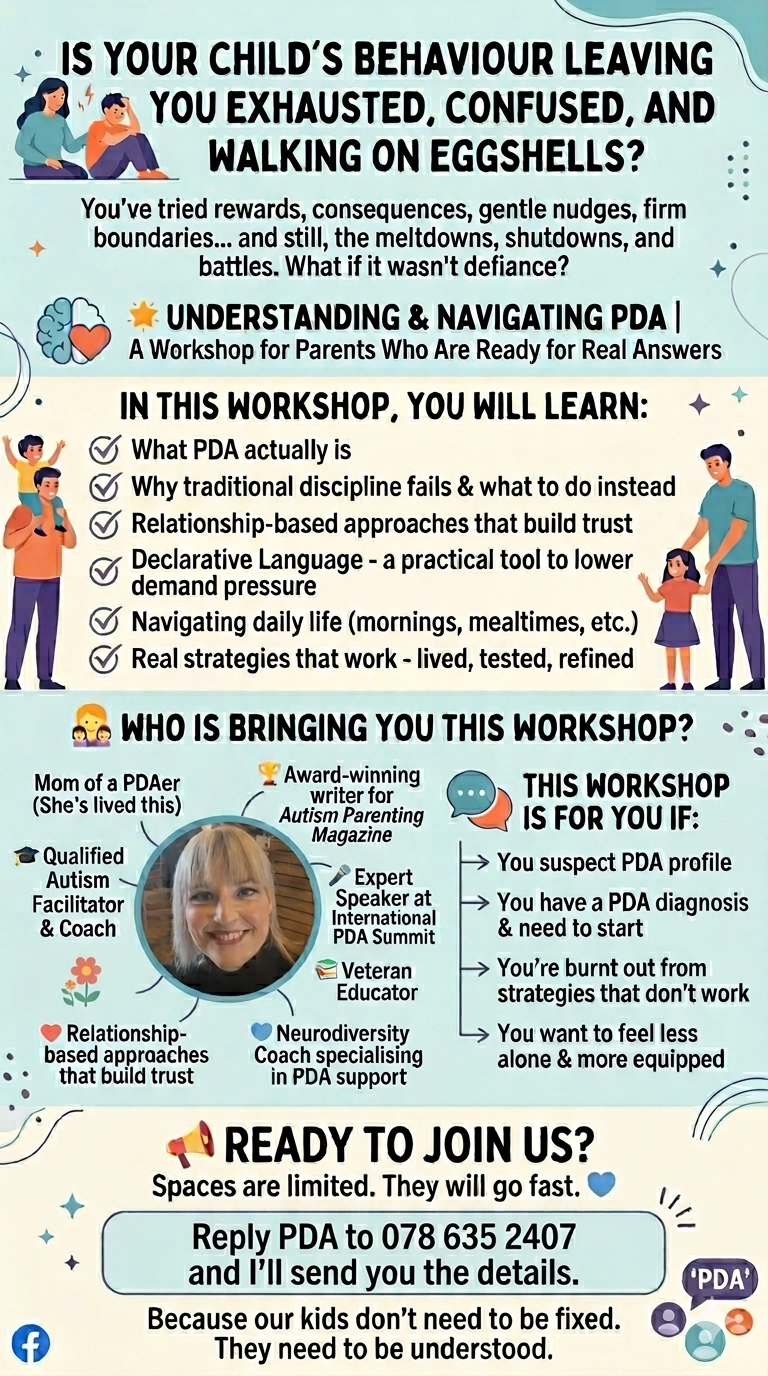
If you'd like to be part of the change — whether you are a parent, an educator, or someone who suspects they may be navigating PDA themselves — join me for my upcoming PDA workshop.
The link is below. Let's fix this together. One school, one family, one conversation at a time.
https://forms.gle/