WHY WON'T THEY JUST SLEEP? 😴 The Neurodivergent Brain, Bedtime Battles & the Parent Who Now Requires Horse Tranquilisers
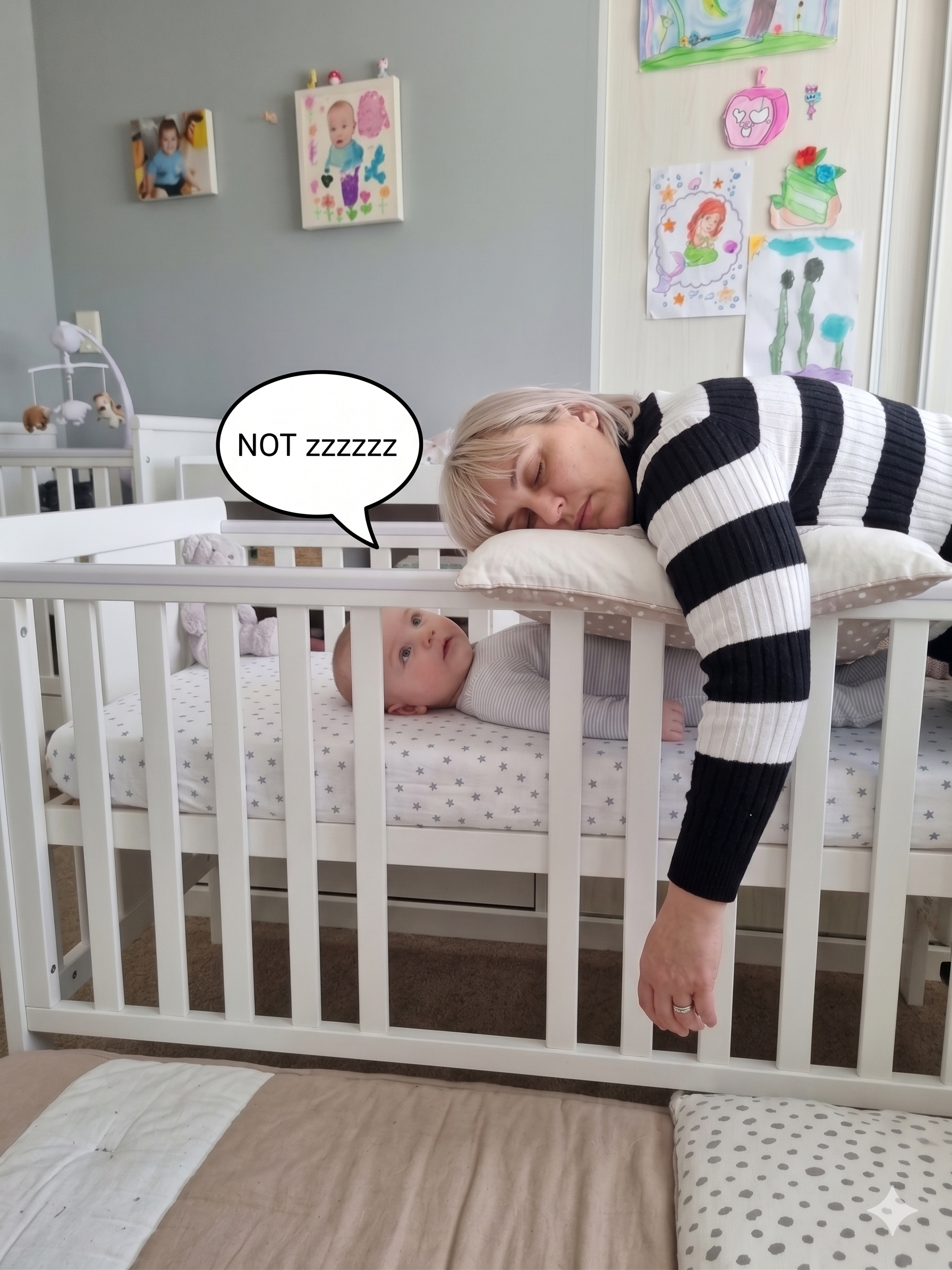
By Andrea Grant | Neurodiversity Coach, Educator & Woman Who Has Not Slept Properly Since 2010
Let me tell you something that no parenting book prepared me for. Olivia did not sleep. Not as a baby. Not as a toddler. Not in any way that could reasonably be described as sleeping. They cried. Constantly. With the dedication and stamina of someone who had made a solemn professional commitment to it.
I tried everything. Rocking. Driving. White noise. Swaddling. Leaving them. Not leaving them. Questioning every life choice that had led me to this moment at 3am, swaying in the dark, weeping quietly into a muslin cloth.
And here's the part nobody warns you about: even when Olivia eventually started sleeping, I didn't. My nervous system had been so thoroughly rewired by months of hypervigilance that I would lie awake listening for breathing. Checking. Rechecking. And then, when I was satisfied they were alive, lying awake anyway — because my own sleep architecture had been so completely demolished that I no longer knew how to do it.
That is how I ended up addicted to prescription sleeping pills. And to cut a very long, very unglamorous story short: I now cannot sleep without being chemically sedated to a degree that my doctor describes diplomatically as "significant." Horse tranquilisers, essentially. Lovely.I did not want that for my children.
So I did the research, tried everything, and eventually found what worked. But before I get to that — let's talk about why neurodivergent brains fight sleep so ferociously in the first place.
Why the Neurodivergent Brain Resists Bedtime
For most neurotypical children, bedtime is just... bedtime. The brain winds down, melatonin kicks in, the body gets the memo. For neurodivergent children — particularly those with autism, ADHD, or a PDA profile — the process is profoundly more complicated.
The melatonin problem. Research consistently shows that autistic individuals produce melatonin differently — often later, in lower quantities, and with a delayed release pattern. While the average child's brain begins producing melatonin around 9pm, many autistic children don't see that hormonal shift until 11pm or later. So when you're fighting your eight-year-old into bed at 7:30pm, their brain is — quite literally — not ready. You are trying to land a plane that hasn't started its descent yet.
The sensory problem. Bedtime is a sensory minefield. The feeling of sheets. The sound of the house settling. A light that isn't quite dark enough. A tag in a pyjama collar. For a child whose nervous system is already working overtime to process the world, the quiet of night doesn't bring calm — it brings every unprocessed sensation rushing in. The daytime noise that masked everything is gone. Now they can hear the neighbour's dog. The tap dripping. Their own heartbeat.
The anxiety problem. Sleep requires surrender. You have to let go of consciousness, of control, of awareness. For a PDA child — whose entire nervous system is organised around maintaining autonomy and safety — this is not a small ask. It is enormous. Falling asleep means losing control of your environment. For a brain that experiences demand as threat, unconsciousness can feel genuinely dangerous.
The transition problem. Autistic children frequently struggle with transitions, and sleep is the biggest transition of the day. From awake to asleep. From the known world to the unknown one. From regulated to unregulated. Without the right scaffolding, this transition can trigger the kind of anxiety spiral that keeps a child — and their entire household — awake until midnight.
When I tell you the struggle is real, I mean it. I have clients whose children haven't slept alone since birth. Others whose kids routinely see 1am as a perfectly reasonable bedtime. One family told me their child hadn't slept more than four consecutive hours in three years. The parents looked like ghosts. Lovely, devoted, completely hollowed-out ghosts.
What I Did — And What Actually Worked
When Olivia finally started sleeping with more regularity, and then when my younger children came along, I was absolutely determined not to recreate the chaos. I had seen what sleep deprivation did to me. I was not repeating the experiment.
I tried the Chair Method — and it changed everything.
The principle is simple, though the execution requires patience of almost spiritual proportions. You sit next to your child's cot or bed until they fall asleep. The following night, you move the chair slightly further away. Then further. Then to the doorway. Then just outside it. Over a period of weeks, you gradually withdraw your physical presence while your child learns — deeply, viscerally, in their nervous system rather than just their head — that they are safe. That you exist. That you are not going anywhere. That sleep is not abandonment.
For a neurodivergent child, especially one with a PDA profile, this matters enormously. You are not forcing them to self-regulate in isolation. You are co-regulating with them while slowly, incrementally, building their capacity to do it without you. The chair moves. The safety stays.I did this with both of my neurodivergent children. It was slow. Some nights I sat there so long I considered just sleeping in the chair myself. But it worked.
They both learned to sleep independently, and they did it without the kind of trauma that comes from being left to cry alone in the dark.
Do I think controlled crying works for neurodivergent children? Genuinely, no. A PDA child who is left to cry is not learning to self-soothe — they are learning that their distress signals don't work. That is a very different lesson, and not the one we're going for.
The Bedtime Structure That Saves Us
Here is the other thing I am absolutely evangelical about: consistent, non-negotiable bedtimes. In our house, this is not up for debate. My youngest goes to bed at 8pm. My son at 8:30pm. Olivia, now sixteen, at 10pm. Every night. Even weekends, with minor flexibility. The predictability itself is regulating — the neurodivergent brain, which can struggle enormously with transitions, actually does better when bedtime is not a negotiation but simply a fact of life, like gravity or load-shedding. Now — and this is important for my PDA parents specifically — I am not suggesting you announce bedtime like a military command and expect compliance. That way lies madness, and also a meltdown. The structure is non-negotiable. The language around it needs to be collaborative and low demand. Instead of "it's bedtime, go brush your teeth," try: "I wonder if your body is starting to feel tired yet?" "Shall we start our wind-down? I'll come sit with you." "Your bed is all cosy — do you want the light on or off tonight? "Same destination. Completely different road.
Building a Low-Demand Wind-Down Routine
The hour before bed is where you either set yourself up for success or accidentally detonate the whole evening. Here is what the research — and seventeen years of lived experience — suggests:
Dim the lights from about 7pm. Bright light suppresses melatonin. This means overhead lights, screens, tablets, and yes, the TV. I know. I'm sorry. Blue-light blocking glasses can help if screens before bed are a non-negotiable in your household — and for some families, they genuinely are.
Reduce demands progressively. The lead-up to bed is not the time for homework reminders, difficult conversations, or asking them to tidy their room. You are trying to bring the nervous system down, not spike it again.
Offer sensory input that regulates, not stimulates. A warm bath or shower (the subsequent drop in body temperature actually triggers sleepiness), deep pressure like a weighted blanket, or a firm hug if your child tolerates touch. Olivia always responded well to what we called "the panini squish" — being gently pressed between two pillows. Proprioceptive input is deeply calming for many autistic children.
Make it predictable and their own. The routine should be the same every night, and wherever possible, your child should have genuine choices within it. Which pyjamas. Which book. Which side of the bed. Autonomy within structure — especially for PDA children — is not optional. It's the whole point.
Melatonin supplements — worth discussing with your paediatrician, particularly for children whose circadian rhythm is significantly delayed. In South Africa, low-dose melatonin is available and can help shift the sleep window earlier. It is not a magic bullet, and it works best alongside good sleep hygiene rather than instead of it.
A Note to the Parent Who Is Also Not Sleeping
I see you. I have been you. I have been the person lying rigid in the dark, listening for breathing, unable to switch off a nervous system that spent years on high alert and never quite got the memo that the emergency was over. Parental sleep deprivation in neurodivergent families is chronic, serious, and almost completely unaddressed. We talk endlessly about our children's sleep. We talk almost never about ours.If you are struggling — if you have been surviving on fragments for years — please talk to someone. Your GP. A therapist. Another parent who gets it. Sleep deprivation is not a badge of honour. It is a health crisis that erodes your capacity to be the parent your child needs.I learned that the hard way. You don't have to.
The Bottom Line
Sleep is not a luxury for neurodivergent families. It is the foundation everything else is built on — regulation, learning, emotional resilience, and the basic human capacity to get through a day without crying in a supermarket car park. Your child's brain is not broken. It is wired differently, and it needs different scaffolding to find its way to rest. The Chair Method, consistent structure, low-demand language, sensory wind-down routines, and sometimes a little melatonin — these things work. Slowly, imperfectly, but they work. And one day — I promise you this — you will sit in that chair next to their bed, watch their breathing slow, see their face go completely peaceful, and think: we did it. Then you'll go check if they're still breathing approximately four more times before you go to bed yourself. Because we are who we are.
Andrea Grant is a qualified neurodiversity coach, educator, and mother of three neurodiverse children based in Cape Town. She offers home coaching, school advocacy, and parent workshops across South Africa.