When "Warm Regards" Gets Returned as "NO Regards": A Professional's Encounter with the World's Most Defensive Email.
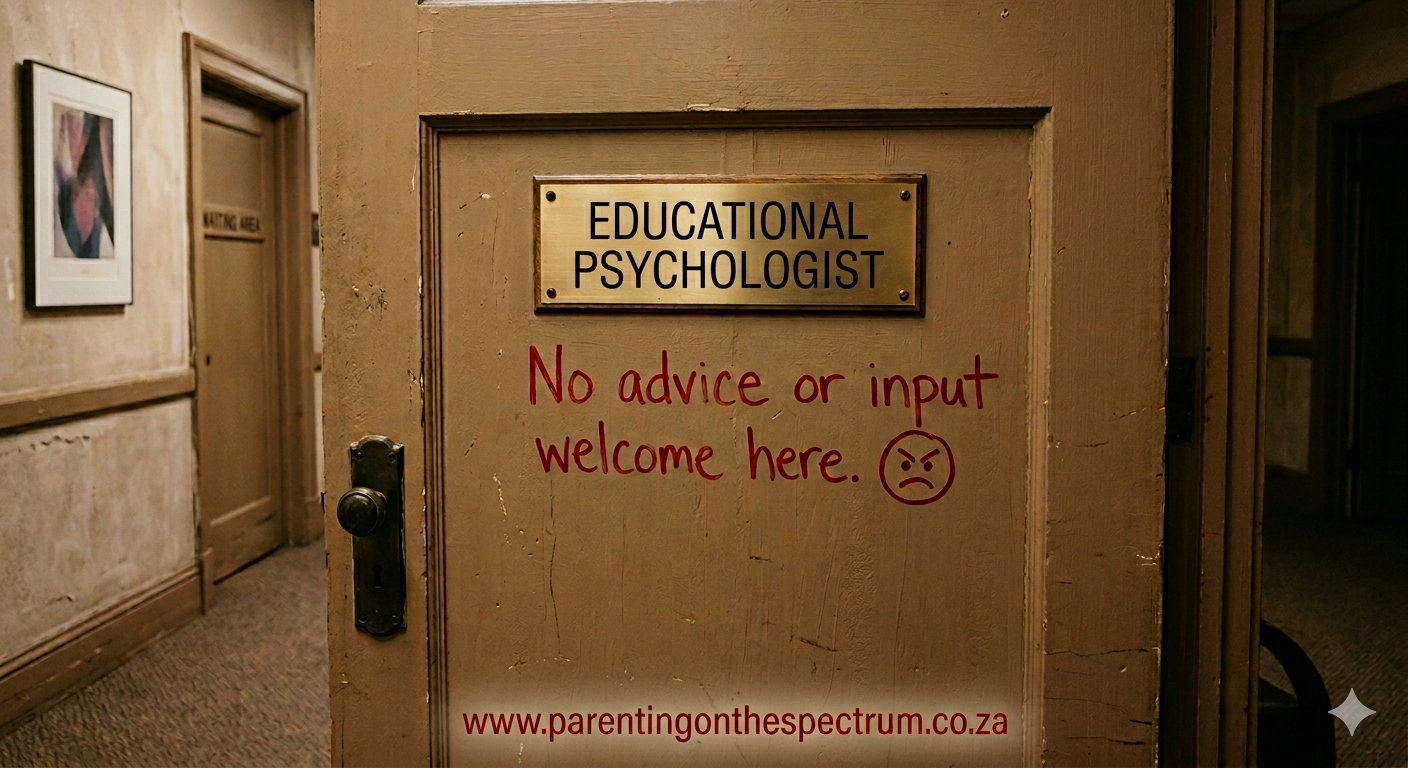
📧 There's a moment, in every professional's career, where you read an email and your jaw quite literally hits your desk. Not because of bad news. Not because of a difficult situation. But because another professional — a supposedly regulated, trained, credentialled adult — has written their response to you entirely in red font.
Reader, we need to talk.
I have been doing this work long enough to know that I do not know everything. That sentence alone probably distinguishes me from a certain someone we'll get to shortly.
As a Neurodiversity Coach, Qualified Child and Adolescent Counsellor, Qualified and SACE Accredited Educator, PDA specialist, mother, and facilitator, I have sat across from hundreds of families navigating some of the most complex neurological terrain South Africa's healthcare system has to offer.
🎓 have studied. I have qualified. I have continued to study and re-qualify. And through all of it, the most important thing I have learned is this: the moment you believe you know everything is the moment you become dangerous to the people you serve.Which is why I have always — always — encouraged my clients to seek second opinions. To try other approaches. To tell me when my suggestions aren't working. Because that is how we all grow. That is the whole point.
👨👩👦 So when a family approached me for support and shared some information from their current therapy team, I did what I naturally do: I offered to help. I crafted a careful, warm, collegial email to the family's psychologist — a man with qualifications, a practice, and presumably a fair amount of self-regard — offering some supplementary information from my own specialisation in Pervasive Demand Avoidance (PDA).
I ran it past MULTIPLE colleagues first. I praised his work. I made it unambiguously clear that I was not there to step on anyone's toes. I was simply adding a layer of specialised knowledge on behalf of a family who needed it.
💥 What followed can only be described as a Category 5 meltdown — which, incidentally, is something I know quite a lot about professionally, and this one had all the hallmarks.
The Email Heard Round the Therapy Room
The response I received was not merely cool or dismissive. It was not a polite "thank you, but no thank you." No. He questioned my qualifications (I provided them, cheerfully). He questioned my role. He accused me of — and I quote — "running over his whole body with cement blocks with spikes."Bold imagery. One imagines him at his desk, composing this dispatch, pausing to think: Should I use red font? Yes. Yes, I should.
He was furious. Incandescent. And I — because I am the kind of professional I am — apologised. I said plainly that it had never been my intention to cause upset. I signed my reply with "Warm Regards."His response? "Apology NOT accepted."And then: "NO REGARDS."
🤔 I want you to sit with "NO REGARDS" for a moment. As a sign-off. From a mental health professional.
🤝 What We Actually Know About Working Together (Spoiler: It's Better for Everyone)
I would like to pause here and invite a brief stroll through the research, because I find facts enormously comforting in situations like this.
🧠 In mental health care, the evidence for interprofessional collaboration is unambiguous. Integrated methods of care improve patient outcomes, enhance cost efficiency, and reduce medical errors.When professionals communicate openly and frequently, there is more consistency for the family — for the child — sitting at the centre of it all. That is the whole reason we are doing this work, is it not?
🇿🇦 Here in South Africa specifically, the need for collaborative practice has been called out loudly and consistently.Researchers and policy-makers have proposed collaborative care models for mental health service delivery, describing a team-based approach that restructures the roles of health care providers across sectors.
The University of the Western Cape has been building this into its education model for decades — actively breaking down silos while preparing health professionals to enter the workplace as members of a team, not lone operators of impenetrable kingdoms.And yet, a 2024 systematic review of South African literature found that the integration of collaborative practice is still limited, with healthcare professionals operating in silos. (ResearchGate)In. Silos.There it is. The single word that explains almost everything about that red-fonted email. Silos.
The professional equivalent of pulling up the drawbridge, pouring boiling oil over the battlements, and refusing to acknowledge that anyone else might have anything useful to contribute.
🛖 PDA: Precisely the Kind of Thing That Requires a Village
Here's what makes this situation particularly bewildering. The area in which I offered insight was Pervasive Demand Avoidance — a profile that is, by any measure, specialist territory.PDA is gaining traction as a way of capturing a neurotype in which a threat to autonomy is not merely annoying but registers as a primal, embodied threat to existence itself — and therapists often mistake PDA for pathology rather than a neurotype with advantages. (Psychology Today)
This is not a criticism of anyone. PDA is complex, nuanced, and evolving. As our understanding of neurodiversity expands, important questions are emerging about how we understand, assess, and support individuals who struggle with extreme demand avoidance — questions with real implications regardless of underlying neurological profile. (Neurodiversitycentre)
🤲 The field is practically begging for collaboration.
When a family's PDA-specialised coach reaches out to share additional context, this is not an attack. This is the system working as it should. This is the village it takes.
⚔️ On Cement Blocks with Spikes (and What They Might Tell Us)
I will confess that I have thought at length about the cement block metaphor. It is vivid. It is dramatic. It invites curiosity rather than judgement. And so I'll offer this gently, with the compassion I always try to bring to my work.
Studies indicate that ego conflicts between professionals contribute to communication breakdowns, delayed decision-making, and lower staff morale — all of which collectively result in poorer patient outcomes. (Americanhhm)
😡 When a professional reacts to collegial input not with curiosity but with red font and creative punctuation, it may be worth asking what is sitting beneath that reaction.
🥱 Stress has consistently been shown to be associated with the use of lower level defence mechanisms, and those experiencing high levels of stress are likely to use more immature defence mechanisms than those experiencing less. This is not shade. This is neuroscience.
And here in South Africa, we know that our healthcare professionals are carrying enormous loads. Extensive research has documented high levels of burnout among South African doctors and medical students, with the COVID-19 pandemic unmasking a systemic failure to protect individual healthcare workers from trauma, excessive workload, and challenging work conditions.
Burnout is recognised by the World Health Organisation as resulting from chronic workplace stress that has not been successfully managed — characterised by emotional exhaustion and reduced personal accomplishment.
I say none of this to excuse behaviour that was, objectively, unprofessional. I say it because I genuinely believe that the kind of reaction I received does not emerge from a well-rested, well-supported, professionally fulfilled person. Someone working from a grounded and secure professional identity does not write their emails in red.
What Good Collaboration Actually Looks Like
For those in the back — and perhaps for that particular inbox — here is what professional consultation between colleagues looks like when it is done with any degree of grace.
You receive an email from a fellow professional offering supplementary insight. You read it. You consider whether any of the information might be useful. If it is not, you say something along the lines of: "Thank you for reaching out — I'll keep your observations in mind." If it is useful, you say: "That's an interesting angle, I'd love to discuss further."
What you do not do is write in red. What you do not do is weaponise your sign-off. What you do not do is suggest that someone sharing specialist knowledge is, in effect, assaulting you with construction materials.
The Collaborative Care Model demonstrates that 75% of individuals with a collaborative care team reach a diagnosis and start treatment within six months — compared to only 25% under usual, siloed treatment. Three times the outcome. Three times the support. Simply by letting people work together.
💚 The family at the centre of this story — the actual humans we are all meant to be serving — deserved better than a turf war conducted in red ink.
🌍 A Word on Humility (Which I Hear Is Still Free)
I want to be absolutely clear: I am not perfect. I have made mistakes in my work. I have given advice that needed revising. I have been wrong. I remain open to being wrong again. The professionals I most respect in this field are the ones who approach every interaction with a spirit of "what can I learn here?" rather than "how dare you."
What I offered was not a threat. It was not a challenge. It was information, offered professionally, reviewed by colleagues, and delivered with warmth. That it was received as an act of aggression says something — but not about me.
I do not need to defend my empathy or my competence. Anyone who has walked through some of the hardest seasons of their family life alongside me already knows who I am. I am secure enough in that to say simply: I am sorry my email upset you. I still don't think the cement block analogy was proportionate. And I genuinely hope you get some rest.
In Conclusion: We All Need Each Other
The neurodiversity field in South Africa is growing. It is imperfect. It is under-resourced and over-stretched, and our families — our beautiful, exhausted, fiercely loving families — are trying to navigate systems that were not built with them in mind. The very least we can do, as the professionals lucky enough to sit in these seats, is talk to each other.Not in red font. Not with dramatic punctuation. Just talk.I will always show up to that conversation with warm regards. Every single time.
#NeuroAffirmingParenting #PDAawareness #NeurodiversitySouthAfrica #InterprofessionalCollaboration #ParentingOnTheSpectrum
