When the School is the Problem:Why Finding the Right Environment Changes Everything.
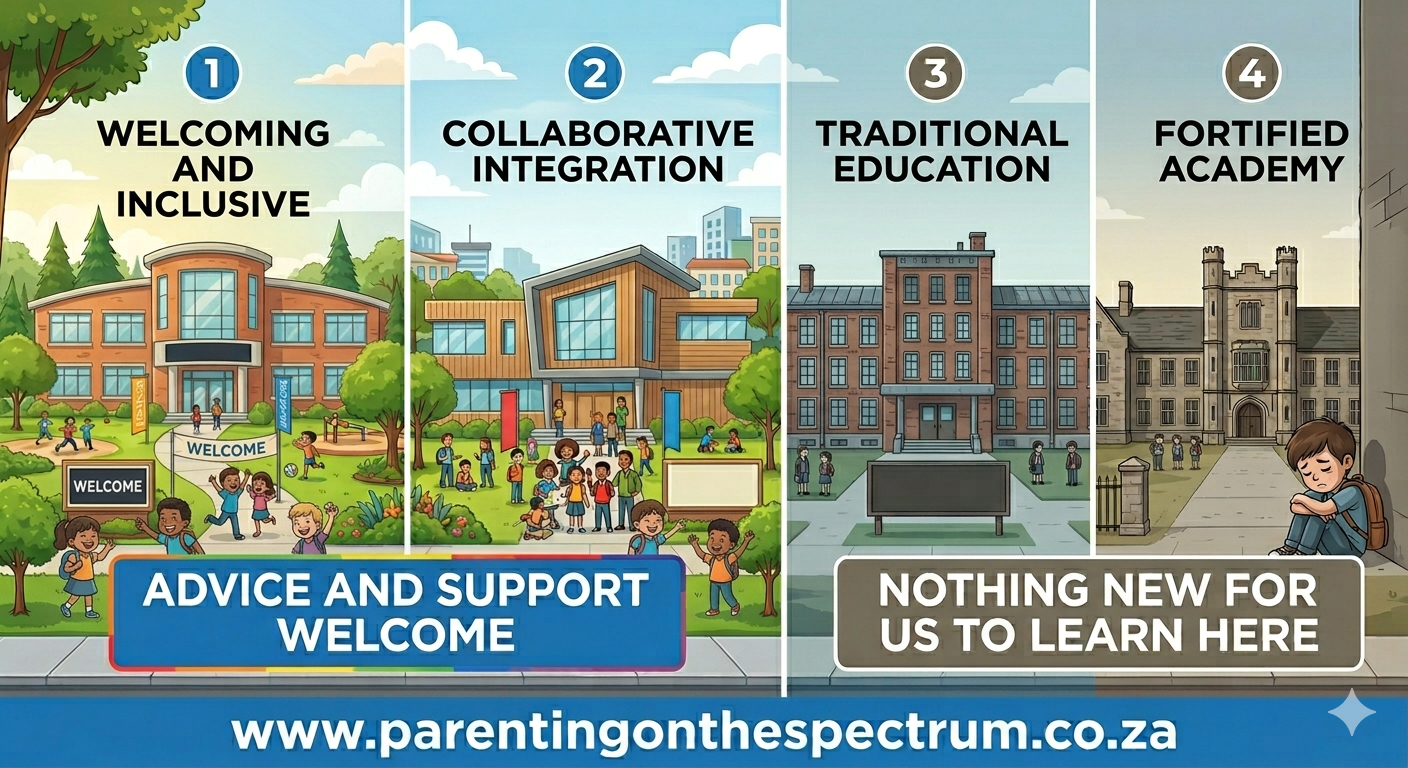
I want to talk about something that doesn't get nearly enough airtime in the neurodiversity conversation. Not the diagnosis. Not the therapy. Not even the homework meltdown at 6pm on a Tuesday.
I want to talk about school fit — and what happens when it goes catastrophically wrong.Because here's the truth I sit with every time I walk into a new school: some of the most intelligent, curious, joyful children I have ever met have been quietly — and sometimes not so quietly — destroyed by being in the wrong environment.I don't use that word lightly.
🖊️ What I Actually Do (Let Me Explain)
There seems to be some confusion about what school facilitation involves, so let me clear it up.
When a family is considering a new school for their neurodivergent child but isn't sure whether it's the right fit, I go with them. If I don't already know the school through my network, I visit it alongside your child for a three-day trial period.
Most schools are open to this. I shadow your child in the classroom, at break, in the corridors, with other kids. I get to know the environment holistically — the energy of the place, the dynamics between learners, the unwritten rules, the sensory experience of being there.
I try to get to know as many teachers as I can in that time.
📝 At the end of those three days, I provide the family with a detailed written report and my honest recommendations.
💸 This matters for a very practical reason: starting at a new school is expensive.Registration fees, deposits, uniforms, stationery — it adds up fast. And doing all of that before you know whether the school is actually going to work for your child is a gamble no family should have to take.
🫶 The trial facilitation exists to give you peace of mind before you're financially committed.
I also go into schools where a child is already enrolled and things are not going well — where there's been bullying, persistent conflict, or a creeping sense that your child is getting smaller instead of bigger. Where your child is starting to carry a stigma for misconstrued behaviours. In those cases, I'm there to understand what about the environment, the teaching methods, or the classroom dynamics is not working and why.
👀I observe. I gather information. Then I try to offer teachers practical, research-backed suggestions — things like using Declarative Language instead of imperatives, which reduces pressure on neurodivergent learners by sharing observations rather than issuing commands, giving children space to respond naturally and lowering the anxiety that comes with repeated direct questions or demands.
➕ Some teachers receive this with genuine enthusiasm. ➖ Some do not. I will always be honest with families about what I found.
🇿🇦 The SA School Landscape: More Choice Than You Think
One thing South African families are genuinely fortunate to have is curriculum choice. We are not locked into one system. We have CAPS (the national curriculum), IEB, Cambridge, Waldorf, various hybrid models, and a growing number of online platforms — including NeuroMe, which is currently South Africa's only homeschooling curriculum designed specifically for neurodivergent learners from Grade R to Grade 12.
♥️ But here is where I have to be honest with you, and I say this as a teacher of over twenty years and Mom to my own neurodiverse children: curriculum choice is not one-size-fits-all, and some of the most prestigious options are not the most accommodating.
In my experience, both IEB and Cambridge environments can be quite rigid. 🏃Movement breaks, sensory breaks, scaffolded activities — these are often treated as exceptions rather than norms.
🆘🙂🩼Applying for concessions through these systems can be an exhausting, drawn-out process, and to be brutally frank about it, elite academic schools want academically strong learners who will boost their matric pass rates.
They are not always genuinely invested in making meaningful accommodations for learners who need them.
And many times, after I have fought tooth and nail for a family to get a concession, what arrives is something wholly inadequate — a computer-generated voice as a reader, for example. Which is a whole other article.
The sweet spot is something different: environments with flexibility built in, teachers who view outside input as support rather than as a personal affront, and schools that are genuinely willing to learn. They exist. I know many of them. Finding them is the challenge.
💔What Happens When the Fit Is Wrong
Research indicates that between 5% and 10% of children in South Africa are affected by ADHD, consistent with global prevalence rates, and the prevalence of autism is estimated at between 2% and 5% of the population — though given the limitations of data collection here, the true figure is likely higher.
These are not small numbers. And yet many public and even private schools, lack trained staff, specialised materials, and the infrastructure to support diverse learning needs, (Sajce) while rigid curricula, limited differentiated instruction, and inadequate teacher training continue to hinder adaptability.
The cost of placing a neurodivergent child in the wrong environment is not abstract. Research consistently shows that neurodiverse learners are at a higher risk of comorbid depression and anxiety, peer rejection, academic difficulties, and challenges coping with mainstream schooling. (Safmh) And when the environment is not just a poor fit but actively hostile — when a child hears their name called out in a negative way multiple times a day, when stimming is misread as aggression, when 'rough play' is treated as a behavioural problem rather than a sensory need — what follows is burnout.
🤯 Neurodivergent burnout can look very different from ordinary exhaustion.
It can show up as meltdowns and significant behavioural changes that are frequently misread by teachers and caregivers as deliberate non-compliance.
What the child is actually communicating is that they need to be understood. (Psychology Today) Research has begun documenting autistic burnout specifically in children, noting that it remains significantly under-recognised, particularly in the context of school avoidance.
I have watched bright, enthusiastic, genuinely lovely children on the spectrum become smaller versions of themselves in the wrong school.
I have watched them stop wanting to get out of the car.
I have watched them stop eating at break because the sensory experience of a crowded tuckshop is too much, and nobody noticed.
No child should be forced to stand in front of a class with their finger on their lips. No child should be publicly chastised in front of their peers. These are not minor inconveniences — they are experiences that leave marks.
👎On Teachers Who Are "Open to My Visit" But Not My Suggestions
This is the part that quietly breaks my heart.I am not the enemy. I am not arriving with a clipboard to evaluate anyone's worth as a teacher. I have been teaching for over twenty years. I have my own neurodivergent children. I am still learning, every single day, because the landscape of neurodiversity is continuously evolving and anyone who tells you they know everything is not someone I would trust with your child.
We are told, as teachers, that we should be lifelong learners. That principle applies here more than anywhere.
When I come into your classroom, I am on your team. My suggestions — have you tried this? what about adjusting that? — are not criticism. They are ideas, offered in the spirit of collaboration, from someone who has spent years accumulating exactly this kind of knowledge so that I can be useful to you and your learners. And side note:in spite of what many of these teachers think, the answer to problems is NOT always medication.
Research on neurodiversity in South African education highlights the urgent need for advocacy structures that affirm and embrace cognitive diversity rather than marginalise it. (Wiley)
That starts in individual classrooms, with individual teachers making small, evidence-backed shifts.
📌 When a school becomes defensive because a family has called in external support — when they treat it as a threat rather than an opportunity — that tells you something important.
It tells you that the environment prioritises its own comfort over your child's wellbeing.
If that is the school your child is in, it is not the right school for your child.
📲 📞 Trust Your Gut — and Then Call Me
The thing about school fit is that parents usually know before they can articulate it. You feel it when you walk through the gates. You see it in your child's face on Sunday evenings. You hear it in the way they talk (or don't talk) about their day.
If you are considering a school for your neurodivergent child and you are not sure — I can help.
If your child is already somewhere and something feels off — I can help with that too.
Through twenty years of teaching, my own children's journeys, and an extraordinary network of colleagues across the country, I am in a position to visit schools with you, walk alongside your child, and give you an honest, thorough picture of whether you have found your right fit.
You should not have to spend a fortune finding out the hard way.Because here is what I know, after all these years, after all these children, after every classroom I have walked into and every report I have written: the right environment does not just change a child's school experience. It changes who they believe they are. I have watched children who were labelled disruptive, defiant, difficult — children whose names were synonymous with problems — walk into the right space and absolutely bloom. 🌹 💐 Not because they changed. Because finally, the world around them did.
Your child is not the problem. They never were.
If you would like to discuss a school facilitation visit — whether for school selection or to assess a current placement — you can reach Andrea at andrealgrant@gmail.com or ☎️078 635 2407.
Every child deserves an environment where they are not just tolerated, but truly seen.