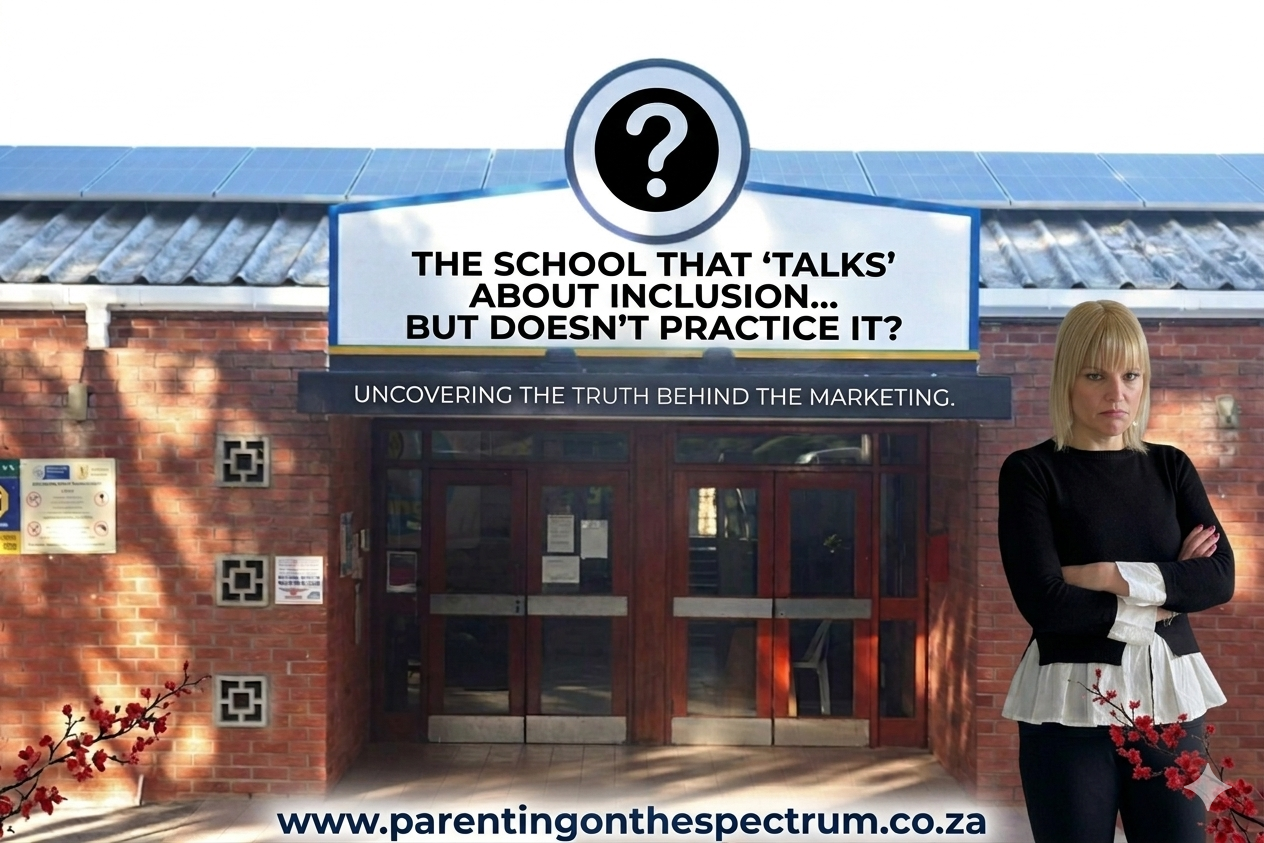
When Inclusive is AGAIN Just a Word on a Website: A Cape Town Mom's Fight to Get Her Son the Support He's Legally Owed.
♥️ I love my job. I love sitting on a worn-out couch with a cup of tea that's gone cold because I got distracted listening to a parent finally exhale after weeks of holding their breath.
🫶 I love the moment a child realises someone actually gets them. That's the good stuff. That's why I do this.
What I don't love is the other stuff. The marginalising, the overlooking, the quiet objectifying of children who simply learn differently — not less, not worse, just differently.
And I especially don't love watching it happen to a kid who is, by every professional report I've read, bright, articulate, funny, and entirely capable of learning to read. He just hasn't been taught how. Not because he can't learn — because nobody's actually taught him.
👨👨👧👧Let me introduce you to my newest "second family" *with their permission* (I say second family because, much like the last ones, I suspect we're going to be spending a fair amount of time together — not because I'm needy, but because apparently that's what it takes to get a mainstream WCED school in the Fish Hoek area to do what it's already legally required to do.)
🏅🤯The Glossy Website Versus the Reality
This particular government primary school has a website that reads like a warm hug.
Inclusive education. Support for diverse learners. A nurturing environment where every child can thrive. It's lovely. Genuinely.
If I didn't know better, I'd want to enrol my own kids.
📚 Here's what's actually happening on the ground: a child with a known, documented neurodivergent profile — diagnosis on file, school fully aware — was pushed through to the next grade without being able to read. Not "struggling a bit with reading." Not reading. At all. He is now sitting in a classroom, every single day, watching content fly past him that he has no foundational ability to access, while internalising the very reasonable conclusion that he must be stupid.He is not stupid. He is unsupported.
⚖️ What the Law Actually Says (Spoiler: It's Not Optional)
So let's talk about what's supposed to happen, because South African education law isn't vague on this.
Under the South African Schools Act and White Paper 6 on Inclusive Education, schools have a legal obligation to identify, assess, and support learners experiencing barriers to learning.
This isn't a nice-to-have. It's policy. The Department of Basic Education's SIAS (Screening, Identification, Assessment and Support) policy explicitly requires schools to put support processes in motion the moment a learner is identified as needing them — and this child was identified a while ago.
The WCED also requires learners receiving additional support to be logged onto CEMIS (the Central Education Management Information System), which flags them for resourcing, support tracking, and accountability.
❗If a child isn't logged, on paper they don't exist as a learner needing support — which conveniently means the school doesn't have to demonstrate it's doing anything about it.
📝 Then there's the Individual Support Plan (sometimes called an Individualised Education Plan or IEP), which should be a living document — created collaboratively, reviewed regularly, and used to actually guide how a child is taught. Not filed away. Not theoretical. Used.
📌 And crucially: parents have the legal right to include external professionals as part of their child's support team.
A school cannot refuse a parent the right to bring in a facilitator, coach, therapist, or advocate, and cannot insist on meeting with a parent alone if that parent has requested support be present.
This isn't a courtesy extended at the school's discretion. It's the law.
😡 So when this school refused to meet with me, and repeatedly tried to insist on parent-only meetings — after this mother had already sat through one bruising round-table where she was essentially handed a list of her son's deficits and politely shown the door towards "alternative schooling" — that wasn't just unkind. It was unlawful.
The Reports That Should Already Exist
When I stepped in, I did what I always do: I asked for the documentation. Standard stuff. The paperwork that, frankly, should already be sitting in a file with this child's name on it, given that his diagnosis isn't news to anyone.
⚠️Here's what I asked for, and what any learner receiving support is legally entitled to have on record:
The Individual Support Plan (ISP/IEP) — outlining identified barriers, support strategies, and measurable goalsSNA forms (Support Needs Assessment, SNA1–SNA3) — the formal SIAS documentation tracking the support process from identification through to interventionCEMIS registration confirmation — proof the learner has been logged for additional support and resourcingRecords of remedial or learning support sessions — what's been offered, how often, and by whomProgress monitoring reports — tracking whether interventions are actually workingMinutes from any School-Based Support Team (SBST) meetings — the internal team meant to coordinate exactly this kind of support.
⁉️The mother asked for these. Multiple times. I asked for these. Also multiple times. We have received, to date, nothing.
Now — call me a cynic (you'd be right), but there are only two explanations here. Either the school has this documentation and is choosing not to share it, which is gatekeeping of exactly the kind the law prohibits.
Or the school doesn't have it, because none of this was ever actually done — which means a child has been quietly failing for years with no formal support process ever properly activated, despite a school that markets itself as the inclusive option.Neither explanation is good. Both are, unfortunately, entirely plausible.
🚌 So Where Does That Leave Us?
It leaves a mum who is already financially stretched paying out of her own pocket for support the school should be providing — because when she asked, she was told the support classes were "full" and she should hire someone privately. And she did. Me. And the school still refuses to help or listen.
😞It leaves a clever, kind, funny little boy convinced he's "bad at school," when actually, school has been bad at him.
🌉 🔥 And it leaves me, once again, trying to build bridges with an institution that seems more interested in defending its reputation than supporting the child whose name is on its enrolment list.
I'm not interested in a fight. I never am. I'd genuinely rather sit in a staffroom with tea and biscuits, working with a school, because that's almost always better for the child.
But cooperation requires two willing parties, and right now I'm the only one showing up with an open hand.
Here's what I know for certain: this child is not the problem. He never was. The problem is a system that talks beautifully about inclusion on a webpage and then, when an actual neurodivergent child walks through the door needing exactly the support that webpage promises, suddenly finds itself very busy, very full, and very unavailable.
We are not going away. This mum deserves answers. Her son deserves to read. And no parent should have to fight this hard, against this much resistance, for a school to simply do what it was already legally obligated to do in the first place.
Watch this space.
www.parentingonthespectrum.co.za #NeurodiversityCapeTown #InclusiveEducationSA #PDAAwareness #WCEDAccountability #FishHoekFamilies
