WHEN EVERYTHING CHANGES: Puberty, the Neurodivergent Body & Surviving the Hormonal Apocalypse
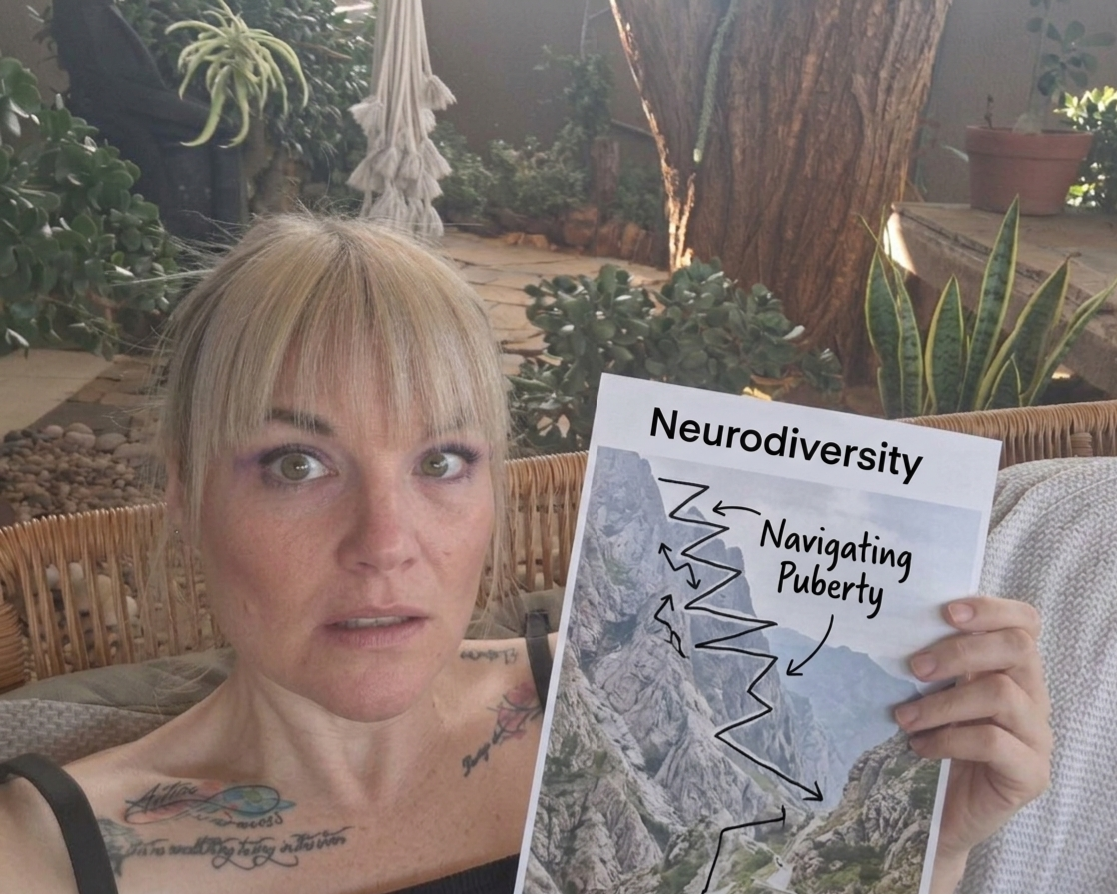
By Andrea Grant | Neurodiversity Coach, Educator & Woman Who Has Had Some Very Interesting Conversations with a Nine-Year-Old.
Nobody told me that puberty with a neurodivergent child would be quite so much. I don't mean difficult, exactly — though it was that too. I mean a lot. A lot of emotions. A lot of sensory chaos. A lot of conversations I was absolutely not prepared for. A lot of moments where I stood in the bathroom doorway thinking: there is genuinely no manual for this.There isn't. But there should be. So consider this article a start.
The Early Arrival Nobody Warned Me About
Here is the thing about neurodivergent children and puberty: it often arrives early. Not fashionably early. Aggressively early.Research shows that autistic girls — and children assigned female at birth — are significantly more likely to experience precocious or early-onset puberty than their neurotypical peers.
The exact reasons are still being studied, but hormonal dysregulation, differences in the hypothalamic-pituitary axis, and the complex relationship between the stress response and reproductive hormones all appear to play a role.
What this means in practice is that you may be having conversations about periods and body hair and breast development with a child who is still, emotionally and cognitively, very much a primary schooler. I know this because Olivia got their period at nine years old. Nine. We were still doing puzzles together. They were still obsessed with building elaborate owl habitats out of cardboard boxes. And suddenly we were navigating menstruation — which, under any circumstances, is a significant thing — in a child whose interoceptive awareness made the whole experience even more complicated than it needed to be.
The Interoception Problem
Interoception is your body's ability to sense its own internal state — hunger, thirst, temperature, pain, and yes, what's happening with your flow on any given day. Many autistic and neurodivergent children have significant interoceptive differences, which means they genuinely cannot feel what's happening inside their bodies with any reliability. For Olivia, this meant accidents. Lots of them. Not because they were careless or inattentive — but because their brain simply wasn't receiving the signals that most people take for granted. The flow would arrive. Or increase. And Olivia would have no idea until it was far too late. I want to be honest about how distressing this was — for both of us.
For Olivia, the unpredictability was deeply anxiety-provoking. For me, watching my child navigate something already overwhelming, with the added layer of not being able to trust their own body's signals, was heartbreaking.So we problem-solved together.
Olivia and I sat down — as we do with most things — and we came up with a system that worked for them, not a system borrowed from a neurotypical playbook. We set alarms. Every few hours, Olivia's phone would remind them to check and change. Not because they felt they needed to — but because the alarm removed the demand of having to remember and replaced it with an external prompt their nervous system could actually respond to. It worked. Not perfectly, not immediately, but it worked. And more importantly, it gave Olivia back some control over a situation that had felt completely out of their hands.
If your child struggles with interoception and menstruation, this simple strategy can be genuinely life changing. Set a recurring alarm. Remove the internal guesswork. Give them the external scaffold their nervous system needs.
Gender, Demands & the Safety of Being Non-Binary
For many PDA children and teens, gender itself becomes a source of demand. And that is not a small thing. Gender carries with it an enormous weight of expectation — how to look, how to dress, how to behave, what your body should be doing, how others should relate to you.
For a child whose nervous system experiences demand as threat, the accumulated pressure of gendered expectations can become genuinely intolerable. I watched this unfold with Olivia over several years. The older they got, the more the gendered demands of the world pressed in — from school uniforms to social expectations to the very specific and exhausting experience of being perceived as a teenage girl. And the more it pressed, the more distressed and dysregulated Olivia became.
Identifying as non-binary made sense. Not as a trend, not as a phase, but as a genuine release of pressure. A way of saying: I don't have to perform this. I don't have to be what you expect. I can just be myself. For a PDA child, that kind of autonomy is not optional. It is essential.I have seen the same pattern in many of the families I work with at parentingonthespectrum.co.za — a disproportionate number of PDA children and teens identify as gender diverse. Research supports this: studies consistently show significantly higher rates of gender diversity among autistic individuals compared to the general population.
These identities are valid, they are real, and they are often deeply connected to the autistic experience of refusing to be boxed in by social constructs that were never designed with them in mind.
Boobs, Binders & the Gamechanger from Genderwear SA
Olivia's chest development also began early. And it was not small. And Olivia — who already struggled with sensory sensitivities, with body awareness, with the demands of gender — found it deeply distressing.I did what I always do: I researched. I asked questions.
I listened to what Olivia was telling me, not just in words but in the escalating dysregulation that came with every ill-fitting bra, every comment from a well-meaning relative, every school uniform that suddenly felt like a costume they hadn't consented to wear. And then I found chest binders. I want to talk about this openly because I think many parents — particularly in South Africa — don't know this is an option, or feel nervous about it, or worry what it means.
So let me tell you what it meant for us: it meant watching my child walk out of their room standing taller. Calmer. More themselves. The transformation was not subtle. It was immediate and it was profound.For anyone in South Africa looking for safe, well-made binders, I cannot recommend Genderwear SA highly enough. They offer binders designed for safe, comfortable wear — because safety matters enormously here. An ill-fitting or unsafe binder can cause real physical harm. Please, if this is something your child needs, go to a reputable supplier. Genderwear SA is exactly that.Seeing the confidence that came with Olivia being able to present in a way that matched their internal experience — that is something I will never forget. It cost me very little. It gave them an enormous amount.
The Sensory Nightmare of a Changing Body
Even setting aside the gender dimension entirely, puberty is a sensory crisis for most neurodivergent children. The body that they have finally, painstakingly learned to live in — that they have calibrated their sensory diet around, that they have found coping strategies for — suddenly becomes unfamiliar. It smells different. It feels different. It moves differently. It does things without permission.
For an autistic child who relies heavily on predictability and sameness, this is profoundly destabilising. Consider what puberty actually involves from a sensory perspective: New smells — body odour is real and it is unfamiliar and for a child with heightened olfactory sensitivity, it can be genuinely distressing.
Many of my clients' children become hyperaware of their own smell and develop intense anxiety around it — leading to either obsessive hygiene rituals or complete avoidance of hygiene because the products themselves are overwhelming. New textures — body hair, changing skin, the requirement to suddenly wear different underwear or sanitary products.
For a child who has always been particular about fabric and texture, this is a significant new set of sensory challenges to navigate. New physical sensations — period cramps, breast tenderness, the general physical turbulence of hormonal fluctuation. These are hard to process for anyone. For a child with interoceptive differences, they can be terrifying because they don't know what they're feeling or why.
Emotional dysregulation — hormones don't just change the body. They dramatically amplify emotional experience. For a neurodivergent child who is already working incredibly hard to regulate their nervous system, the hormonal surges of puberty can feel completely catastrophic. Meltdowns that had begun to reduce in frequency and intensity may spike again.
Parents often interpret this as regression. It is not regression. It is puberty hitting a nervous system that was already at capacity.
Innocence, Consent & Bodies They Didn't Ask For
One more thing I want to address, because it comes up constantly in my work with families: many neurodivergent children and teens are significantly more innocent and naive about sex and physical intimacy than their peers. This is not a criticism. It is simply the reality of a different developmental timeline and a different way of moving through the world.
Many autistic children are not absorbing the same social cues and peer conversations that neurotypical children pick up on — the informal, sideways education that happens in playgrounds and group chats. They often reach their teen years with significant gaps in their understanding of relationships, consent, and bodies.
Olivia does not like being touched without explicit permission. Full stop. And Olivia does not like referring to certain body parts — in fact, the existence of those body parts is something Olivia finds genuinely distressing.
After a great deal of research, I have come to understand that this is remarkably common among neurodivergent young people — particularly those with a PDA profile and those who are gender diverse. The disconnect between the body one has and the body one feels at home in can be a source of profound, ongoing distress.This means that the standard approach to puberty and sex education — clinical, body-part-focused, often delivered in a group setting at school — can be actively harmful for some neurodivergent children. It demands they engage with concepts and vocabulary that feel violating. It assumes a level of comfort with their own bodies that they may simply not have.
At parentingonthespectrum.co.za, puberty navigation is one of the core areas I work on with parents and children on the spectrum — finding ways to have these conversations that are low-demand, affirming, and paced entirely by the child. There is no one-size-fits-all script. But there are approaches that work.
How to Have These Conversations: A Neuro-Affirming Approach
Here is what I have learned, through Olivia and through the many families I support:
Follow their lead, always. Puberty conversations should never be a lecture delivered at a child. They should be a slow, ongoing, low-pressure dialogue that begins long before puberty arrives and evolves as the child does.
Drop information in small amounts.
Answer questions as they arise.
Never force the conversation. Use their language. If your child has their own words for body parts — words that feel safer and less loaded — use those words. The goal is communication and safety, not anatomical precision. Correct terminology can come later, gently, when trust is established.
Validate the distress. Puberty is hard for everyone. For neurodivergent children, it is harder. Say that out loud. "I know this feels like a lot. It IS a lot. Your feelings about this make complete sense." Validation is regulating. It tells the nervous system it is not alone.
Practical tools over feelings-first conversations. Many autistic children respond better to practical, logical information than to emotional processing conversations. Olivia always did better with "here is what is happening, here is why, here is what we can do about it" than with open-ended emotional check-ins.
Know your child. Consent is the foundation. Begin conversations about body autonomy and consent early — long before puberty — and make it a living practice in your home. Olivia grew up knowing that their body was their own. That nobody touched them without permission. That they could say no.
This framework became the foundation for every difficult conversation we had later.
For South African parents — resources in our context are limited but growing. SECTION27, the Gender DynamiX organisation, and the South African Depression and Anxiety Group (SADAG) all have resources relevant to gender-diverse and neurodivergent young people. And for personalised, neuro-affirming support through puberty and adolescence, my coaching practice at www.parentingonthespectrum.co.
What I Want You to Take Away
Puberty with a neurodivergent child is not the same journey it is for neurotypical families. It arrives differently, lands differently, and requires a completely different set of tools. It may come earlier than you expect. It will almost certainly be more intense than you're prepared for. And it will ask you, as a parent, to set aside most of what you thought you knew about how this process was supposed to go.
But here is what I also know: the parents who approach this with openness, with flexibility, with genuine willingness to follow their child's lead — those are the parents whose children come through this feeling seen. Feeling safe. Feeling like their body, however complicated, is something that can be navigated rather than endured. Olivia is sixteen now. They have their alarm system and their binder and their own language for their own body. They know their boundaries and they know how to name them. They are not entirely at peace with every aspect of their physical experience — but they are themselves. Fully, fiercely, unapologetically themselves. That is everything.
Andrea Grant is a qualified neurodiversity coach, educator, and mother of three neurodiverse children based in Cape Town. She offers home coaching, school advocacy, puberty navigation support, and parent workshops across South Africa.