What Is PDA Autism? (And Why Your Child Isn't "Just Being Difficult")
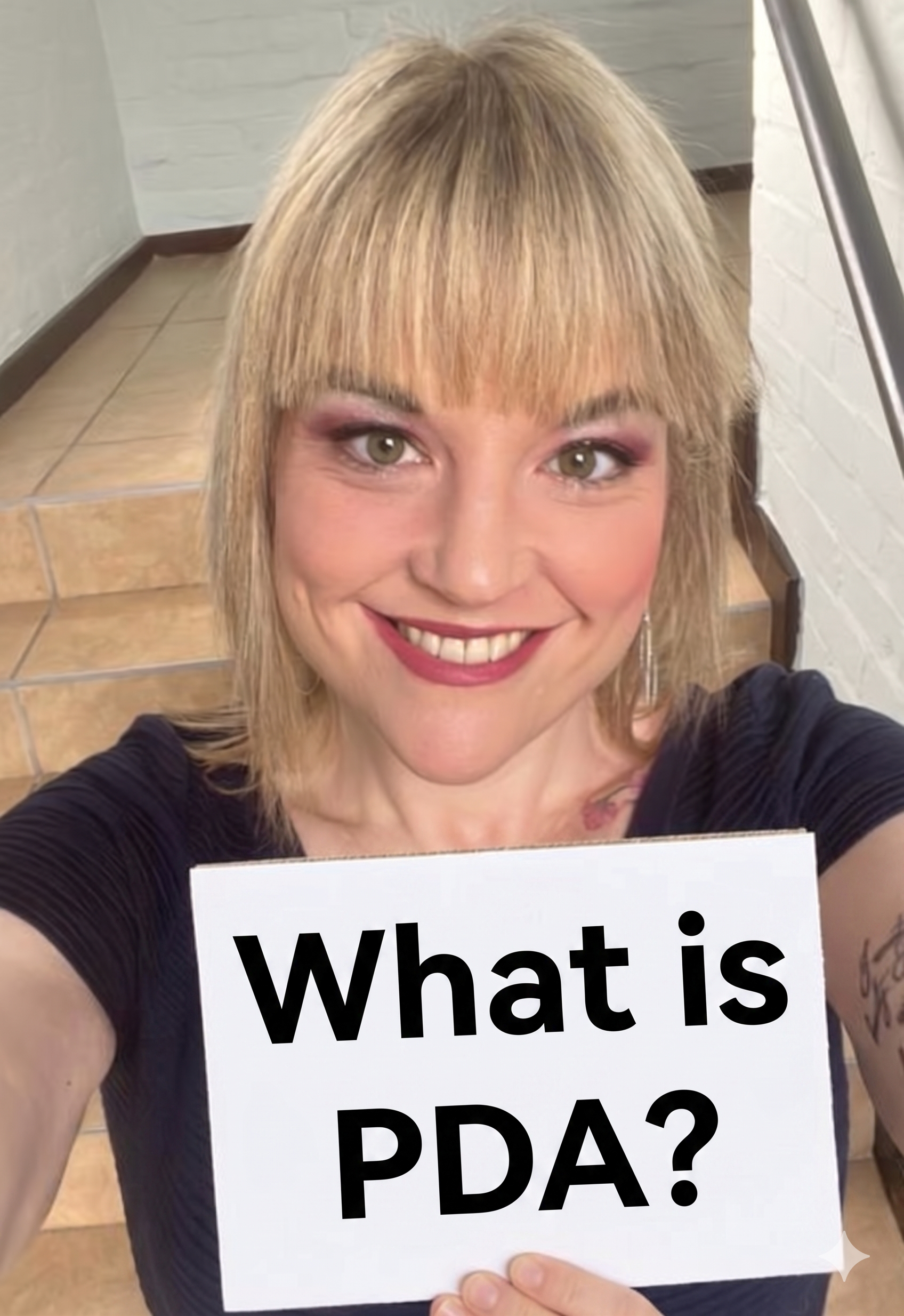
Strap yourselves in folks, this is a long one:
Let me paint you a picture.
It's a Saturday afternoon. You're at a birthday party. The cake has arrived, the candles are lit, and every adult in the room has assumed the universally recognised "we're about to sing" stance. And then it happens. The first note of Happy Birthday rings out and your toddler — your beautiful, bright, bewildering toddler — absolutely loses the plot.Not a little whimper. Not a quiet tear. A full-scale, code-red, everybody-stare-at-the-mother meltdown.
That was us. That was Olivia and I, roughly fifteen years ago, before I had a single word to explain what was happening. Before I knew about nervous systems and demand avoidance and co-regulation. Before I understood that my child wasn't being dramatic or naughty or "badly raised." Before I even knew that PDA existed.
We stopped going to birthday parties. It was easier than the alternative.
So. What Actually IS PDA?
PDA stands for Pathological Demand Avoidance — though many in the neurodiversity community, me included, prefer the reframe Pervasive Drive for Autonomy, because it better captures why it happens rather than making it sound like a character flaw.
PDA is a profile that sits within the autism spectrum. It is not a separate diagnosis — in South Africa, as in most countries, you won't find "PDA" written on a diagnostic report. What you will find is an autism or ASD diagnosis, sometimes accompanied by anxiety, sometimes ADHD, and a very puzzled set of professionals who can't quite work out why the standard autism strategies aren't working.
That's because PDA is not standard autism. And treating it like standard autism is a bit like giving someone with a broken arm a plaster and wondering why they're still crying.
At its core, PDA is a nervous system disability driven by anxiety. The brain of a PDA person perceives everyday demands — and I mean everyday, including getting dressed, being asked how their day was, or hearing someone sing Happy Birthday — as threats. The nervous system responds accordingly: fight, flight, freeze, or fawn. It is not a choice. It is not manipulation. It is a survival response.
The Demand Problem (It's Not What You Think)
Here's where South African parents and teachers often get tripped up. When we say "demand avoidance," we don't mean your child refuses to clean their room. We mean that the perception of a demand — even a joyful one, even an exciting one — can trigger an anxiety response so intense that the nervous system goes into full alarm mode.
Demands that can trigger a PDA response include:Explicit demands — "Sit down," "Eat your lunch," "It's time for school."
Implicit demands — The unspoken social expectation that when someone gives you a gift, you smile and say thank you. Olivia did not get this memo. What Olivia gave gift-givers instead was what I lovingly came to call The Funeral Face — a completely blank, entirely earnest expression of zero visible enthusiasm, while I flapped around in the background whispering, "They actually love it, they really do, I promise."I'm not going to lie. There were some awkward Christmases.
Biological demands — Hunger, tiredness, needing the bathroom. Yes, really. The body telling a PDA person what to do can be enough to cause dysregulation.
Time-based demands — "We leave in five minutes." Translation, to a PDA nervous system: threat incoming.
The Classroom Problem (This One Is Urgent)
I need to talk about school. Because this is where things can go very, very wrong — and where they went wrong for Olivia.
My child used to elope. That's the technical term — I didn't know it existed at the time. I just knew that Olivia could not handle being physically contained at a desk for hours on end. The body needed to move. The nervous system needed an exit. So Olivia found one.
What happened next is something I've seen play out in dozens of families since. The school's response was to punish the behaviour. Olivia was made to sit at a desk, produce work, in front of a teacher they now didn't trust, while classmates stared. The anxiety spiked. The nervous system, already running on fumes, hit its limit.Olivia went into what we call Hulk Mode.
If you have a PDA child, you know exactly what I mean. If you don't, imagine a pressure cooker that has been building steam for hours and someone just sat on the valve. It is not pretty. It is not quiet. And in a classroom full of children who have never been taught a single thing about neurodiversity, it is terrifying to witness.
Olivia was labelled dangerous.
My child. My brilliant, funny, tender-hearted child, was labelled dangerous by people who did not understand that what they were witnessing was a traumatised nervous system doing exactly what traumatised nervous systems do.
What followed were years I don't look back on lightly. Self-harming. School avoidance. Burnout — both Olivia's and mine. More schools than I care to count. More meetings, more reports, more professionals shaking their heads.
I am a qualified educator. I am a certified Autism Facilitator and Coach. I am a two-time award-winning writer for Autism Parenting Magazine and an expert speaker for the international PDA Summit - all because I had to spend years trying to decode my own child.
That is how invisible PDA is. That is how little support exists. And that is why I write articles like this one.
What PDA Is NOT
Let's clear a few things up, because South Africa has some particularly enthusiastic myths circulating:
"They just need firmer boundaries." No. Increased demand = increased anxiety = increased avoidance. A firmer approach with a PDA child is like trying to put out a fire with petrol. It will not end well for anyone.
"It's bad parenting." I'm a single mother who has dedicated her professional life to neurodiversity. I have three children, two of whom are on the spectrum. If it were bad parenting, I'd have cracked the code a lot sooner.
"All kids avoid demands sometimes." True. But PDA is not occasional or selective avoidance. It is pervasive — hence the name — and it is driven by nervous system dysregulation, not preference or laziness.
"They're just anxious." Partially true, actually — anxiety is at the root of PDA. But standard anxiety strategies often don't work either, because PDA anxiety is uniquely tied to autonomy and perceived control. You need a different map entirely.
What DOES Help (The Good News)
Here is where I get to give you something useful. Because PDA is not a life sentence of chaos. Olivia is living proof of that.
After years of learning, training, failing, trying again, and eventually finding our rhythm, Olivia and I found what works. It looks different from conventional parenting. It raised a few eyebrows along the way. But it works.
Low demand, high autonomy, and a solid, collaborative relationship. PDA children need to feel that they have control over their lives. This doesn't mean no boundaries — it means offering choice, flexibility, and collaboration wherever possible. "Would you like to do maths before or after a snack?" is more effective than "Do your maths now."
Declarative language.
Instead of instructions ("Put your shoes on"), try observations ("I notice we're leaving in ten minutes"). It sounds subtle. The difference in response is not.
Co-regulation before expectation. You cannot reason with a dysregulated nervous system. Connection first, direction second. Always.
Indirect communication.PDA children often respond better to suggestions, hypotheticals, and humour than direct requests. "I wonder if your shoes might feel lonely without feet in them" genuinely works better than "PUT YOUR SHOES ON" in our house. Don't ask me to explain it. Just trust the process.
Safe, predictable relationships. Olivia now attends a school that understands them. Liv will never love school — let's be honest about that. But Liv is safe there. Liv is known there. And that makes all the difference.
A Note to South African Teachers
I speak at international PDA Summits. I write for international magazines. I am invited onto podcasts in countries where PDA is increasingly understood, accommodated, and planned for within education systems.But I live in South Africa, where the term PDA still draws blank stares in most staffrooms.
This is not a criticism of individual teachers. Teachers in this country are working miracles daily with overcrowded classrooms, limited resources, and almost no training in neurodiversity.
The problem is systemic. PDA is not in our curriculum. It is not in our teacher training programmes. It is barely on our radar.
But the children are here. Right now, in classrooms across Cape Town, Johannesburg, Durban, and every small town in between, there are PDA children being misread, mismanaged, and mislabelled. Some of them are sitting in the corner doing The Funeral Face. Some of them are eloping. Some of them are heading toward Hulk Mode because no one has given them an exit.
I'm asking you — please — to learn. You don't need a PhD. You need curiosity and a willingness to see a child differently. That's it. That's the whole ask.
Where To Start
If any of this has resonated with you — whether you're a parent who just exhaled for the first time in years, or a teacher who suddenly understands that one student you've been worried about — here is where to begin:
PDA Society (pdasociety.org.uk) — the most comprehensive international resource available
The PDA Summit — an annual international online event featuring expert speakers (yes, including me)
Autism Parenting Magazine — where I've published multiple articles on PDA and neurodiversity.
www.parentingonthespectrum.co.
PDA does not have to mean years of crisis. It does not have to mean dangerous labels and school avoidance and burnout.
With the right understanding, the right tools, and the right people in your corner, it can mean a kid who goes from meltdowns at birthday parties to navigating the world on their own extraordinary terms.Olivia does that now. And honestly? Watching them do it is the greatest privilege of my life.
I offer neurodiversity coaching, school support, and parent workshops across South Africa, online or in person. To book a session or attend an upcoming workshop, email me an andrealgrant@gmail.com