The PDA/ ASD Pass: Because "He Just Needs a Firm Hand" is So 1950s
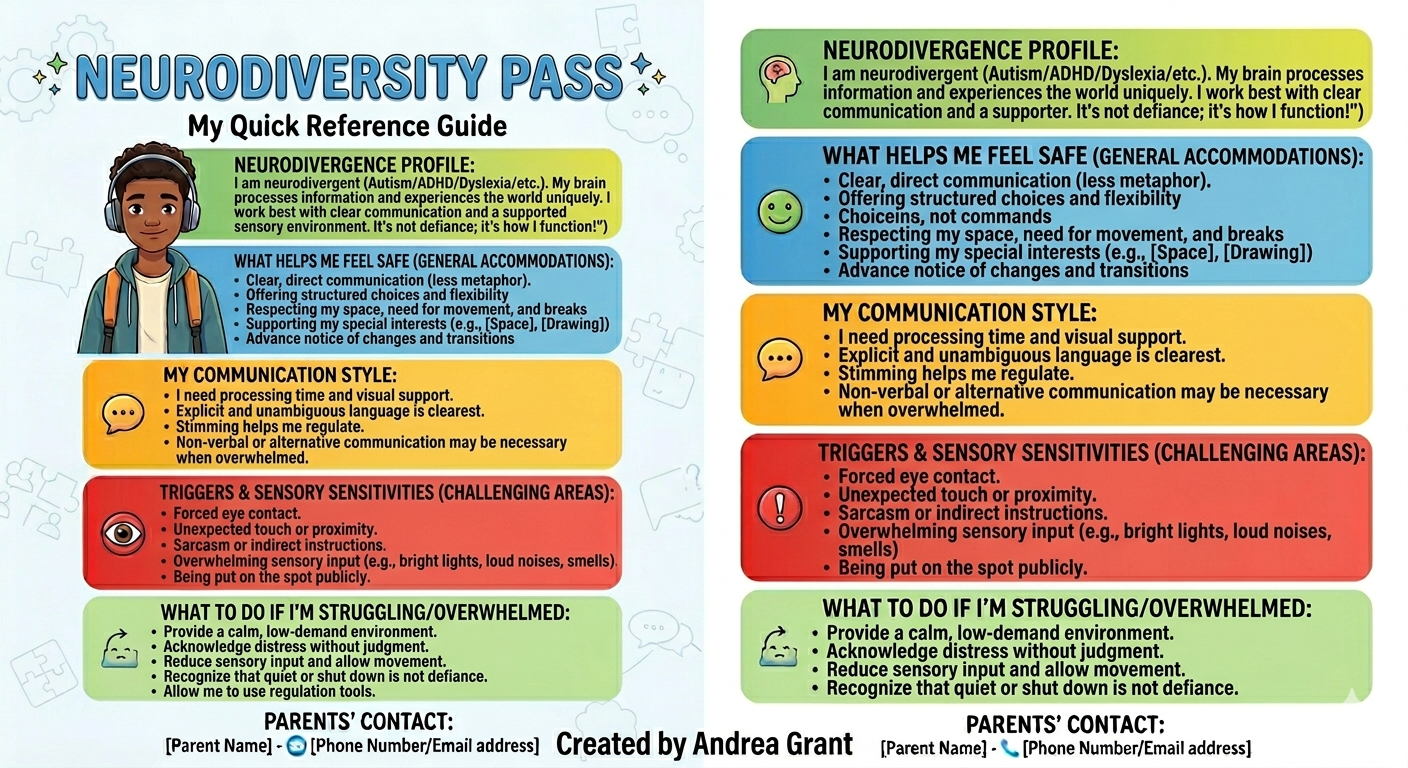
Let’s be real for a second. We’d all love to believe we’re living in a progressive utopia where every teacher, barista, and judgmental aunt has spent their weekend attending seminars on neuro-affirmative care. We hope for a world where "different" is just a Tuesday. And sure, as society slowly wraps its head around the fact that gender isn't a binary and being queer isn't a plot point from a Victorian gothic novel, you’d think we’d have a little more grace for the kid who can’t look you in the eye because your perfume smells like a chemical spill (to them).
But then... there are teenagers. And schools. And the "back in my day" brigade. The reality is that while we wait for the rest of the world to catch up, our neurodiverse kids are out there navigating a minefield of context blindness and sensory assaults. That’s why I stopped waiting for the world to "get it" and started handing out what I like to call the PDA Pass.
The "Cheat Sheet" for Human Interaction
If you have a child with a Pathological Demand Avoidance (PDA) profile, or anywhere on the spectrum for that matter, you know the drill. You’ve accumulated enough paperwork to fuel a small bonfire: Ed Psych evaluations, OT reports that analyze their grip on a pencil like it’s a forensic science, and psychiatrist feedback that costs more than my car.
The PDA Pass is essentially the "CliffNotes" of those million-dollar reports. It’s a quick-reference guide—a cheat sheet for the adults in the room who are about to misconstrue a panic-induced shutdown as "being difficult.
"Why do we need it? * Anxiety is a Liar: Even after years of collaboration, when PDA anxiety hits, my child’s ability to communicate goes out the window. The "Pass" speaks when they can't.
- The Stigma Shield: It provides context before the labels of "naughty" or "defiant" can stick.
- Teacher Sanity: Most teachers are overworked and under-informed on neurodiversity. Giving them a one-page sensory profile is a mercy act for everyone involved.
It’s Not a Personality Replacement (But It’s Close)
Look, a piece of paper can’t capture the glorious, complex, often exhausting masterpiece that is a neurodiverse brain. What can?
But the Pass helps bridge the gap when context blindness kicks in. It tells the teacher, "If they’re staring at the wall, they aren't ignoring you; they’re currently processing the humming of the fluorescent lights and the fact that Jimmy is chewing his gum too loudly.
"I’ve been using this with my own child for years, and the results have been—dare I say—actually helpful? I’ve even started implementing it with my clients. It turns out that when people have a "manual" for the human in front of them, they’re slightly less likely to be accidental jerks.
The Goal: Less Judging, More Doing
We can’t follow our kids around with a megaphone explaining their nervous system to every passerby (though God knows I’ve been tempted). But we can arm them with a tool that demands understanding in the places it matters most—classrooms, therapy offices, and new environments.
If you’re tired of carrying around a filing cabinet of reports and want a streamlined way to advocate for your kid before the world decides to "stand in judgment," let’s chat. You can reach me at andrealgrant@gmail.com.Because at the end of the day, our kids shouldn't have to set themselves on fire just to be seen.