The Man Who Can't be Moved
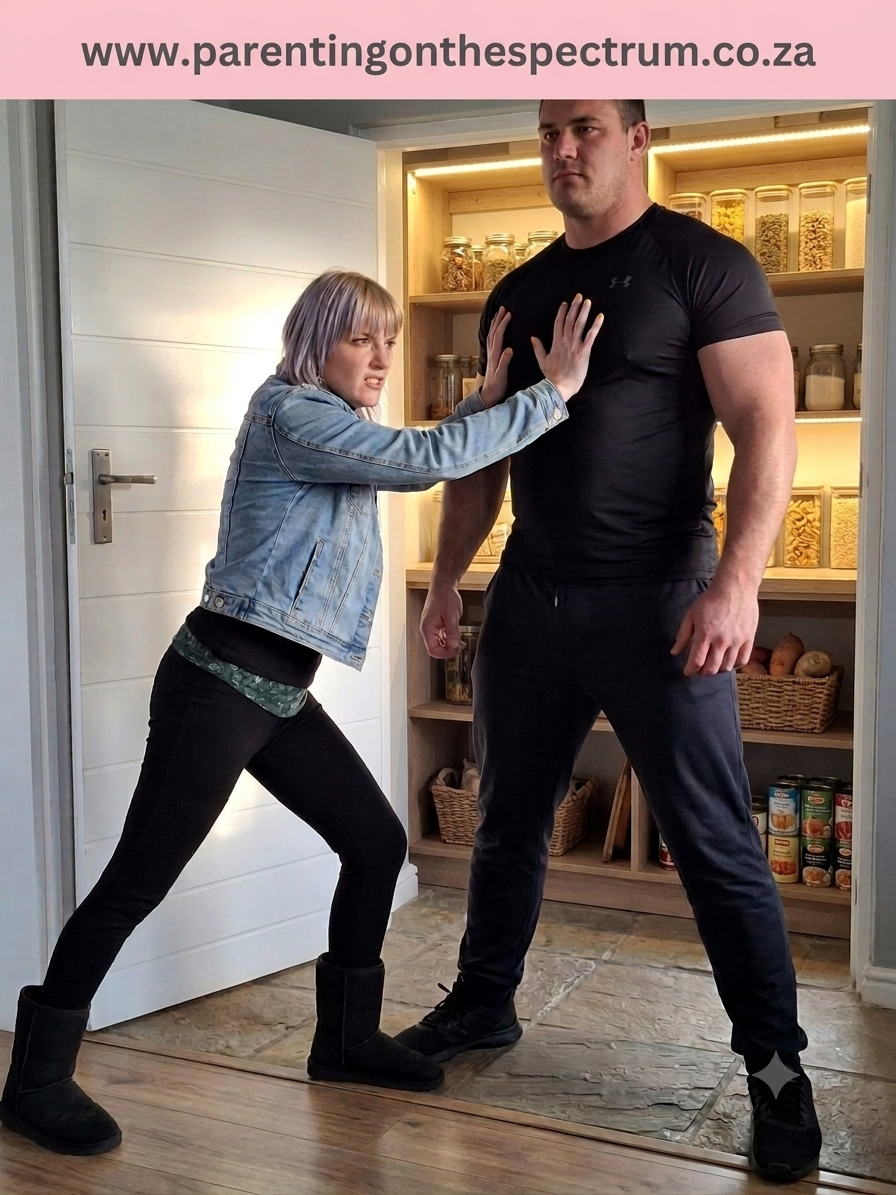
There's a song by The Script — you probably know the one — about a man standing on a corner, refusing to leave, waiting for someone who isn't coming back. Every time I hear it, I think of a very different kind of man who can't be moved. Not the romantic kind. The kind sitting across from me in a session, arms crossed, nodding at everything I say, and going home to change absolutely nothing.
I've been doing this work for a long time now, and if there's one pattern that makes me want to lie face-down on my bedroom floor and stay there, it's this one.
I meet a family. One parent is exhausted, informed, up at 2am reading about sensory regulation, quietly grieving the parenting journey they thought they'd have while showing up fully for the one they actually have. And the other parent is... still waiting for the child to "just behave."
Let me be careful here, because I mean it:I am not about to stand on a soapbox and declare that fathers are the problem. I have worked with dads who have moved mountains for their children — who've changed careers, learned entirely new ways of communicating, sat on the floor of a meltdown with their kid without flinching. They exist, and they deserve far more credit than they get.
But I also have to be honest, because that's the whole point of me having a platform: in the majority of cases that land in my arms, the parent who cannot or will not be moved is the father. And it isn't usually cruelty. It's usually inheritance.
Many of the dads I sit with were raised by their own fathers on a simple formula — men don't show weakness, children don't have moods, and if a child is "difficult," the solution is more discipline, not more understanding.
Nobody handed them a manual for a child who experiences the world differently, and the manual they were handed instead is now actively working against their kid.
I know this one from the inside: I don't usually put my own story into my articles, but this one earns it. I was married to a man who, before children, just seemed like a lot of personality — idiosyncratic, particular, intense. The kind of thing you find endearing until you're the one living inside it.
Once we had children he very much wanted, things came apart at a pace that surprised us both. He was, unofficially and much later, on the spectrum himself, late-diagnosed the way so many of that generation were — because nobody was looking for it in adults, and certainly not in fathers.
He would come to some sessions. Psychologist appointments, psychiatrist consults, the occasional parenting workshop. He would nod, he would engage, he would mask beautifully — genuinely, impressively well. And then we would get home, and the version of parenting we'd apparently agreed on in that office would quietly not happen.
Sometimes he fought me on purpose. Sometimes I don't think he even knew he was doing it. Either way, the actual work of raising our children the way they needed to be raised landed on me, every single day, twice.
I left for my own preservation, and because I ran the numbers honestly: I did not have the capacity to manage a grown man who couldn't accept who he was or who his children were, and still parent effectively.
It was the right call. My eldest remembers those years clearly and does not remember them kindly — there's no relationship there now. My younger two remember less. They'll take the outings, they'll take what he offers. Mollified is probably the word.
Why this matters more in a South African context
We don't talk about this enough here. Research out of the Western Cape found autism identified in roughly 8 in every 10,000 schoolchildren, at a boy-to-girl ratio of over 5 to 1 — and the researchers themselves flagged that this is very likely an undercount, shaped by who gets access to assessment, who gets believed, and who gets taken seriously by a system that's still catching up.
Add to that a culture where, for a lot of our fathers and grandfathers, "spare the rod" wasn't a metaphor, and you get exactly the collision I see in my practice every week: a child whose brain needs flexibility, patience and translation, and a parent who was raised to believe that firmness fixes everything.
The cost of standing still
Here's what "not being moved" actually costs, in case anyone needs it spelled out: it costs the mother her sleep, her nervous system, eventually her marriage. It costs the child a parent who could have shown up but chose comfort instead. It costs the family the version of itself that might have made it through, together, if one more person had just been willing to bend.
I use every ounce of professional charm I have on the reluctant ones. I will use logic, I will use research, I will use gentle guilt, I will use whatever combination of language gets a stubborn parent to hear me instead of just outlasting me. Sometimes it works. Often it doesn't, and I go home and grieve a little for a family I couldn't fully help, because I know exactly what's coming for them.
What I actually want you to take from this
I will never stop fighting for the parent who's drowning and trying to get their partner into the boat with them. I know what that drowning feels like, because I was that parent. But if you're the one reading this and feeling a small, uncomfortable flicker of recognition — I'd ask you to do one thing. Look at the people you love. Actually look. What are they telling you, in the way they're tired, in the way they've stopped asking, in the way your child goes quiet around you specifically? And could you, just once, try to hear it before it's too late to matter? Because being moved isn't weakness. It's the whole job.