The Healthcare Blindspot: Why I’m Banging on the Closed Doors of South African Hospitals.By Andrea Grant
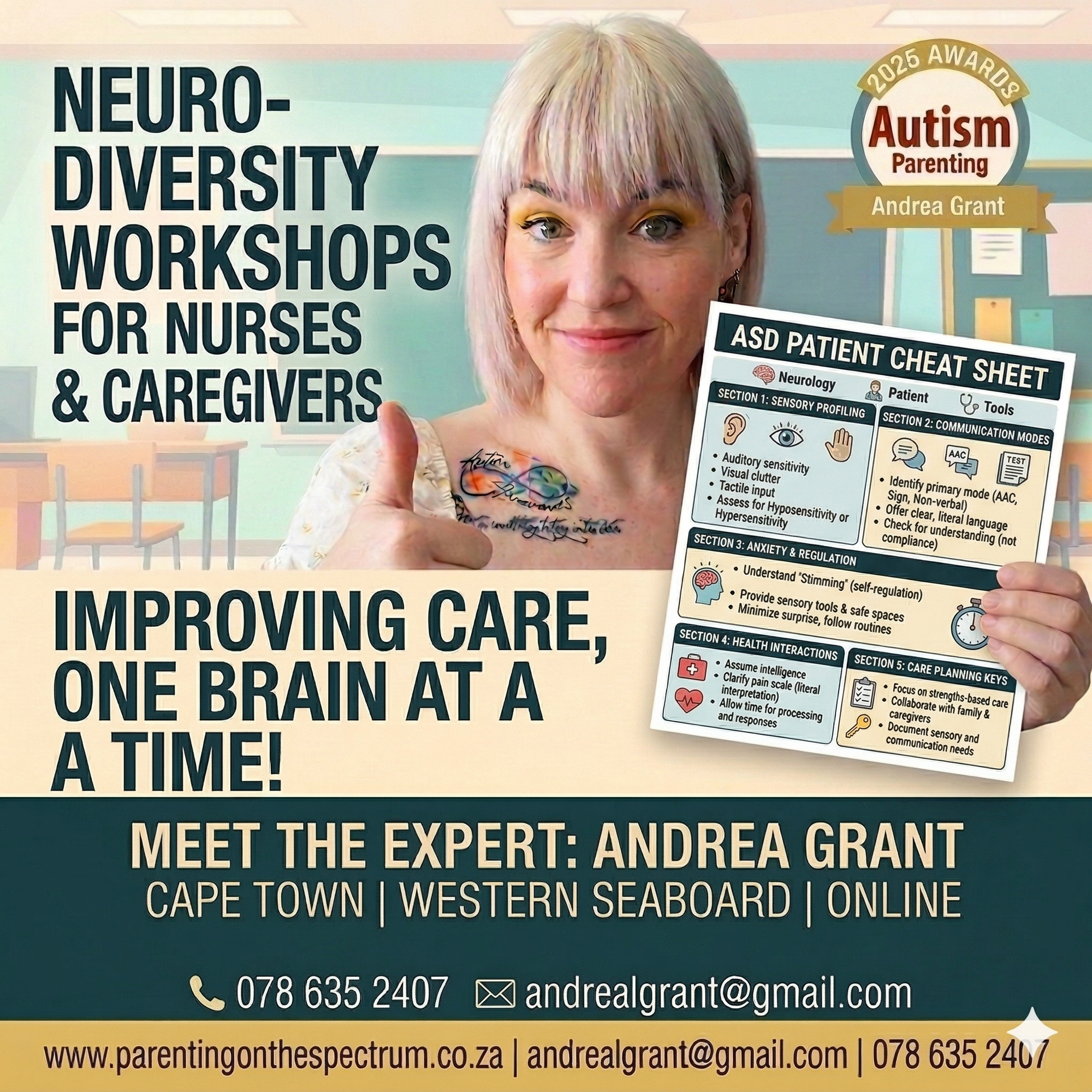
For 20 years, I’ve stood at the chalkboard, the podium, and the bedside. I’ve navigated the complexities of neurodiversity as an educator, a certified facilitator, and—most importantly—as a mother to three children, two of whom are on the spectrum.
I’ve seen the "lightbulb moments" in my workshops and the relief on a parent’s face when they finally feel understood.
But lately, I’ve been facing a different kind of wall. Not a sensory wall or a communication barrier, but a bureaucratic one.
For months, I have been emailing and calling every "Tom, Dick, and Harry" in the South African healthcare sector. From private hospital groups and nursing directorates to public health colleges, I’ve reached out with a singular, urgent mission: to train our frontline staff in neuro-inclusive care.The response? Silence. Or worse, a polite "noted" that disappears into the void of administrative apathy.
The Data They Are Ignoring
While the doors remain shut, the evidence of a crisis is mounting. My recent Bridging the Gap survey of South African caregivers revealed a staggering reality: 77.8% of parents reported that during their last hospital visit, staff didn’t even ask about their child’s sensory triggers.
This isn't just a "nicety" we're missing. It’s a clinical failure. Studies from the University of Cape Town and the Centre for Autism Research in Africa (CARA) confirm that while South African nurses are dedicated, they are often left "stuck in old ways"—trained in a traditional medical model that lacks the specific tools to manage neurodivergent profiles.
Research shows that a lack of provider knowledge is one of the single biggest barriers to healthcare for autistic individuals in our country, often leading to "healthcare avoidance" where parents stop seeking help for serious conditions because the hospital experience itself is too traumatic.
The PDA Factor
In my work, I specialise in Pathological Demand Avoidance (PDA)—or as many in the community prefer, a Persistent Drive for Autonomy.
In a hospital setting, where "compliance" is the gold standard, a patient with a PDA profile is often mislabeled as "difficult" or "naughty."
Without training, a nurse’s natural instinct is to increase pressure to get a blood draw or a blood pressure reading. For a PDA child, this is like pouring petrol on a sensory fire.
My training offers a different way: "Low Demand" communication, visual aids, and sensory regulation strategies that turn a potential meltdown into a successful procedure.
A Call for Clinical Courage
I am a two-time award winner for Autism Parenting Magazine. I am a qualified facilitator through the Neurodiversity Centre. I have the data, the lived experience, and the curriculum ready to go.So, why can’t I get in?
Is it because "neuro-inclusivity" is seen as a luxury rather than a necessity? Or is it because our systems are so overwhelmed that they can’t see how 90 minutes of training could save them hours of procedural resistance and staff burnout?
To the Hospital Managers and Nursing Directors of the Western Cape and beyond: My phone is on. My proposal is in your inbox. The caregivers of South Africa have spoken, and they are exhausted from being the "mini-trainers" for your staff.
It’s time to move from a reactive model of care to a proactive one. Let’s open the doors—not just for me, but for the thousands of neurodivergent South Africans who deserve to be treated with dignity, understanding, and true clinical excellence.