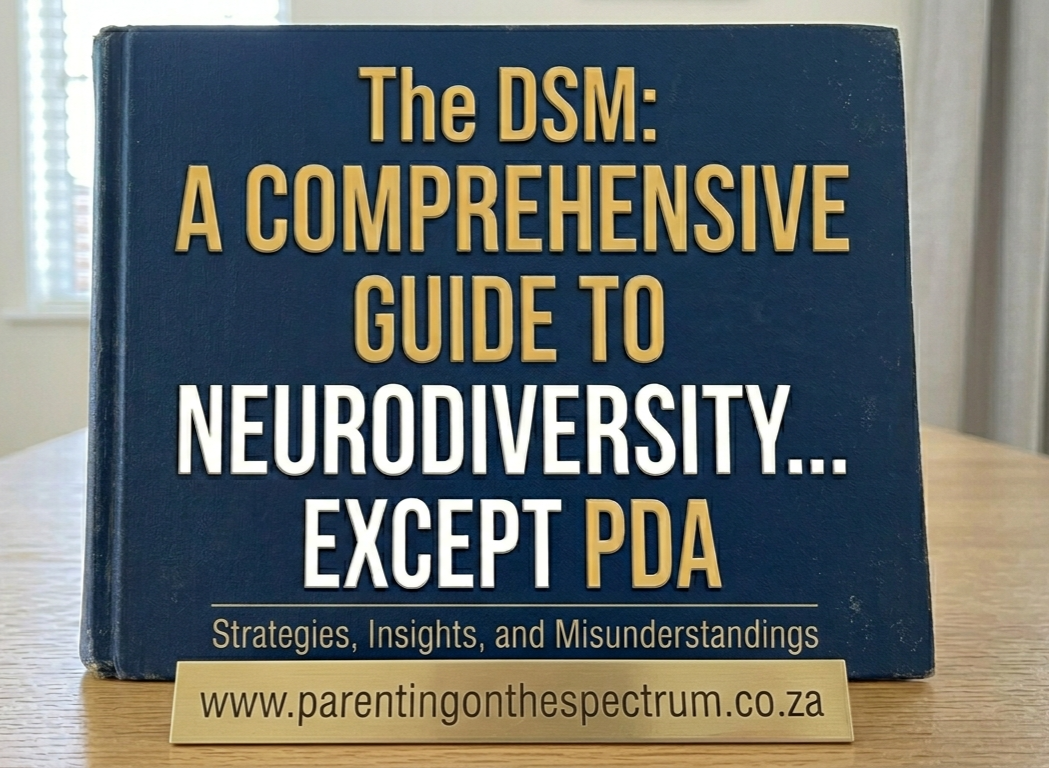
The DSM: the comprehensive guide to everything Neurodiversity... Except PDA.
Again, Science Finally Caught Up. We've Been Here All Along.
A client told me something last week that stopped me in my tracks."You know, Andrea," they said, "you're basically the South African Casey Ehrlich."Now, if you don't know who Casey Ehrlich is, she's the American researcher, coach, and founder of At Peace Parents — the woman who just made history by publishing the very first US-based empirical study on Pathological Demand Avoidance (PDA) in an academic journal.She's brilliant, seemingly tireless, deeply committed, and frankly doing extraordinary work for PDA families across the world.
So yes. I'll take that compliment. I will absolutely take it, frame it, and hang it next to my sixteen years of lived experience, completed studies, and the very functional family I've built using the exact principles that science is only now getting around to putting in a journal. Deep breath.
I'm not bitter. I'm just... punctual.
The Study That Made Me Cheer and Cry Simultaneously
Published in November 2025 in the journal Pediatric Investigation by researchers at the University of Michigan Medical School, the study is titled: "A comprehensive parent training program for parents of neurodivergent children with pathological demand avoidance: The Paradigm Shift Program® Pilot Study."
Lead researcher Dr. Noelle Carlozzi evaluated Casey's 12-week Paradigm Shift Program® — a parent coaching programme built on autonomy-based, nervous-system-supportive approaches — and here's what she found:85% of parents completed the full 12-week programme (if you've ever tried to get a PDA household to commit to a 12-week anything, you understand exactly how significant that is).
Participants reported significant improvements in 10 out of 13 health-related quality of life domains. And the children? They showed measurable trends toward improvement in externalising behaviours and demand avoidance.
The study also confirmed what the research team described as strong "feasibility and acceptability" — academic language for: this works, and people will actually do it.
I read this and I felt two things at once.
First: pure, genuine joy. Because this is the first empirical evidence from a US research university that non-behavioural, low-demand, autonomy-based approaches actually help PDA children and their families.
In a landscape where ABA (Applied Behaviour Analysis) has dominated the so-called "evidence base" for autistic children — a compliance-heavy, demand-heavy approach that, for PDA children specifically, is about as useful as throwing petrol on a fire — this study is a very big deal.
Second: a very specific kind of dismay that only comes when science confirms something you've been screaming into the void for nearly two decades.Sixteen years, friends. Sixteen.
Meanwhile, in the Southern Hemisphere…Let me tell you something about PDA in South Africa, because the statistics here are both illuminating and quietly devastating.
We don't have a centralized database counting PDA diagnoses. We don't have localized South African studies that have isolated a standalone PDA prevalence percentage.
What we do have is the broader autism prevalence data, and the internationally recognised clinical consensus — cited by South African neurodiversity organisations including Autism Resources South Africa — which tells us this:
Approximately 10% of individuals on the autism spectrum present with a distinct, pervasive PDA profile. Up to 30% of autistic individuals exhibit mild to moderate demand-avoidant traits driven by anxiety, even if they don't meet the full profile criteria.
Now, South Africa's autism prevalence is estimated at roughly 1 in 45. Run those numbers and you're looking at hundreds of thousands of South Africans — children and adults — who are living with PDA traits that their teachers, their doctors, their psychologists, and often their own parents have NEVER heard of. And I know, because I work with exactly these people on a daily basis. And they want to learnBut they need to know WHAT.And PDA isn't even in the DSM yet.Let that sit.
The diagnostic manual that the entire psychological and psychiatric profession leans on to identify, describe, and support neurodivergent people does not yet contain PDA.
Which means families are getting diagnoses like Oppositional Defiant Disorder (a label with its own significant problems), or they're getting nothing at all.
Meanwhile their child is in crisis, their home is in chaos, and every professional they see tells them their parenting is the problem.
I know. I've met these families. I meet more of them every single week.
Sixteen Years of Living Proof
Here's what I want to be clear about: I am not writing this to take anything away from Casey Ehrlich's extraordinary work. The US study is genuinely important. Building an empirical evidence base is essential — it's what gets things into journals, into training programmes, into diagnostic manuals, and ultimately into the hands of the professionals who are still, in 2025, telling PDA parents to "just be more consistent."(Please. For the love of all things holy. Stop telling PDA families to be more consistent.)
But I want to name something honestly: low arousal approaches, relationship-based parenting, autonomy-supportive frameworks — these are not new.
They have been practiced, taught, refined, and evidenced through lived experience for a long time. My own home is living proof. My family — the one I built while also building Parenting on the Spectrum, while also coaching as many educators, care givers, and South African families as I can, while also completing not one, not two, but three studies on PDA practices and strategies through the Neurodiversity Centre — is living proof.
The approaches work. They have always worked. The families I work with know they work. The children know they work. Science is just now getting its paperwork in order.And I say that with love. Genuinely. Because we need the paperwork.
A Message to the Families Reading This
Every day I meet more families with children who have very obvious PDA presentations. Children who have been labelled defiant, manipulative, explosive, or simply "too much."
Parents who have been blamed, shamed, and sent home with behaviour charts that made everything worse.If this is your family: you are not alone, and you are not failing.
PDA is real. The research is building. The evidence is accumulating. And while the DSM catches up — because it will, eventually, catch up — there are practitioners in South Africa who see your child, who understand what's happening, and who have been in this work long enough to know exactly what helps.It shouldn't take a US research university to validate what PDA families already know in their bones. It shouldn't still be unrecognised in our diagnostic systems. It shouldn't still be something you have to fight to name.But until the systems change, we keep going. We keep learning. We keep building the evidence. And we keep showing up for the families who need us.Sixteen years in. Not even close to done. 🤍 Andrea
The study: "A comprehensive parent training program for parents of neurodivergent children with pathological demand avoidance: The Paradigm Shift Program® Pilot Study" — Pediatric Investigation, November 2025. Available at: https://onlinelibrary.wiley.com
