The Devastating Cost of Faux-Inclusivity in schools for PDA Kids.
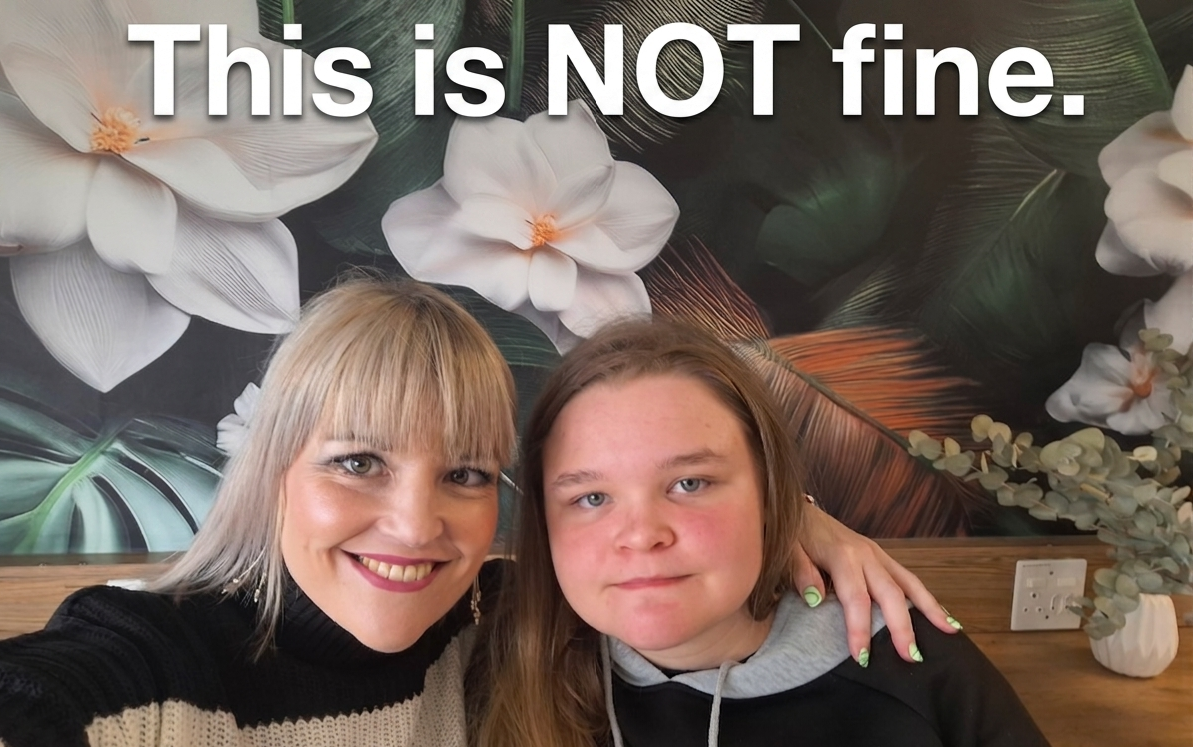
I am a neurotypical woman. If you look at the photo attached, you see a smile on my face. You see someone who looks "fine." But that smile is a tool; I can be falling apart on the inside—furious, heartbroken, exhausted—and still present a happy, composed face to the world.
Now, look at my eldest child, Olivia, on my right. This image was taken today, during a period of high internal distress. To the untrained eye, their face is merely blank. It is crucial to understand that this lack of expression does not mean, "I am all warm and tingly inside." It doesn't mean "I’m fine."
Just as I can mask my distress with a smile, Olivia masks their catastrophic anxiety with a total neurological shutdown. When teachers or administrators look at Olivia, they see a compliant, quiet student. They see someone who is "perfectly happy and adjusted" because they are not "disrupting" the class.
In reality, they are looking at a child whose nervous system has gone into "freeze." Their silence is not cooperation; it is a primal survival mechanism. This is the central battleground of Pervasive Demand Avoidance (PDA)—recently reframed as a Persistent Drive for Autonomy.
This misconception, perpetuated by systemic failure in a school that promised safety to MY child, is destroying my child.
The Bait and Switch: When Specialization is Replaced by Savings
I enrolled Olivia in a school that actively marketed itself as a sanctuary for neurodivergent and PDA students. It had the ultimate promise of understanding: a principal who had started the school because she had a PDA child of her own.
I was assured flexibility, an environment that respected autonomy, and specialized AEP streams that could accommodate the various manners in which neurodiversity presents. In the beginning, much of this happened.
Now, three buildings later and a change of management and that sanctuary is gone.
In its place is an institution focused on financial efficiency, hiring teachers right out of teaching college so they can be paid as little as possible. The inevitable consequence is a complete erosion of knowledge.
When Olivia’s current teacher admits to having zero knowledge of PDA, yet the school administration refuses my offer of free specialist workshops, the "inclusive" branding becomes a negligent lie.
The Anatomy of a Systemic Nightmare
A school that truly understands PDA knows that consistency, predictability, and genuine relationships are the currency of safety. Yet, this school has systematically dismantled every element necessary for Olivia to function.
We are now enduring:
Constant Teacher Rotation: Relationships are vital. For a PDAer, trust is built slowly. By constantly changing teachers, the school ensures that no relationship—and therefore no sense of safety—is ever formed.
Daily Transitions: Moving between classes and navigating different teachers multiple times a day is a sensory and executive functioning minefield.
Lack of Staff Communication: Despite my credentials—I am a teacher of 20 years, an Autism Facilitator, and a Coach—I am forced to act as a human filing cabinet.Olivia and I have to repeatedly explain their profile to a rotating roster of staff, arguing why a child with dysgraphia and dyscalculia cannot color in five pages or complete thirteen pages of math for homework.
The Invisible Crisis of the "Good" Child
Olivia, born female, is an expert masker. Like many adolescent girls with a PDA profile, they internalized the lessons learned early in their education. "Fighting" got Olivia years of detention and constant trouble. So, Olivia learned to freeze.
The school environment now operates on a dangerous fallacy: that silence equals satisfaction.
By perceiving Olivia’s non-responsiveness and lack of expression as compliance, they ignore the internal tsunami of anxiety that precedes a demand.
The Reality of Late Diagnosis in Girls:
Research confirms that girls are often diagnosed with PDA much later than boys because their symptoms go missed. They are less likely to present with externalizing "disruptions" and more likely to use sophisticated social strategies, including social mimicry and "fawning."
While a boy’s distress might be seen as rebellion, a girl’s distress is mislabeled as shyness, passivity, or simply "fine."
Regression to Ground Zero
Our home environment is stable. I have dedicated my career to studying neurodiversity. Yet, because the school environment is so toxic to their nervous system, Olivia is now in a state of profound PDA Burnout.
When Olivia spent years fighting, they had the energy. Now that they have internalized the stress, they are at ground zero.
A child who was once engaged is now finding everyday life impossible. Brushing their teeth is a demand too large to process. Washing hair is a burden of epic proportions.
The damage being done by the misinformation and false advertising surrounding "inclusivity" is catastrophic. I am no longer trusting the brochures. I am now personally vetting schools, peeling back the marketing to determine which environments are truly neurodiverse and which merely use it as a tagline.
If you are struggling with a school’s lack of PDA understanding, or if you are tired of being given "PC-friendly" responses while your child’s flame is being extinguished, I want to hear from you.
Contact Andrea Grant: andrealgrant@gmail.com
Specialist in PDA, Autism Facilitator, and Coach.