The 8 Sensory Systems in Autism: Why Your Child Bumps Into Walls (and Can't Tell They're Sick)
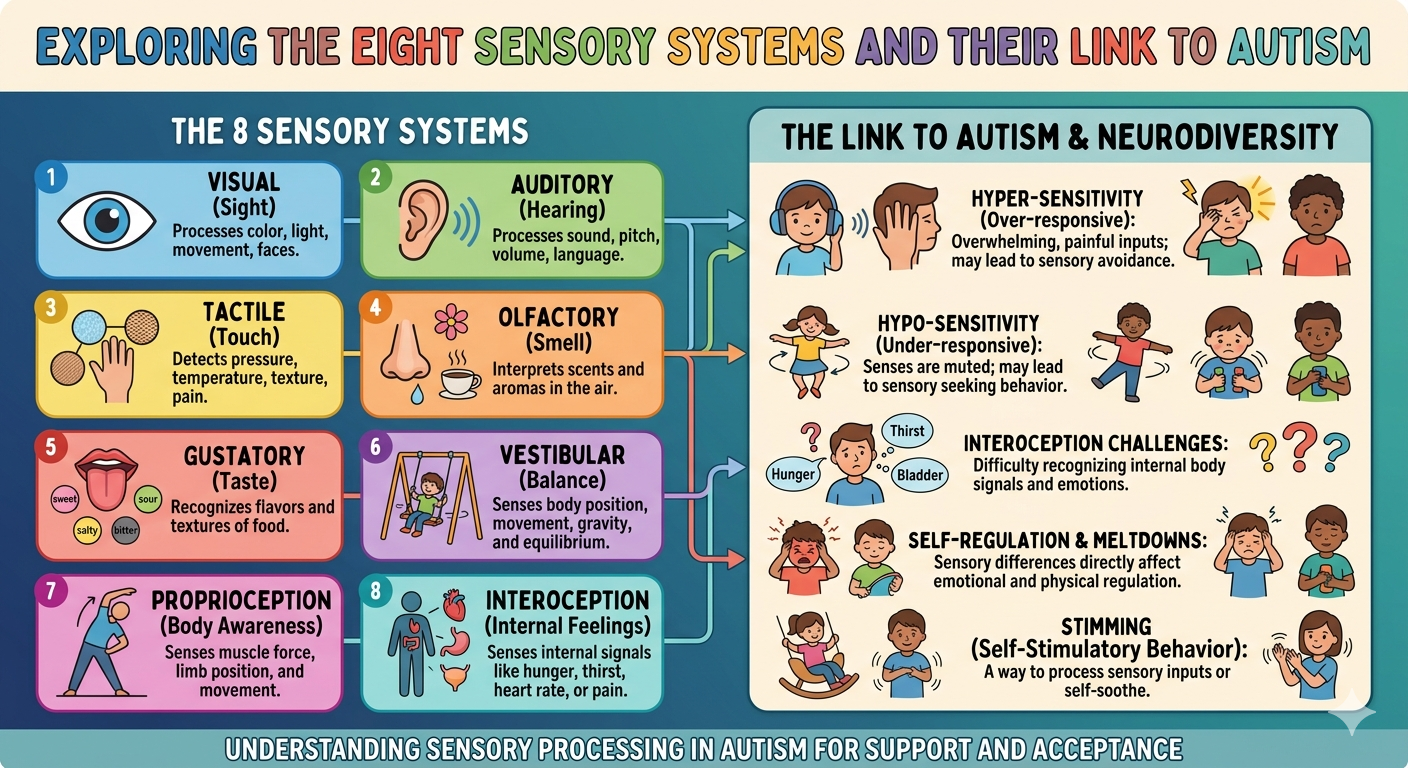
Let’s talk about the eight sensory systems—yes, eight. If you thought we stopped at the "Big Five" we learned in primary school, welcome to the neuro-affirming reality where things get a lot more complex, a little more scientific, and significantly more hazardous to my big toe.
As an educator with 20 years in the game, I’ve spent my career dissecting neurodiversity. But nothing humbles a "certified expert" quite like a teenager named Olivia careening through the hallway like a rogue pinball, leaving a trail of crooked picture frames and my shattered dignity in their wake.
The "Secret" Three: Beyond Sight and Sound
We all know the classics: Visual, Auditory, Tactile, Olfactory, and Gustatory. They tell us if the coffee is hot or the lights are too bright. But for the neurodivergent community, the real "main characters" are the internal systems:
- Vestibular (Balance): The inner ear’s GPS. It tells you where your head is in space.
- Proprioception (Body Awareness): The feedback from muscles and joints. It’s the internal map that tells you where your limbs are without you having to look at them.
- Interoception (Internal Feelings): The "mood ring" of the organs. It signals hunger, thirst, heart rate, and pain.
Why Olivia Bumps Into Everything (and my poor big toe)
In many autistic individuals, the Proprioceptive and Vestibular systems are "under-responsive." Think of it like this: Olivia’s internal GPS hasn't been updated since 2004. Because their brain isn't receiving enough feedback from their joints about where their body ends and the hallway begins, they move with a "heavy" or "bounding" energy to force that feedback.
This is why I use double-sided tape on every single picture frame. Without it, the "Olivia Tornado" leaves my walls looking like a funhouse gallery. It also explains why my big toe is a permanent shade of "Hematoma Purple." Since they were old enough to walk, Olivia has used my feet as accidental speed bumps. It’s not clumsiness; it’s a biological quest for sensory input.
The Medical Mystery: When "Dead" is an Appropriate Response
This lack of body awareness doesn't just affect my furniture; it makes medical diagnosis a literal guessing game. Because Olivia’s Interoception and Proprioception are so dampened, they are often the last person to know they are actually unwell.
When I ask how they’re feeling, "I don’t feel well" is a vague umbrella term that could mean anything from a hangnail to a fractured limb. In Olivia’s world, "Dead" or "Dying" are perfectly acceptable descriptors for a tummy ache.But here’s the kicker: if Olivia actually vocalizes that something specifically hurts, I go into high-alert mode. Unlike their sister Georgia—who is a delicate flower and will narrate the life story of a papercut—Olivia has a massive threshold for physical discomfort because they simply don't register it early. In our house, a "sore ear" from Olivia isn't a request for a warm compress; it’s usually a "pull out every antibiotic ever invented and head to the hospital" kind of emergency. By the time they feel the pain, the fire is already through the roof.
Breaking the Cycle: From Cold Shoulders to Deep Pressure
This sensory landscape is also why Olivia requests "co-regulation hugs" multiple times a day. Depending on their "Sensory Cup"—whether it's overflowing from a loud school day or empty from a lack of movement—the frequency changes. Sometimes they need a light squeeze; sometimes they need to be squished like a panini to feel "grounded."
This is where my professional life meets my personal healing. Growing up, my mother was... let's say, demonstrative adjacent. Affection wasn't just rare; it was non-existent. I spent my childhood performing a high-stakes psychological tightrope walk, anticipating her every mood to avoid being a "burden." It was exhausting, and it cost me a significant amount of therapy to realize I wasn't the problem.But that stress gave me a superpower: The knowledge of how vital affirmation is.Unlike my upbringing, our house is a verbal laboratory of feelings. I tell my kids when my own interoception is screaming and I've reached my limit.
"Olivia, I love you, but I cannot listen to a three-hour thesis on how Roblox moderators are linked to Trump and Epstein right now. My brain is at capacity."
I lose my horse manure on a regular basis. I am human. But I apologize, I explain, and I show them that being a parent isn't about being a perfect, unmoving statue—it’s about being a regulated human being who knows when to step back.
The Science of the "Why"
Understanding these eight systems isn't just "nice to know"; it's a parenting manual. Research in sensory integration shows that when a child's sensory needs aren't met, their nervous system enters a state of "dysregulation."
- Predictability reduces anxiety: When we understand the why behind the bounding, we stop seeing "naughtiness" and start seeing a "need."
- Co-regulation builds resilience: By providing the deep pressure (hugs) Olivia needs, we are literally helping their nervous system shift from "Fight or Flight" back into "Rest and Digest."
Parenting on the spectrum is a wild ride. It’s a mix of profound neurological insights and the constant fear of losing a toenail. But at the end of the day, I’d take a thousand crooked picture frames over a silent, cold house any day. Now, if you'll excuse me, I need more double-sided tape.