Sitting on Nails: What My PDA Teen Taught Me About Broken Promises and Quiet Courage
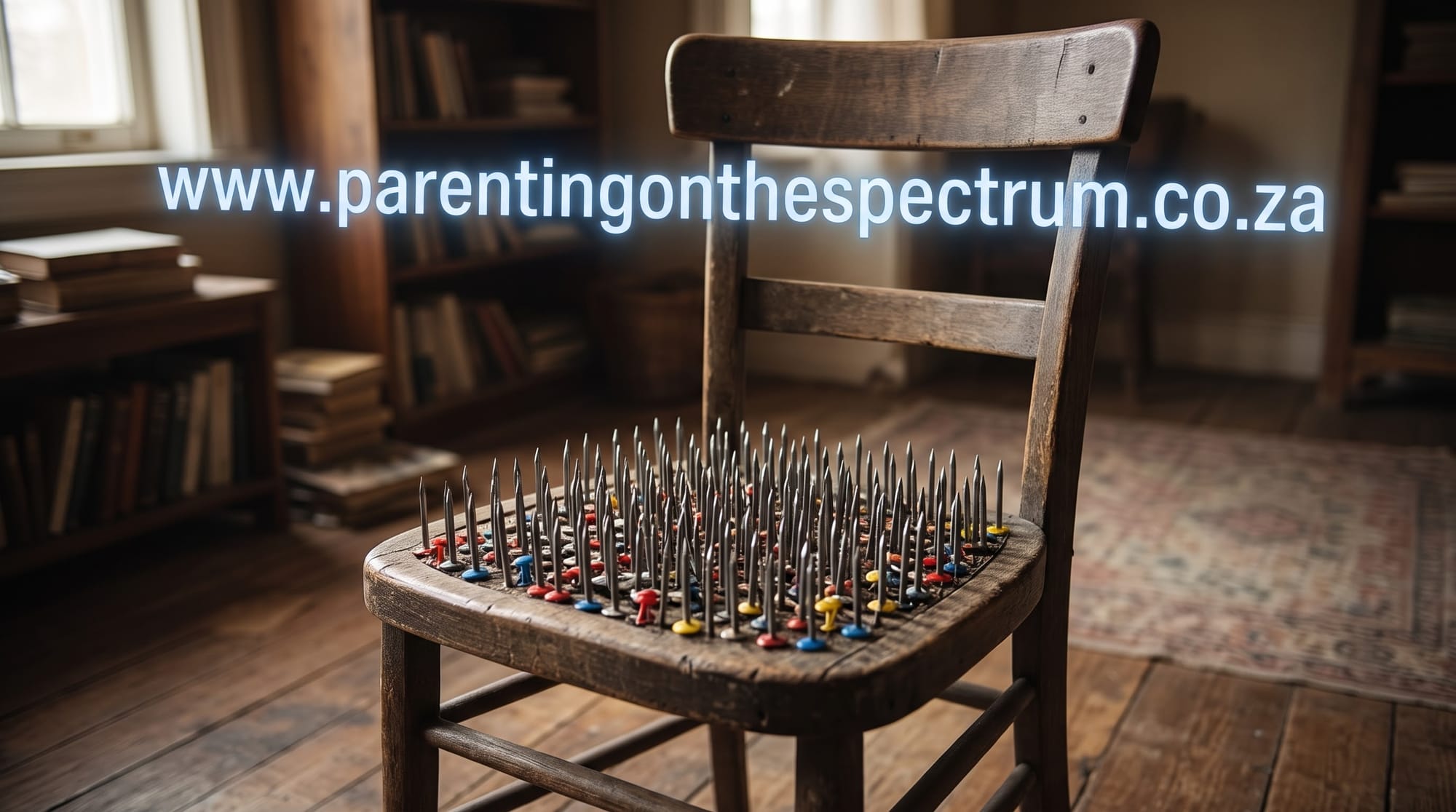
The chair
I have a party trick. It isn't a good one, at least not in the "let's invite Andrea to every braai" sense, but it works a treat in a room full of teachers.
At my live workshops, I ask for a volunteer. Somebody always obliges. It's usually the brave soul in the front row who hasn't yet learned that front-row seats at a PDA talk are a trap. From where they're sitting, they can't see what's waiting on stage. When they get up there, they find two chairs.
One is a perfectly ordinary chair, which I sit on, smugly. The other is lovingly decorated with nails and drawing pins, points up.
The rules are simple. They can choose to sit on the chair or not. What they may not do is explain why.
Then I start. "Come on, just sit down. I'm sitting. Look how easy it is. Everyone else in this room is sitting. Why are you being so difficult? What is wrong with you? Honestly, it's a chair. You've sat on chairs your whole life."
The volunteer stands there, shifting from foot to foot, getting redder by the second. The audience laughs. Then, usually around the third "what's wrong with you," the laughter goes quiet, because people start to recognise the script. They've said it. At the breakfast table. At the classroom door. At the bottom of the stairs on a school morning with the car keys in their hand.
I call it The Lived Experience of PDA. The idea came from my colleague and friend Hythem Betts, who has PDA himself and knows a thing or two about invisible nails.
Every day, people with a PDA profile face demands that everyone around them considers perfectly doable: get dressed, answer the phone, sit down, just do it. What the rest of us can't see is that, for them, the chair is covered in spikes. And they're not allowed to explain it in a way we'll accept.
The research is catching up with what PDA families have known for years. Studies increasingly see demand avoidance as driven by anxiety and intolerance of uncertainty. It's a way of getting back some predictability when anxiety is climbing. Some researchers go further and argue it may be a rational way of avoiding anxiety, especially for people with little control over their lives. Like, say, children. In other words: they're not being difficult. They're looking at the nails.
The woman who sat down
I've done this exercise more times than I can count. I know how it goes. The volunteer refuses, I goad, the penny drops, we all have a moment. Lovely.
Then, at a presentation the other day, a woman walked onto the stage, looked at the chair, looked at me, and plonked herself down. Hard. On the nails. And the drawing pins.
"OW!"
I'm a professional speaker. I have spoken at the PDA Summit. I've spent twenty-odd years standing in front of teenagers, which is the conversational equivalent of a gladiator arena. And I had absolutely nothing. I stood there with my mouth open like a goldfish who'd just been told about taxes.
When I told Hythem about it afterwards, half laughing and half still traumatised, he went quiet for a moment. Then he said, very thoughtfully:
"You know, there's a metaphor in there too. Because we often have to grit our teeth through things we don't want to, to get to the other side. And that's when we have to choose to sit on the chair, in spite of the pain."
I've been carrying that sentence around ever since. The chair exercise was designed to show people what avoidance looks like from the inside. What I hadn't considered was what it looks like when someone with PDA doesn't avoid. When they look at the nails, know exactly what's coming, and sit down anyway.
It turns out I'd been watching someone do exactly that, in my own house, for weeks.
My eldest, Olivia, is sixteen. Liv is non-binary and autistic, with a PDA profile, a wicked sense of humour, and opinions about artificial intelligence that I won't print in a family magazine. (Suffice to say, if the robots ever rise up, Liv will be leading the resistance with a soldering iron.)
Liv's relationship with their father is complicated. That's the polite word. When Liv was growing up, their dad simply didn't understand them. He parented the way he'd been parented: firm boundaries, consequences, because I said so. If you've read anything I've ever written, you'll know that's roughly the PDA equivalent of putting out a kitchen fire with a jerry can of petrol.
It wasn't for lack of information. I tried. Other professionals tried. There were conversations, articles, gently highlighted paragraphs, slightly less gently highlighted paragraphs. None of it landed. Every interaction that could have been low-demand became a standoff. Every meltdown was treated as defiance.
In chair terms, he spent years standing over Liv asking what on earth was wrong with them, while refusing to look at the nails.
Liv carries a lot from the years when we all lived under one roof. Today, they choose not to spend time with their father or to talk to him.
I want to be clear: that isn't stubbornness, and it isn't something I engineered. It's a young person protecting themselves from something that has hurt them, over and over.
Many PDA teens have exquisitely sensitive threat detectors. Liv's has simply learned from experience.
The deal
Enter the gaming PC.
Liv wants one. More than that, Liv needs one. It isn't a status symbol. It's the tool for the coding and game design that light them up and could well become their future. Unfortunately, a decent gaming PC costs roughly the same as a small car, a kidney, or a term of school fees, and this particular Santa's sleigh is running on fumes this year.
Liv's father, on the other hand, earns a very decent salary. So he made an offer. He would buy Liv the PC on one condition: Liv had to make an effort to talk to him every day and keep up regular messaging.
And Liv did it.
I need you to understand what that means. For Liv, socialising in any form comes at a cost. Not a figurative one, either: it's a real drain on a limited supply of energy.
Every message to their father was a withdrawal, and the account doesn't refill overnight. A conversation in the morning meant there was less left for everything else that day: schoolwork, a shower, getting through supper without the wheels coming off.
Research on autistic adults describes this beautifully, if painfully. Masking and effortful social performance are consistently linked to exhaustion.
Autistic adults name masking as a leading cause of autistic burnout, which often first appears in adolescence. On the flip side, a study by Cook, Crane and Mandy found that when autistic people feel they can be themselves, interactions take less energy and leave more room to engage.
Messaging a parent who has never really made it safe to be yourself is about as far from "authentic and low-cost" as you can get.
Then came the cherry on top. Liv's dad asked them to play a test version of an AI-generated Star Trek game. Liv. Who hates all things AI with the fire of a thousand dying stars. Liv played it. Politely. And gave feedback.
I watched all of this happen and kept thinking about Hythem's words. Liv was choosing to sit on the chair. It was the only route to something they wanted and genuinely needed, so they gritted their teeth and sat down on the nails. Every single day.
More nails
And then, as so often happens in these stories, somebody added more nails.
Liv's father raised the stakes. Daily messages were no longer enough. The PC would only appear if Liv agreed to see him face to face.
Their last in-person encounter left Liv anxious and depressed for a good while afterwards. So you can imagine the enthusiasm. Picture the face of a cat being shown the bath. Still, we talked about it.
We did it carefully and without pressure, the way you talk about anything big with a PDA teen: as an option on the table, not a demand on a deadline. Liv was weighing it up. They were genuinely considering sitting on an even sharper chair.
Then he announced he couldn't get them a PC after all.
The promise that wasn't
I wish I could say I was shocked. I wasn't. This isn't my first rodeo, and it isn't Liv's either. For weeks I'd been quietly preparing them, a little every day: Someone promising something doesn't mean they'll deliver. We hope, but we hold it loosely. It's not the sort of lesson any parent wants to teach. But I would rather Liv be braced than blindsided.
It still landed like a brick. It was a devastating disappointment, and one more crack in a relationship that already has more cracks than a taxi in Table View.
There's a well-known piece of research that keeps coming back to me. You've probably heard of the marshmallow test, where children who could wait for a second treat were held up as models of self-control.
In 2013, Celeste Kidd and colleagues re-ran it with a twist. Before the marshmallow appeared, an adult either kept two small promises to the child or broke them.
Children who'd seen the adult keep their word waited around four times longer. Kidd's point was blunt: waiting only makes sense if you believe the second marshmallow is actually coming. As the researchers put it, for a child used to broken promises, the only treats you can count on are the ones you've already eaten.
Later replications found a smaller effect, so no one should treat those numbers as law. But the principle holds, and every parent of a PDA child knows it in their bones.
Trust is built on reliability. Every kept promise is a brick in the wall, and every broken one pulls a few out. Children learn, entirely sensibly, who is worth waiting for.
So when people ask why PDA kids struggle to "just trust" adults, I'd gently suggest we look at the adults first.
Liv still sat in the chair!
Here's the part I want you to take home, because it's the part that keeps me up at night, in the best possible way.
This has been a brutal year for our family. We've lost people we loved. Grief has moved in and rearranged the furniture without asking. Liv has been carrying all of that, plus the everyday weight of being a PDA teen in a world built for compliance.
And in the middle of all of it, Liv still sat in that chair.
They looked at the nails. They knew exactly how much it would hurt, because they've sat on that particular chair before. They did it anyway: daily, deliberately, at real cost, for something that mattered to them. That's not avoidance. That's not "oppositional." That's not a child who "won't try." That's courage of the quiet, unglamorous kind that nobody hands out certificates for.
The PC didn't arrive. The effort was still real. And I will not let the first fact erase the second.
The moral of the story
We tend to measure people with PDA by whether they sat down. Did they go to school? Did they do the task? Did they answer the phone? When they don't, we ask what's wrong with them.
The better questions are: How sharp are the nails? And, when they do sit down: What did that cost, and what did they get for it?
So here is what I'd love every parent, teacher and well-meaning relative to remember:
1. Nobody can see the nails but the person sitting on them. Before you ask what's wrong with them, ask what the chair looks like from where they're standing.
2. When a PDA person sits down anyway, that's a gift, not a given. Notice it. Name it. Never treat it as proof they "could have done it all along."
3. Don't move the chair once they're sitting. Changing the terms after someone has paid the price teaches them one thing: effort doesn't count, and adults can't be trusted.
4. If you make a promise, keep it, or don't make it. For a child who has learned that promises break, your reliability is the most valuable thing you can give them. It's worth more than any gaming PC.
And to Liv, who will roll their eyes so hard at this article that I'll hear it from the next room: you sat on the chair. I saw you. I'll always see you. And for the record, the robots don't stand a chance.
#PDAParenting #PathologicalDemandAvoidance #NeurodivergentTeens #ParentingOnTheSpectrum
Sources
• Kidd, C., Palmeri, H. and Aslin, R. N. (2013). Rational snacking: Young children's decision-making on the marshmallow task is moderated by beliefs about environmental reliability. Cognition.• Stuart, L. et al. (2020). Intolerance of uncertainty and anxiety as explanatory frameworks for extreme demand avoidance in children and adolescents. Child and Adolescent Mental Health.• (2022). Autistic traits and anxiety as predictors of demand avoidance in adults (two online surveys, 267 and 549 participants). Journal of Autism and Developmental Disorders.• Miller, D., Rees, J. and Pearson, A. (2021). Masking is life: experiences of masking in autistic and nonautistic adults. Autism in Adulthood.• Raymaker, D. M. et al. (2020). Having all of your internal resources exhausted beyond measure: defining autistic burnout. Autism in Adulthood.• Cook, J. M., Crane, L. and Mandy, W. (2023). Dropping the mask: It takes two. Autism.