Screen Time & Hyperfocus: Friend or Foe? By Andrea
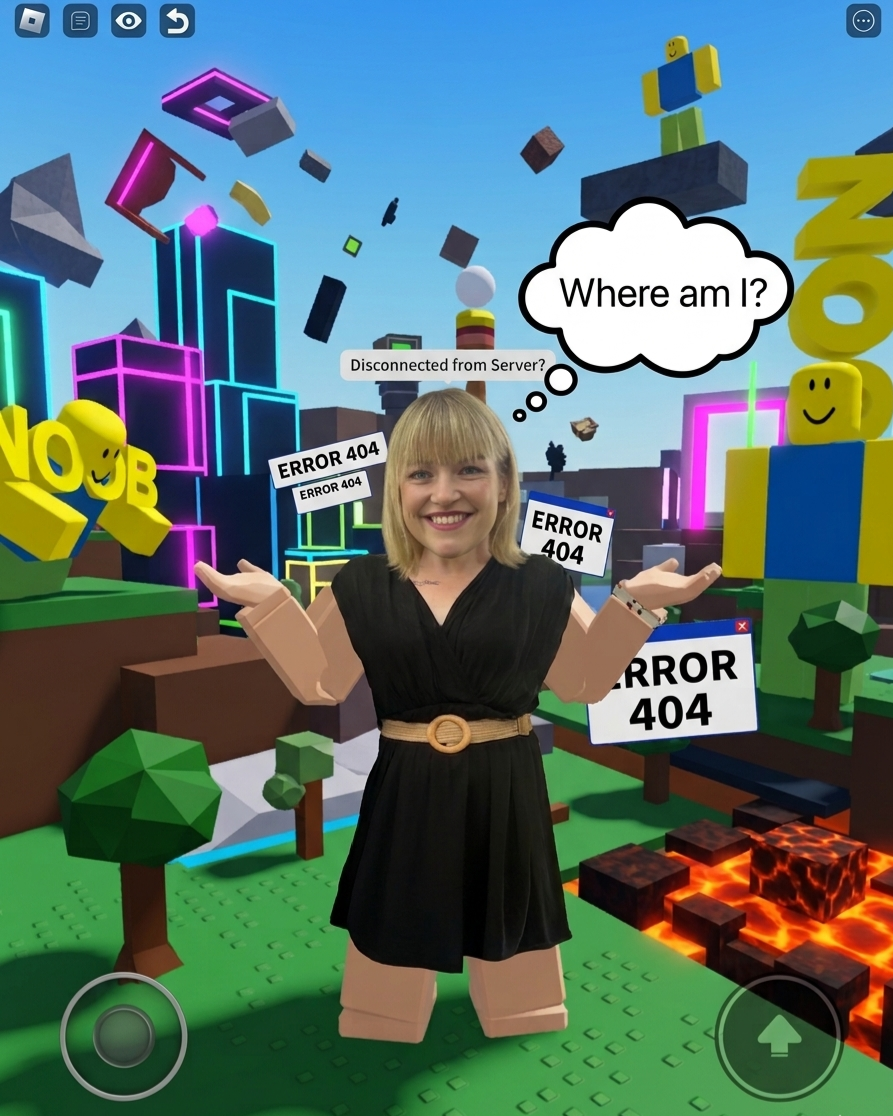
I have to get this out: I genuinely cannot stand Roblox. I do not understand it. I find it visually chaotic, the characters are unsettling little blocky avatars, and the noise it produces makes me want to relocate to a different continent. And yet — Roblox has been one of the most socially transformative experiences of my eldest child, Olivia's life. That tension is exactly what I want to talk about today.
The Minecraft Era
Before Roblox, there was Minecraft. For a long time, our household was entirely absorbed by it. Harrison and Olivia were obsessed — blocks and villagers and building elaborate structures and escaping zombies at nightfall. I used to wonder if they were actually learning anything. Architecture, maybe? Resource management? The art of not panicking when a creeper appears?
Here's what I know now: they were doing something neurologically important. They were hyperfocusing. For neurodivergent kids, hyperfocus is not the same as addiction, though it can look identical from the outside. The difference lies in what it's doing to the nervous system.
For many autistic and PDA (Pathological Demand Avoidance) children, a deeply engaging game isn't escapism in the avoidant sense — it's regulation. The predictability of game mechanics, the clear cause-and-effect logic, the sense of mastery and control in a world that otherwise feels overwhelming and unpredictable — these are genuinely calming. The brain isn't checking out. It's settling down.
This doesn't mean all screen time is equal or that there are no limits to set. But it does mean that the conversation is more nuanced than "screens bad, get outside."
Olivia, Roblox, and the Business of Online Safety
Then came Roblox, and with it, something I did not anticipate: community.Olivia didn't just play Roblox. They became a moderator. They take this role with extraordinary seriousness, actively trolling for sexual predators and reporting back to me on the truly appalling things that happen on the platform. My child — who once struggled profoundly with social connection — now has a role, a responsibility, and a purpose within a community. That is not nothing. That is, in fact, enormous.
This is the kind of neurodivergent plot twist that no parenting book prepares you for. The game you can't stand is giving your child a sense of agency and moral purpose. File that away.
Discord, Friendship, and a Child in "Pineapple"
Olivia also has Discord. And before you close this tab — I hear you. Discord sounds terrifying to a lot of parents. It was not my first choice either.But here is the truth: for Olivia, forming friendships in the conventional sense was not accessible at the time. The social rules of in-person interaction were too unpredictable, too demanding, too full of unspoken expectations. Online connection, with its asynchronous nature and text-based communication, removed many of those barriers.
Through Discord, Olivia started to form actual friendships. Real ones. Including, at one point, what I can only describe as an online "love interest" — someone from the Philippines, which Olivia cheerfully refers to as "Pineapple," because geography and proper nouns are not high on the list of priorities when you're neurodivergent and in the early stages of what feels like a very important connection.
I won't pretend I wasn't relieved that this particular relationship was happening across several thousand kilometres of ocean. But I also won't pretend it wasn't a genuinely important developmental moment for my child.
Georgia Gets None of This (And That's the Point)
My youngest, Georgia, is nine. She does not have access to any of the above. No Roblox, no Discord, no unmonitored platforms. This is not arbitrary — it is age-appropriate, and age-appropriate boundaries are not punishment. They are parenting.
Different ages carry different risks and different readiness levels, and "but my sibling has it" is not a compelling counterargument in our house.
Why I Removed YouTube Shorts — And Why You Should Too
This one I want to address directly, because it matters particularly for neurodivergent children. I have removed YouTube Shorts from all devices in our home. Here's why, and the evidence backs this up clearly.
Short-form video content — YouTube Shorts, TikTok, Instagram Reels — is algorithmically engineered to exploit the brain's dopamine reward system. Each video is typically 15 to 60 seconds, and the algorithm learns almost immediately what keeps a user watching, serving an endless, frictionless stream of content tailored to maximise time on screen.
There is no natural stopping point. There is no narrative arc that concludes. There is just more.
For neurotypical children, this is problematic. For neurodivergent children, it is a significantly higher-risk proposition.
Research consistently shows that children with ADHD and autism are more vulnerable to the dopamine-seeking loop that short-form content creates, because many neurodivergent brains already have differences in dopamine regulation.
In South Africa, a 2022 survey by the South African Depression and Anxiety Group (SADAG) found that adolescent screen time had increased substantially post-COVID, with concerns raised specifically about anxiety, mood dysregulation, and sleep disruption in younger users — all of which are already elevated concerns for neurodivergent children.
Short-form content also compresses attention spans in ways that are directly counterproductive to the kind of deep, sustained engagement that neurodivergent kids are actually capable of and benefit from. It is the opposite of hyperfocus — it is the deliberate interruption of focus, over and over, rewiring the brain to expect constant novelty.
And then there is Harrison.
Harrison will repeat virtually everything he hears — whether he understands it or not. Most of the time, he does not. He is not being defiant or inappropriate. He is processing, echoing, trying language on for size. This is common and completely understandable. But it means that what enters his ears will, with high probability, exit his mouth — at school, at the dinner table, in front of his grandmother. The content moderation piece is therefore not optional for us. It is urgent.
Short-form video, with its unpredictable and often wildly inappropriate content, is simply not a safe input channel for a child who will absorb and repeat what he encounters without filtering.
If your child is neurodivergent, the hyperfocus piece makes content moderation even more critical than it is for neurotypical kids. They don't just watch — they immerse. What they consume becomes part of how they think, speak, and engage with the world.
How We Actually Manage This (Practically Speaking)
I want to be honest about the tools I use, because I think parents deserve real information rather than vague reassurances. I have an app on my phone that allows me to monitor everything my children do on their iPads. This is not because I am a voyeur or because I don't trust my children — it is because I am a parent of neurodivergent kids in an era where the internet contains genuinely dangerous people and content, and my children's neurological profiles mean they may not always recognise risk in the way a neurotypical child might.
I have set all games and viewing options to my children's actual ages. This sounds obvious, but it requires active maintenance — apps update, settings change, and children are creative about finding workarounds.
I have also limited overall screen time. This is calibrated per child, per context. Olivia's moderation work on Roblox is treated differently to passive gaming. Harrison's Minecraft time is treated differently to YouTube. Context matters.
And — my personal favourite tool — I can switch off everyone's WiFi with a single button on my phone. I will not pretend this isn't enormously satisfying. But here is my very strong advice, particularly if you are parenting a PDA child: warn them in advance that this is a consequence. Tell them clearly, at a calm moment when no one is dysregulated, that this is a tool you have access to and under what circumstances you might use it. Do not — I repeat, do not — use it as a surprise punishment.
PDA children have a nervous system that is fundamentally oriented around autonomy and the perception of demand. Sudden, unexpected loss of control — particularly of something they are deeply invested in — is not just upsetting. It can trigger a level of dysregulation that takes hours or days to recover from, and it will almost certainly erode the trust you need for any of the other strategies to work.The WiFi button is a useful tool. Use it as a known, forewarned consequence, not as a power play. The goal is regulation, not retaliation.
The Bigger Picture
Screens are not the enemy. Unmanaged, unlimited, algorithmically-curated screens with no parental context or conversation? That is a different story.
For neurodivergent kids, the relationship with screens is complex and genuinely individual. Hyperfocus on a game can be regulating. Online friendships can be genuinely life-changing. Digital communities can offer belonging that the offline world has failed to provide.
At the same time, the very qualities that make screens potentially beneficial for neurodivergent children — the intensity of engagement, the immersive quality, the repetition — also make thoughtful oversight more important, not less.
You do not have to understand the game. (I still do not understand Roblox. I have made my peace with this.) You do have to understand your child, their nervous system, and the environment they're spending time in. That's the job. And it's more nuanced than anyone's simple hot take on screens will tell you.
Andrea is a neurodiversity coach and PDA specialist based in Cape Town, South Africa. She works with families navigating neurodivergent parenting, and is, herself, a parent of three wonderfully chaotic children.