Same House, Different Brains: What Mixed Neurotype Families Really Need to Know
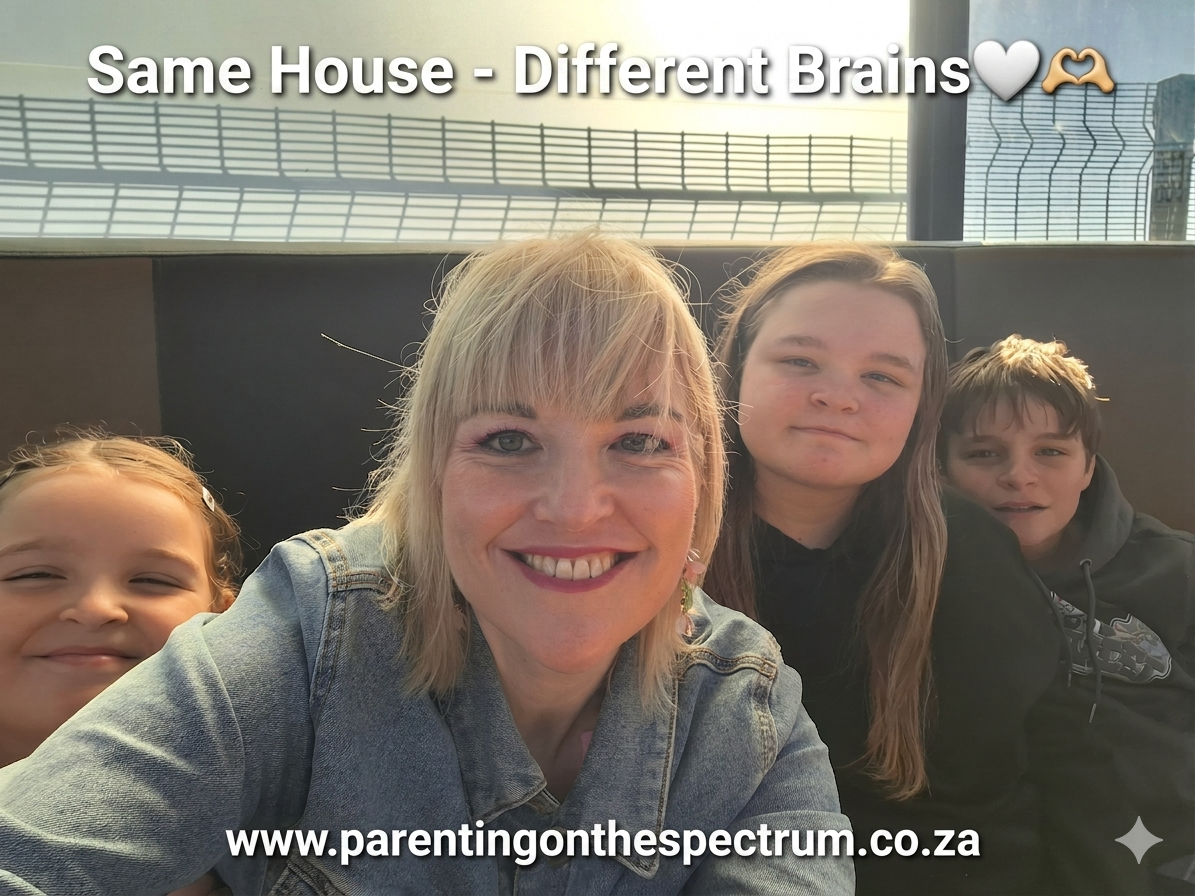
🧠 🌈 By Andrea Grant
"The world will teach your children some very harsh lessons. Home needs to be a supportive and safe space to land."
🫶 I work with a lot of families. Beautiful, complicated, exhausted, loving, overwhelmed families. And one of the things I encounter most frequently — with a frequency that would surprise you, but probably shouldn't — is the mixed neurotype household.
⚖️ One child who needs structure and clear consequences.
🤯 One child who implodes if you even suggest a consequence.
🎁 One child who opens gifts with the enthusiasm of a Labrador puppy (cue my youngest child, Georgia), and one who looks at you like you've handed them a subpoena (yes, this would be Olivia).
🏡 Welcome to my house. Pull up a chair. Try not to trip over the laundry on your way in.
I have three children. Georgia, who is neurotypical like me, and then Olivia and Harrison, who are not. And before I say anything else — that word "not" is doing NO work here except contrast. It is not a diminishment. It is not a tragedy. It is simply a description. Different, not less.
I have used that phrase so many times it has worn grooves in my brain. I'm going to use it a few more times in this article. You're welcome.
🖊️ Let's Start With the Thing Nobody Wants to Explain: PDA Pathological Demand Avoidance. Or, as many in the autistic community now prefer, Pervasive Drive for Autonomy — because "pathological" is doing nobody any favours, least of all the child being described by it. PDA is a profile of autism characterised by an intense, pervasive drive for autonomy and a heightened sensitivity to demands that threaten that autonomy — behaviour rooted in an anxiety-based need to feel in control. It does not appear in the DSM-5 — which tells you a lot about how far behind diagnostic frameworks are when it comes to actually recognising what families like mine are living with every single day. (Autismresources)
What this means in real life is that I cannot run my household the way most parenting books — bless their sweet, optimistic hearts — suggest I should.
🧩There are chores. There is pocket money. There are family dinners and birthday traditions and expectations that life runs on a kind of dependable rhythm. And that works beautifully for some of us.
For others, on some days, it genuinely does not. Not because they are being difficult. Not because they are ungrateful. Not because I have failed as a parent. But because their nervous system, on that particular day, has reached its limit — and insisting on participation anyway is not discipline. It is harm.
👍 My kids understand this. All of them. Because I have made it my business — and genuinely my life's work — to make sure they do.
⚰️🪞The "Funeral Face" and the Honest Mirror
Let me tell you about Christmas and birthdays in our house, because I think it will help.
Olivia has what we cheerfully call "the funeral face." It is not rudeness. It is not ingratitude. It is alexithymia — a reduced ability to identify and express emotions externally — which means the corresponding feeling simply does not always show up on their face.
Opening a gift in front of a room full of people waiting for a reaction, watching them, expecting delight — that is, for Olivia, approximately their worst nightmare. Everyone watching. Everyone waiting. The clock ticking on an emotional performance they do not have access to.
We handle this. We adapt. We protect.
Harrison is the opposite problem. Harri is 100% honest. His face will tell you, with absolute clarity, what he thinks of your gift. Not because he is rude. Not because he lacks gratitude. But because filtering is hard when your brain is wired for transparency. He will let you know. Lovingly. Immediately. Unapologetically.
🎊And then there is Georgia, who flings wrapping paper with the energy of an Olympic gymnast, ecstatic and effusive and entirely, beautifully neurotypical in this one specific way.
3️⃣Three children. Three entirely different gift-opening experiences.
🧑🧑🧒🧒One family that has learnt to hold space for all of them — and one extended family that has had to be gently, patiently, repeatedly educated on why we do not all gather in a circle and perform unwrapping on demand.
🧑🧑🧒🧒➕👨👨👧👧 Blended Families: The Plot Thickens
Now add divorce into this. Add a blended family.
Add children who did not choose each other suddenly living under the same roof and being expected to function as a unit.
I speak as someone who had multiple step-parents. I know what it is to be handed a new family configuration without adequate warning and told, in so many words, to simply adjust. To like these new siblings. To love them, even. And then — perhaps most disorienting of all — to lose them again when the relationship ended, to absorb the grief of that departure while everyone around me moved on to the next arrangement.
💕 I am someone who emotionally connects with people. I make it my business to find out who you are and to do my best to get to know you. I form relationships. So that experience was a mind bomb for me as a neurotypical teenager.
I cannot even begin to map what that transition does in the mind of a neurodivergent child, for whom predictability and safety and sameness are not preferences but genuine neurological needs.
📚 Research from the University of the Witwatersrand published in 2022 specifically examined the experiences of neurotypical South African siblings living alongside children with autism — and found themes of emotional burden, premature development, perceived unfair treatment, and feelings of being overburdened.
‼️ This is our context. This is the South African family navigating, often without adequate support or information, what other countries are only beginning to research.
Siblings often grow up faster than they should, taking on caregiving roles (I know I did), struggling with embarrassment, or feeling invisible in households where the neurodivergent child absorbs the majority of parental attention. (The Neuroverse)
This is not an indictment of parents. It is an indictment of systems that leave families without the tools and knowledge to do better.
💬The Part Where I Say It Plainly: You Cannot Parent Them the Same Way
I work with families who are frustrated — genuinely, understandably frustrated — because the strategies that worked on one child are not working on another. They come to me and say: "We take things away when he misbehaves. It worked for the others. Why won't it work for him?"And I have to sit with them in that frustration and explain, as gently as I can: because he is not misbehaving. He is dysregulating.A meltdown is a neurological event marked by complete loss of control. During a meltdown, the child has reached such intense sensory and emotional overload that their brain effectively short-circuits and can no longer process information or cope with surrounding demands. (PX Docs)
The brain perceives highly dysregulated inputs as a literal threat to survival, initiating the fight, flight, or freeze response — and at that point, sensory information stops transmitting to the emotional processing or analytical parts of the brain, making rational thought functionally impossible.
🧸 🪀 You cannot take a toy away from a child in this state and call it discipline. You can only make it worse.
A tantrum is a deliberate attempt to get something or gain control of a situation.
A meltdown is an involuntary response of the autonomic nervous system. (Curriculumforautism)
These are NOT the same thing. Treating them as the same thing is not strict parenting. It is a misunderstanding of neuroscience.
And similarly — you cannot deny a child with ADHD and autism the sensory regulation tools that help their brain function, like screen time and specific foods, while their siblings enjoy those same things in plain sight. For a seven-year-old, that is not a logical consequence. That is a daily message that they are bad. Different. Wrong. And many neurodiverse children are already fighting that message from every direction.
🟰 Equity Is Not a Dirty Word
This is where I will say the thing that makes some parents uncomfortable: equity is not the same as equality, and your children need to understand the difference.
When resources are distributed equally, the smallest person still cannot see over the fence — and the tallest person has something they didn't need.
Equity means each person gets what they actually need to participate fully. (PubMed Central) This is not favouritism. This is fairness.
It looks different for different people, and that is the point.
I have had parents tell me: "But my kids will think it's unfair." And I always say — then explain it to them. Because kids can understand far more than we give them credit for, when we take the time to speak to them honestly and age-appropriately.
I have three of them. I know.
Research consistently shows that helping neurotypical siblings understand and respect the routines and differences that benefit their neurodivergent siblings can significantly reduce frustration and conflict within the family.
Understanding is not just a nicety. It is a practical tool. When Georgia understands why we don't always have family dinner together, she doesn't resent it.
When she knows that Olivia being in burnout is not a choice or a performance, she checks in rather than feeling dismissed. That is empathy in action.
That is the kind of sibling she is growing into — not despite the complexity of our family, but because of it.
🔠 Language Matters. More Than You Think.
I want to pause here to say something clearly: words like "moron" and "retard" used to describe neurodivergent siblings are never, ever acceptable.
Never. Not as a joke. Not in a moment of sibling frustration. Not because "kids will be kids."
These words carry the weight of generations of dehumanisation. They are not playful insults that went too far — they are, historically and practically, language that has been used to exclude, institutionalise and dismiss people exactly like the children in these families.
When we allow them, we are teaching our children that difference is something to mock. We are teaching them the opposite of everything I spend my professional life trying to build.
This must be addressed. It must be disciplined. And it must be explained — not just as a rule, but as a value.
🆘What I Actually Do With Families
When families come to me and say "I don't know how to make this work," I don't give them a generic handout.
I say: give me the specific moments. Give me the exact scenarios where it breaks down. The morning routine. The dinner table. The birthday party. The homework hour.
The sibling who feels overlooked. The child who cannot cope with noise. The parent who is running on empty.
And then I give you exact, practical, personalised responses. What to say. What not to say. How to move. How to give a choice that isn't really a choice but feels like one, to a child who needs autonomy to feel safe.
How to validate the neurotypical sibling without undermining the neurodivergent one. How to hold the whole house without dropping anyone.
South African research highlights the need for additional support for neurotypical individuals within these families — supported by programmes that enhance awareness so as to mitigate the impact of heightened childhood stress, stigmatisation, and marginalisation.I couldn't agree more.
This is precisely the gap I try to fill — not just for the child with the diagnosis, but for every person in the family system.
🤗 Home Is the One Place You Get to Choose
The world is going to teach your children some things you did not sign up to teach them.
It will teach them that different is suspicious. That slow is lazy. That crying is weakness. That needing more support means you're less capable.
The world does not have time for nuance, and it is not particularly interested in your child's sensory threshold.
🏚️ Home does not have to work that way.
Home — your home, the one you are building right now, with all its chaos and noise and complicated dinner arrangements — can be the place where every child is seen for exactly who they are.
Where the child who needs quiet gets quiet. Where the child who cannot manage gifts on demand is not put on the spot. Where the word "different" is not an insult.
Where your neurotypical child grows up to be the kind of adult who makes space for people who are wired differently, because they grew up alongside someone they love who is.
That is not a small thing. That is actually enormous.And it starts at home.
It starts with you being willing to say: my children are not the same, and I am going to stop pretending that they are, and I am going to love each of them in the way that they actually need.
If you need help figuring out what that looks like — that's what I'm here for.
Andrea Grant is an Autism Facilitator, Coach and PDA Specialist based in Cape Town, South Africa. She works with neurodiverse families through in person or online one-on-one coaching, school facilitation and parent and school workshops. #neurodiversity #PDAsouthafrica #autismparenting #neurodivergentfamily #parentingonthespectrum
