Lost in Translation:Context Blindness, Radical Honesty, and Why Your Neurodivergent Child is Actually Doing You a Favour.
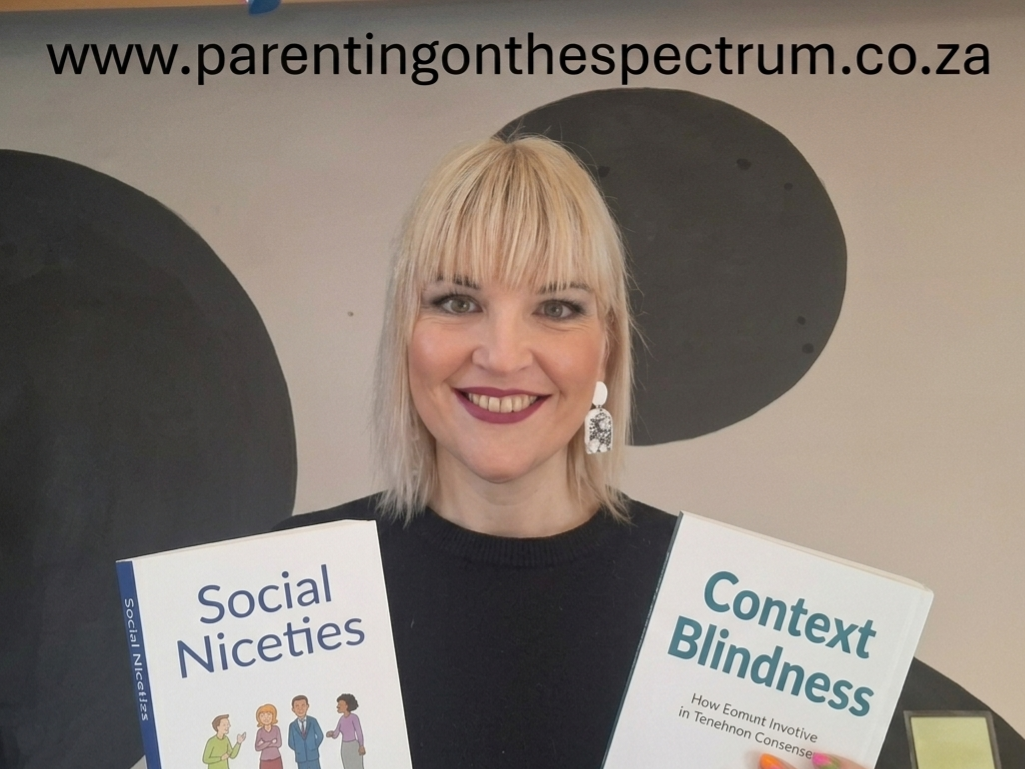
There is a moment that every parent of a neurodivergent child knows intimately. You are in public.
The setting is quiet and dignified — a doctor's waiting room, perhaps, with its hushed reverence and its judgmental magazines from 2019. And then your child opens their mouth (loudly). "My mom lets me drink alcohol."Thank you, Olivia. Thank you so very much.
🍸For the record: one sip. One singular, exploratory sip of my mojito, offered in the spirit of demystification and the noble parenting philosophy of if they try it at home they won't binge it in later life. But context, as any parent of an autistic child will tell you, is not always their strong suit.
The statement was not a lie. It was simply... incomplete. Spectacularly, mortifyingly incomplete, delivered at full volume to a waiting room full of people who were now very interested in our family, and had their fingers at the ready on their phones to dial Child Protective services.
👩🦯This is context blindness in its most glorious form. And while I say glorious with the full benefit of hindsight and a functioning sense of humour, I want to talk about what context blindness actually is — because it is far more nuanced, and frankly far more interesting, than most people give it credit for.
So What Is Context Blindness, Exactly?
Context blindness, a concept developed by Dutch professor Peter Vermeulen, describes the difficulty many autistic people experience in spontaneously using context to fine-tune their thinking, communication, and behaviour. It is not that they cannot understand facts — often, they understand facts with brilliant precision. It is that the invisible surrounding information that neurotypical people use to colour those facts, to soften them, to know when to say them and when decidedly not to, can be opaque to them.
This is closely related to what we have long called the "theory of mind" debate in autism — the idea, popularised by Simon Baron-Cohen, that autistic people struggle to understand that other people have different thoughts, feelings, and perspectives. But here is where it gets interesting, because the research has moved on considerably.
The Double Empathy Problem, first coined in 2012 by autistic researcher Damian Milton, reframes the entire conversation — not as a one-sided deficit in the autistic person, but as a mutual misunderstanding between people with fundamentally different ways of experiencing the world. (Simply Psychology)In other words: it takes two to miscommunication. (Anyone who has ever been in a relationship can attest to this).
Autistic people tend to perceive the world differently, express emotions uniquely, and communicate in a straightforward, literal manner. What neurotypical people might interpret as a social "deficit" is more accurately a difference in social norms and expectations — similar to how, in the past, people from different cultures were labelled as rude simply because their customs were misunderstood.
Here in Cape Town — in South Africa more broadly — we are still, frankly, catching up to this shift. The understanding of disability and autism in Africa is often still influenced by Western, medicalized, deficit-oriented frameworks, which do not always account for non-Western viewpoints or community-based understandings of human difference. (ASHA)
The harder cultural shift is the one that has to happen in living rooms, classrooms, and — yes — doctors' waiting rooms.
The Radical Honesty Problem (That Isn't Actually a Problem)
Here is what I want to tell you about context blindness, because I think we spend too much time focusing on its awkward moments and not nearly enough time appreciating what it produces on the flip side: radical, unfiltered, glorious honesty.
I have watched Olivia navigate the world for sixteen years. They are non-binary, autistic, with a PDA profile, and they are — this is a professional and personal assessment — one of the most socially courageous people I know.
Not because it is easy for them. But because they have learnt, with a great deal of hard work and some spectacularly frank conversations at the dinner table with me, to name what they need.
Last Friday, Olivia went out for the second time on their own — to watch a show with a friend. A wonderful young man, affectionate and enthusiastic and exactly the kind of person who will reach out and grab your arm when he's excited about something. Which, for Olivia, is not ideal.And so Olivia told him. Plainly, without drama, in the middle of the outing: "Yes, I'm also into this show — but remember, I don't like physical contact. Stop touching me."
When they're on the phone and the conversation has run its course: "I'm reaching capacity now. You can say one more thing and then we have to hang up."I stood in the kitchen the first time I overheard this and genuinely had to stop what I was doing.Because here is the question I want you to sit with: wouldn't the world be so much easier to navigate if we all just said what we meant?
We neurotypicals have constructed an elaborate social theatre in which we hint and imply and hope for the best, and then feel wounded when people don't read our minds correctly. We say "I'm fine" when we are absolutely not fine. We say "no, it's okay" when it is categorically not okay. And then we wonder why we feel unseen.
Olivia doesn't do that. Olivia says I am at capacity and means it literally, and the conversation ends, and nobody feels guilty and nobody feels rejected and nobody spends three days overanalysing the tone of a text message.
According to the Double Empathy theory, communication difficulties are not due to autistic cognition alone, but to a breakdown in reciprocity and mutual understanding that can happen between people with very different ways of experiencing the world. (Autism UK)
Which means that if we want things to go better — the neurotypicals among us have some work to do too.
The Translation Tax
Here is a thing that happens in my house regularly. I have written about it before. I explain to Olivia that something they have said to their sibling was hurtful. Olivia looks at me with genuine bewilderment and says: "But obviously that's not what I meant. I said his hair is a grease pit because he has not washed it. I wasn't being mean."And here is the remarkable thing: the two neurotypical members of our household — myself and my youngest — are the only ones who take offence.
My neurodiverse children talk to each other all day long with absolute frankness, nobody bleeds, nobody needs a debrief, because there is no subtext. No hidden agenda. No meaning lurking three layers beneath the actual words. What you hear is what there is.
There is something both humbling and hilarious about realising that the neurotypical members of my family are the ones constantly misreading the room.
Research now suggests that awareness of the differences in how autistic people communicate and express emotion needs to be emphasised in the training of caregivers, educators, and healthcare practitioners — and that future focus should be on increasing empathy in the neurotypical population, rather than placing the entire burden of adaptation on autistic people. (PubMed Central)
I will say that again for the people in the back (especially for certain members and institutions in the community that I have found myself frequenting of late for the families I work with) : the burden should not rest entirely on neurodivergent people to translate themselves for us. That is not inclusion. That is assimilation with extra steps.
When the Click Doesn't Happen — And Why That's Also Fine
I tell parents of the children I work with something that surprises some of them: we will not always click. I am fortunate that it has not happened often, but there are always instances when I meet a child and the connection simply isn't there.
Depending on their age, they will look at their parent and communicate, without a syllable of ambiguity: Nope. Not this one.And I will say, with complete sincerity: Okey dokes. And we will find someone else.
Because this — this is what I most want parents to understand. The directness is not a problem to be managed. It is information, delivered cleanly, without the passive-aggressive social performance that neurotypical people have been trained to offer instead.
When a neurodivergent child tells you they don't feel the connection, they are not being rude. They are being honest in a way that most adults are not brave enough to be.And what I want, ultimately, for every child and adolescent and adult I work with, is for them to feel safe being exactly that honest. To set boundaries with confidence. To say this is where I end and you begin without a preface and without an apology. To lean into what they love and to be unafraid of naming what they don't.
The world will not always understand. Some people will be uncomfortable with the directness. Some people will take it personally, and some of them will not recover.
South African education policy still largely frames neurodivergence in terms of deficit and disorder — and until that changes at a systemic level, neurodivergent people will continue to carry the social translation tax in spaces that were never designed with them in mind. (Wiley)
But the people who matter — the friends, the teachers, the partners, the coaches — will pay attention. They will learn the language. They will understand that "I'm at capacity" means goodbye with love, not goodbye with rejection. That "your hair is a grease pit" means please shower, not you are beneath my regard.
Context blindness, in its most difficult moments, is the mojito anecdote. In its most beautiful moments, it is a sixteen-year-old standing in a theatre, setting a boundary with the casual confidence of someone who has been taught that their needs are worth naming.I'd say that's something we could all learn from. I'd just recommend keeping your drinks to yourself.
Andrea Grant is a neurodiversity coach, PDA specialist, and the founder of Parenting on the Spectrum, based in Cape Town. She works with children, adolescents, and adults, and writes from both professional expertise and sixteen years of lived family experience.#neurodiversity #contextblindness #autismparenting #PDAprofile #parentingonthespectrum
