LOST IN THE LABYRINTH: A South African Parent's Survival Guide to Getting Your Child Diagnosed By Andrea Grant | Neurodiversity Coach, Educator & Reluctant Expert on Waiting Rooms
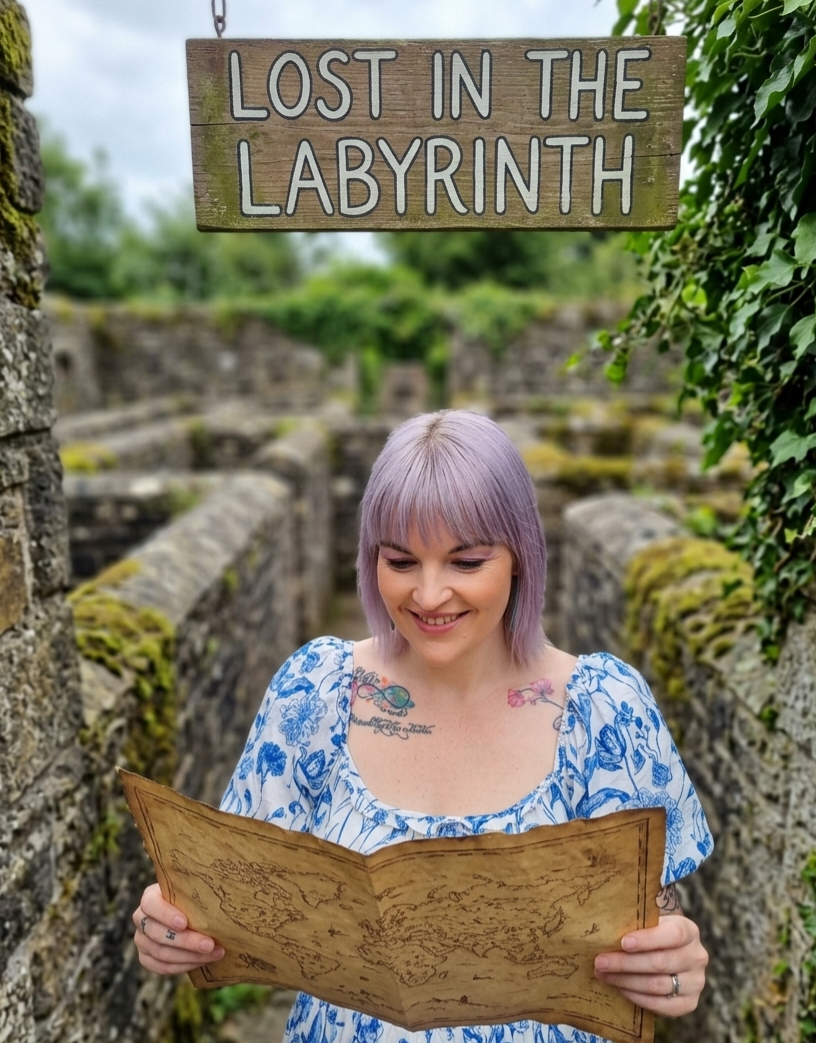
It's 2012. You're sitting in a beige consulting room somewhere in Cape Town, clutching a referral letter from your child's teacher that says something vague like "Olivia may benefit from further assessment." You look at your child — brilliant, funny, ferociously passionate about horror movies and anime and already capable of a monologue that would make David Attenborough weep with envy — and you think: what does that even mean?
That was the beginning of what I now affectionately call The Great South African Diagnosis Odyssey. Part treasure hunt, part bureaucratic nightmare, part Google spiral at 2am. And if you're in the thick of it right now — this article is for you.
Step One: Realising Something is Different
No parent wakes up one morning and thinks "I'll pop my child in for an autism assessment today." The journey usually starts with a teacher's comment, a playdate that went sideways, or — in Olivia's case — a Grade 1 teacher who gently suggested that their "intensity" and "unique social style" might be worth looking at.
Olivia was diagnosed with Autism Spectrum Disorder at age seven. And honestly? Part of me was relieved. A diagnosis felt like a map — finally, we had a name for the terrain we'd been stumbling through. The problem was: the map had massive blank spots.
Nobody mentioned Pathological Demand Avoidance. In fact, when I first Googled "PDA autism," I got a lot of results about personal digital assistants. Which, now that I think about it, is not entirely inaccurate — my child also required very specific instructions delivered in a very specific way to function correctly.
PDA — now more accurately called the Pervasive Drive for Autonomy — is a profile on the autism spectrum characterised by an extreme need for control over one's environment and a nervous-system-level resistance to demands. Not stubbornness. Not naughtiness. A neurological response as involuntary as a sneeze.The psychiatrists didn't mention it. The paediatrician didn't mention it. The educational psychologist gave us a report thicker than a Woolworths Christmas catalogue, and not a single paragraph referred to Olivia's very specific relationship with the word "no."
I found PDA the way most South African parents find it: down a rabbit hole at midnight, in a Facebook group full of exhausted mothers in pyjamas saying "oh my GOD, this is my child." The internet, not the clinic, was our first real breakthrough.
PDA? In South Africa in 2012? You'd have had better luck finding a unicorn at Canal Walk.
The Diagnostic Landscape: What You're Actually Dealing With
Here's the truth nobody puts in the brochure: getting a diagnosis in South Africa is expensive, time-consuming, geographically unfair, and emotionally draining.
You'll need to assemble what I think of as a very unglamorous Avengers team: a paediatrician or paediatric psychiatrist as your entry point, an educational psychologist to assess your child's cognitive profile, a speech and language therapist, an occupational therapist, and ideally a GP who actually listens — rarer than you'd think, but they exist.
Each of these professionals charges separately. Each writes their own report. Some of them speak to each other; many of them don't. You, the parent, become the project manager, the filing system, and the translator between disciplines — all while raising a child who may or may not have just dismantled your kitchen cupboards in protest at the concept of lunch.
In private practice in Cape Town, you're looking at R3,500 to R8,000 per professional, not including follow-up sessions and report fees. A full multidisciplinary assessment can run to R25,000–R40,000 before you've even started on therapy.
I used to joke that I could've taken the whole family to Bali for what I spent on educational psychology reports. And Bali probably would've been more relaxing.
Welcome to the Dys Family
Just when you think you've assembled the complete puzzle, someone hands you more pieces. For us, the autism diagnosis was only the beginning. As Olivia moved through school, more of the picture revealed itself — and what emerged was an entire extended family of challenges I now call, with great affection, the Dys Family.
Allow me to introduce them:
Dyslexia — difficulties with reading, spelling, and decoding written language. Olivia could narrate a 45-minute documentary about how every ghost documentary ever filmed was fake and why but could not read a simple sentence without their brain performing gymnastics.
Dysgraphia — difficulties with writing. Not just bad handwriting — a genuine disconnect between thought and the physical act of forming letters. Their ideas were extraordinary. Getting them onto paper was like trying to run a Formula 1 race in a 1978 Datsun.
Dyscalculia — difficulties with numbers and mathematical concepts. A specific processing difference that meant maths felt like reading a map in a language they had never seen.
Dyspraxia — affecting motor planning, coordination, and the ability to perform sequences of movement automatically. Which explains rather a lot about our long and complicated relationship with shoelaces.
Each of these required its own referral, its own assessment, its own report, and its own remediation approach. None of them showed up in the original diagnostic assessment, because the original assessment didn't look for them. We discovered them the old-fashioned way: through years of observation, a great deal of school advocacy, and one very memorable parent-teacher meeting where a teacher told me Olivia was "just not trying hard enough. "Reader, I did not flip the table. But I thought about it.
Co-occurring conditions in autism are the rule, not the exception. If you've found one, keep looking. The Dys Family rarely travels alone.
The Foot Problem Nobody Warned Me About
Here's something that doesn't make it into most autism awareness articles: neurodiverse children often walk differently. And I don't mean metaphorically.
Many children on the spectrum — particularly those with proprioceptive differences — walk on their toes, pronate inward, put pressure on unusual parts of their feet, or have reduced body awareness that means they genuinely cannot tell when their gait is causing damage. Olivia has always walked with the gait of someone who is deeply suspicious of the floor but committed to crossing it anyway.
By the time they were a teenager, they were dealing with chronic foot pain that their doctors initially dismissed as "growing pains." It was not growing pains. It was a combination of flat arches, a tendency to roll inward at the ankle, and years of putting pressure on parts of their feet that were not designed to take the load.
The irony? The same interoceptive differences that means they often doesn't register hunger or temperature also meant they were not always aware of how much pain they were in — until it became significant.
Neurodiverse children are often brilliant at masking physical discomfort the same way they mask emotional distress. They push through. They compensate. And then one day you notice they've been limping for three weeks and thought it was normal.
We eventually found an OT who specialised in sensory and motor integration, and a paediatric physiotherapist who looked at Olivia's gait without once saying "they'll grow out of it."
Custom orthotics, targeted exercises, and some very frank conversations about footwear have helped enormously. Chronic pain quietly erodes a child's capacity for everything else — learning, social engagement, emotional regulation. Addressing it matters.
Watch for toe-walking, ankle rolling, unusual shoe wear patterns, and complaints of foot or leg pain after school. An OT or paediatric physio can assess gait and refer for orthotics if needed.
What If You Can't Afford the Private Route?
This is the question I get asked most often, and it deserves a completely honest answer: the public health route in South Africa is hard. It is slow, it is under-resourced, and it requires an almost heroic level of persistence. But it is not impossible.Child and Adolescent Mental Health Services (CAMHS) are available at most government hospitals via GP referral. Waiting lists of 6–18 months are not unusual, but this is a legitimate diagnostic route.
University training clinics — UCT, Stellenbosch, and UWC offer Speech Therapy, OT, and Psychology assessments at significantly reduced rates, supervised by qualified professionals.
School-Based Support Teams (SBSTs) — every school is legally required to have one. They cannot diagnose, but they can refer and provide interim support while you wait.
NPOs and parent support groups — organisations like Autism South Africa and ADHASA often have lists of low-cost practitioners and can guide you through the process.
And one more thing: you do not need a diagnosis to start advocating for your child. A diagnosis opens certain doors — it gives you language, legal protection, and access to resources. But your child's needs are real regardless of what the paperwork says.
You are your child's most important diagnostician. You have been collecting data for years. Trust that.
What I Wish Someone Had Told Me at the Start
Fifteen years and approximately four filing boxes of assessment reports later, here is what I know.The diagnostic journey is not a single event. It's an ongoing process of understanding your child more deeply, updating your map as the terrain changes, and advocating fiercely in spaces that were not designed with your child in mind.
Olivia is sixteen now. They are funny, fiercely intelligent, deeply empathetic, passionately opinionated about social justice and the ethical treatment of animals, and currently thriving in ways that the beige consulting room of 2012 could not have predicted.
They still struggle with reading speed and written output. They still have foot pain on bad days. They still have moments when the demand of existing in a neurotypical world becomes too much. They are not "fixed", as Olivia was never broken.But Olivia understands themselves a lot better. And that — more than any report, more than any diagnosis, more than any intervention — is what changes everything.
The labyrinth is real. It's expensive, it's confusing, and it doesn't always have clear signs. But you can navigate it. And you don't have to do it alone.I am a qualified neurodiversity coach, educator, and mother of three neurodiverse children based in Cape Town. I offer home coaching, school advocacy, and parent workshops across South Africa. andrealgrant@gmail.com