Is Your Child's School Truly Inclusive? A Cape Town Teacher and Mom's Guide to PDA and Neurodiversity.
The Inclusive Illusion: Why Your School’s “Neurodiverse Friendly” Tag is Probably Gaslighting You
If I see one more school website featuring a stock photo of a child staring thoughtfully at a single puzzle piece alongside the claim "We Are a Fully Inclusive Environment," I might actually lose my mind. Lately, as I’ve been seeing more clients individually through Parenting on the Spectrum, I’ve moved past "surprised" and straight into "incandescently hopeful for a giant meteor." It is genuinely shocking—and frankly, heartbreaking—how many schools in South Africa and Cape Town specifically, are slapping the "inclusive" label onto their bios like it’s a trendy Instagram filter. Newsflash to the marketing departments: Inclusion is a practice, not a personality trait you can just "manifest" into your school’s Mission and Vision statement.
The "One-Size-Fits-None" Reality
Most parents put a massive amount of thought into schooling. But for us? The parents of neurodivergent kids? It’s not just a choice; it’s a high-stakes tactical operation. I have three children. Three. And they go to three different schools. Why? Because they have three unique profiles, and despite what the brochures say, there isn't a single school in the Table View, Parklands, Milnerton or Melkbos area that is a magical "one-stop-shop" for every type of brain. As a teacher of 20 years, I’ve worked at at least four of the schools that currently top the Google and Gemini search results for "neurodiverse-friendly" in Cape Town. And I am telling you—as an educator, a qualified Autism Facilitator, and a mother who has been in the trenches—most of them are NOT qualified to handle your children.
They use the "tag" because it looks good on the balance sheet. But the moment a child displays a PDA (Pathological Demand Avoidance) profile or needs something beyond "extra time for exams," the "inclusive" mask slips, and the "firm but fair" (read: compliance-obsessed) monster underneath comes out to play.
The Trauma of the "Trial Run"
My eldest, Olivia, went to four different schools before we found the "closest to best" fit. It was a traumatic journey for both of us. Education became a battlefield, and home became a recovery ward. And I was not the one who got to recover. I’ve seen it from the other side of the desk, too. I’ve watched kids attend schools that claim to be inclusive, only to be ostracised and ridiculed because they are fundamentally misunderstood by staff who think "neurodiversity" just means "sits still but needs a fidget spinner." Many of these staff have been good friends of mine. As teachers and people, they have the best intentions, but are simply not provided adequate training to teach our neurodivergent kids. We need to stop pretending that putting a child in a mainstream classroom with a "shadow" (who is often underpaid and undertrained) is inclusion.
True inclusion requires the student body to be part of the conversation. If the other kids don’t understand what neurodiversity is, it will never be normalised—it will just be "that kid who gets to use a laptop," or, "the one who likes to move a lot and sits alone".
The "PDA-Friendly" Audit: How to Spot the Fakes
If you have a child with a PDA profile, you need to be especially vigilant. Our kids have a "neuro-finesse" for sniffing out inauthenticity. If a teacher is faking calm, a PDA kid will find the crack in that armour in approximately four seconds.When vetting schools in South Africa, don’t ask if they are inclusive. Ask how they are inclusive.
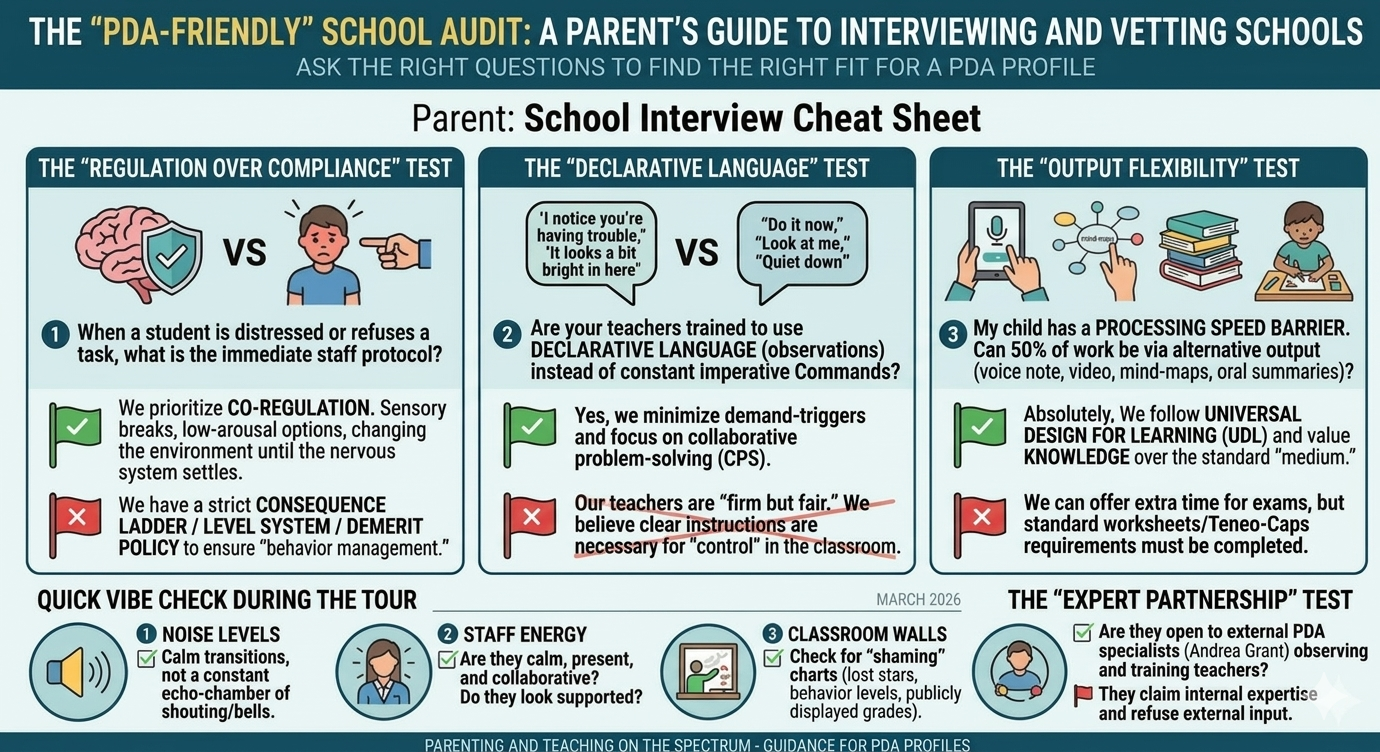
Here is your "Cheat Sheet" for the next school tour:
1. The "Regulation Over Compliance" Test
Ask: "When a student is distressed or refuses a task, what is the immediate protocol?"
- The Red Flag: "We have a strict demerit system/detention ladder to ensure they learn consequences." (Translation: We prioritize your child’s obedience over their mental health).
- The Green Flag: "We prioritize co-regulation and sensory breaks. We change the environment until the nervous system settles."
2. The "Declarative Language" Test
Listen to how the staff speak.
- The Red Flag: Constant imperatives. "Sit down," "Open your book," "Look at me."
- The Green Flag: Declarative observations. "I notice it’s a bit bright in here," or "I wonder if this math problem feels a bit big right now."
3. The "Output Flexibility" Test
South African schools love their workbooks and "Teneo-caps" requirements.
- The Red Flag: "We can offer extra time, but the physical worksheet must be completed."
- The Green Flag: "We value knowledge over the medium. Can they submit a voice note, a mind map, or a video instead?"
4. The "Vibe Check" (The Tour)Walk the halls.
Is it a constant echo-chamber of shouting and bells? Are there "shaming charts" on the walls (you know the ones—the "sad clouds" or public behavior levels)? If you see a "Wall of Fame" that only rewards neurotypical standards of "neatness" or "quietness," run. Fast.
Also, ask for credentials. It is not only your responsibility, but legally, your RIGHT as a parent to know that the people who are teaching your children have SACE certificates, have neurodiversity training, are even actual teachers.
The Expert Partnership
Finally, ask if they are open to external specialists observing and training their teachers. If a school claims they have "internal expertise" and refuses outside input (like, say, a qualified coach who actually knows the child), they aren't looking to support your kid—they're looking to protect their ego. Choosing a school shouldn't feel like a game of Russian Roulette with your child's psyche. We deserve better, and our kids certainly do. I have made an image of the school check 'Cheat sheet' which accompanies this article. Please contact me if you would like any advice.