Finding Their Tribe:Why Churches Need to Do Better for Neurodiverse Children
By Andrea Grant, Parenting on the Spectrum
I never imagined that part of my job description as a neurodiversity coach and PDA specialist would involve becoming a semi-regular fixture in the pews of Cape Town's churches. And yet, here we are.
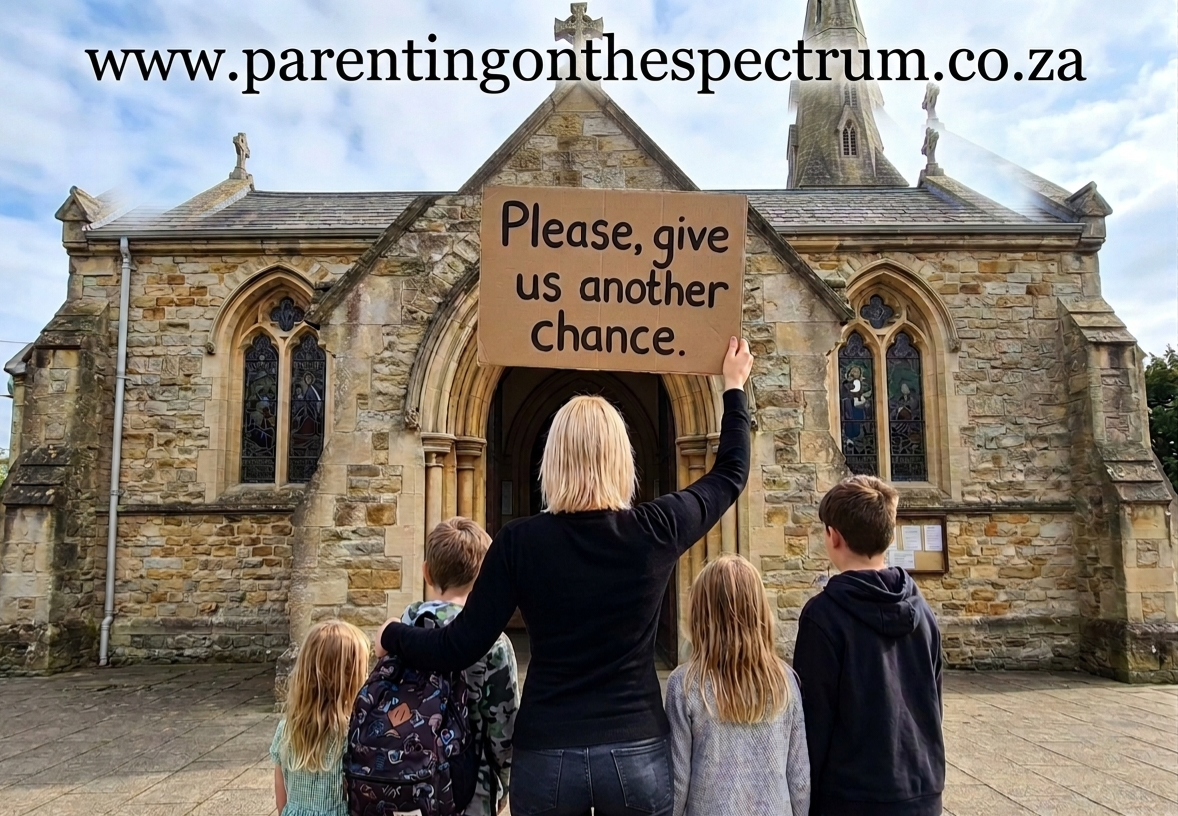
Four churches. Four families. Two children, two adolescents who were shown, in no uncertain terms, that their particular version of existing in the world was a little too much for their congregation to handle.
Four people who were, in gentler language than I'm using right now, asked to leave.I have now visited four different churches across the Cape Town area to advocate for neurodiverse children and adolescents who were asked to leave their church or youth groups because of what was described as "disruptive" or "difficult" behaviour.
I want to pause on that word — difficult — because I think it tells you everything you need to know about the gap between what these communities believe they stand for and what they are actually practising.
🤔Difficult for whom, exactly?
The child who has finally found a place that felt, even briefly, like belonging? Or the adults around them who have simply never been given the tools to understand what they were seeing?
I've been successful in getting all four children reinstated into their groups. I'll take that win. But I'd be lying if I said it came without conditions.
I am currently accompanying one of them to church every Sunday — personally, with my own Sunday morning, thank you very much — to ensure that the approaches I recommended are actually being implemented and that this child is treated with the dignity he deserves.
I would also like to add here that these approaches are not had. They are simple strategies like, bare in mind that many neurodivergent people have context blindness and cannot read the room.
So if you feel they are asking too many questions, gently let them know, and also let them know you will get back to these questions later, once everyone has left and you have the capacity to do that. And then, and this is the important part, follow through. Do what you promised you would.
My own child has PDA. If you tell Olivia you will do something, Olivia takes you at your word. To not follow through results in the erosion of trust. The breaking of relationships. The very things that, as parents, teachers, communities, spiritual leaders, we should be holding in the highest regard.
To further support these churches and their congregations (because that's what it is, support. Not criticism. No need to be defensive. All I want to do is help).
So, I have also provided each of the four churches with free, bespoke support materials I created specifically for their leaders, so that youth group facilitators and Sunday school teachers have something concrete in their hands when they interact with these kids.
Free. Because heaven forbid the church budget stretch to include the children it turned away.
Now, I want to be fair here. In almost every single meeting I sat in — with leaders, pastors, management committees, elders, deacons, and various combinations thereof — the people across the table from me were not unkind.
They were not malicious. What they were, consistently and almost without exception, was uninformed. And what they cited, with remarkable unanimity, as the reason these children had been asked to leave, was this: other members of the congregation were leaving because of these kids.
Let me sit with that for a moment, because I've had to sit with it quite a lot.Other people. Were leaving. The church. Because a neurodiverse child was present.I said — calmly, without being preachy or self-righteous, because I am nothing if not a professional — that to me, this speaks to a profound lack of understanding within the broader congregation. And rather than respond to that lack of understanding by removing the child or adolescent, I would love the opportunity to address it at the source. Let me come and speak to your community.
Let me help your congregation understand what autism can actually look like. Let me explain why a child might make certain sounds, why they might ask the questions they ask, why what looks like defiance is almost always something else entirely.
Let's build some understanding, so that people's first instinct is to lean in rather than look for the exit.
Because isn't that, I asked them gently, what church is supposed to be about?
I'll be honest with you.
I am fighting very hard not to be judgemental about all of this. Very hard. I am holding onto my professionalism with both hands and occasionally my teeth.
Because here is what I know, both as a specialist and as a parent: it is incredibly difficult for people on the autism spectrum to find their tribe. Genuinely, searingly difficult. The social world is not built for them.
Neurotypical social spaces are exhausting and often hostile in ways that are invisible to everyone except the person navigating them.
When an autistic child or teenager finds a community that feels safe — a youth group, a Sunday school class, a church family — that is not a small thing. That is enormous. That is the kind of belonging that sustains a person.And when that community turns around and says, actually, we'd prefer it if you weren't here — the damage that does is not something I can overstate.
In a South African context, where community and ubuntu are values we speak about constantly and with great pride, the irony is particularly sharp.
We are a country that talks beautifully about the collective, about caring for one another, about no one being left behind.
And yet here are children — children who arguably need community more than most — being quietly shown the door because their presence made someone else uncomfortable.
⛪ 🕎 🕌 There is also something worth understanding about the specific nature of autistic engagement with faith.
Many autistic people find the concept of religious belief genuinely difficult to access. This is not stubbornness, and it is certainly not disrespect. It is neurology.
Autistic brains are, broadly speaking, concrete and literal processors.
Abstract concepts — faith, grace, the nature of God, the resurrection — require a kind of cognitive flexibility and comfort with ambiguity that does not come naturally to many people on the spectrum.
When my eldest child, Olivia asks a question in a religious context that makes adults in the room shift uncomfortably, they are not being difficult. They are being exactly who they are: a person who needs to understand things from the ground up, who cannot simply accept something on faith when their brain is wired to interrogate it.
The questions autistic children ask in church are not challenges to authority. They are genuine attempts to understand what everyone else seems to have agreed on without explanation. If anything, those questions should be welcomed. They are the most honest thing in the room.
In the Western Cape, where church attendance remains a significant cultural institution for many communities — coloured, Afrikaans, English-speaking, across denominations from evangelical to Dutch Reformed to Catholic — the stakes of this exclusion are particularly high.
👨👨👧👧For many families, church is not just a spiritual practice. It is their entire social infrastructure.
Their support network. Their community of belonging.
When a neurodiverse child is excluded from that, the family often quietly withdraws too, one by one, until they've lost access to the very support structures they need most.
I have watched this happen. It is not abstract to me.
What I want churches and faith communities across South Africa to understand is this: inclusion is not complicated. It does not require a budget. It does not require a specialised programme or a separate room or a dedicated aide (though all of those things, in the right context, are wonderful). What it requires first and foremost is education.
Give your leaders the language to understand what they're seeing. Help your congregation reframe difference as something other than a threat. Build a culture where a child who makes unexpected sounds, or asks uncomfortable questions, or needs to move around, or refuses to follow an instruction they don't understand, is met with curiosity rather than alarm.
I have offered coaching and training and received feedback that while there are funds available for other things, there are no funds available for this. So I have offered to do it for free. I await an answer from all four churches on whether or not they will allow me to support and educate their congregations. Which I will do respectfully, and with kindness, as I try to do everything.
Being a little bit flexible and welcoming change is achievable. I know it is, because I've watched it happen in the four churches I've now worked with. It is slow. It is imperfect.
As I said, one of those churches now has me sitting in it every Sunday, which was definitely not in my original career plan. But it is happening.
These children have found their tribe. The least we can do — the very least — is let them stay.
Andrea Grant is a neurodiversity coach, PDA specialist, certified Autism Facilitator and Coach, and SACE-accredited educator based in Cape Town. She works with neurodiverse families through Parenting on the Spectrum.
