Co-Regulation: and why it's important
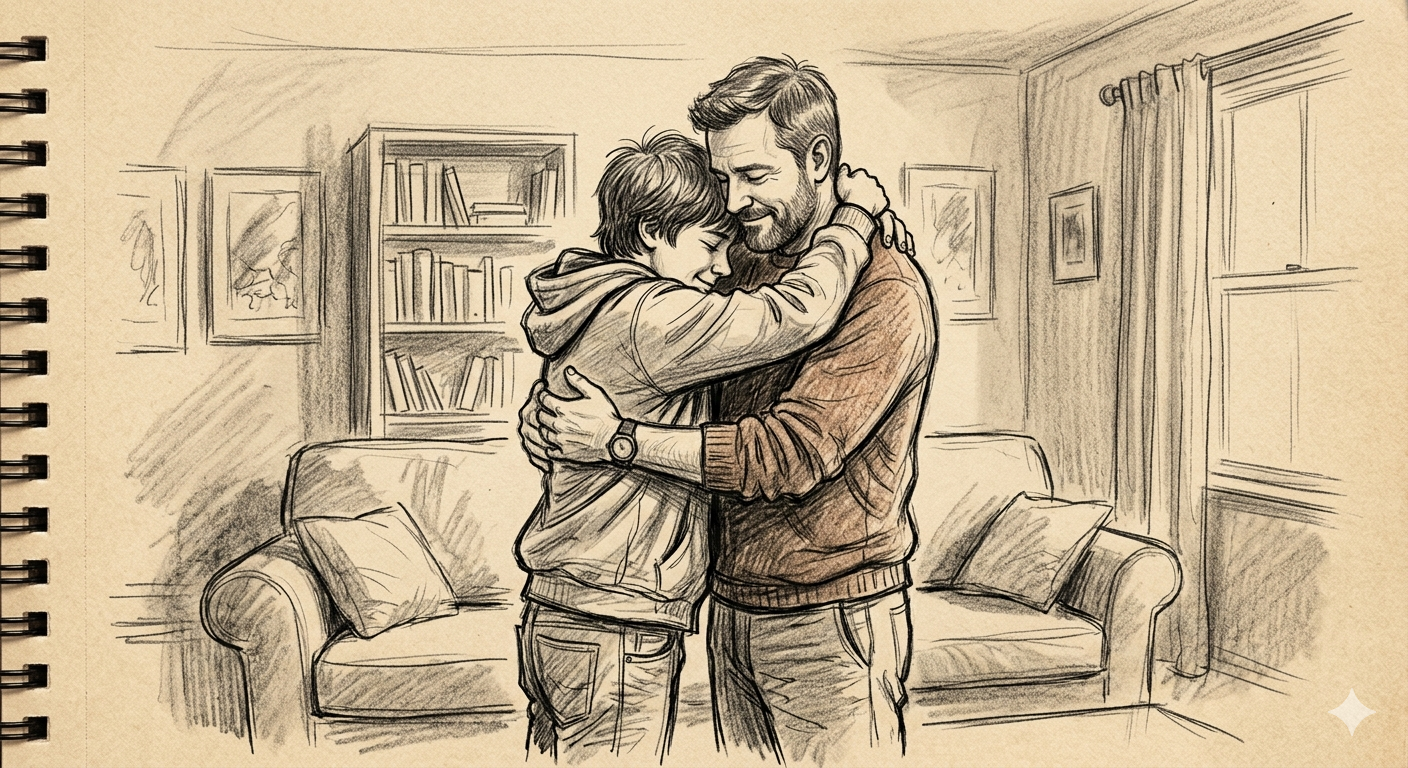
Your Calm Is Their Biology. Now If Only I Could Find Mine.
A brand new Penn State study has just confirmed what neuro-affirming parents have always suspected: your nervous system is literally teaching your child's how to work. Fascinating. Validating. And just slightly inconvenient for those of us who learnt to manage stress by quietly stuffing it into a mental drawer labelled "deal with later."
Science has done it again. Just when you thought you had enough to feel guilty about — the screen time, the school avoidance, the fact that dinner was cereal on a Tuesday — researchers at Penn State have published a study confirming that your nervous system is in constant, real-time biological conversation with your child's.
Your physiological state, in any given 30-second window, directly predicts theirs in the next one. You are not just their parent. You are their nervous system's training programme. Wonderful. No pressure. Of course, many of us with neurodiverse children already know that. This is why I am very honest and open with my kids about my capacity and what it means to be human.So this is actually where it gets genuinely interesting rather than just terrifying — the research is also deeply validating of everything the neuro-affirming parenting world has been saying for years.
Co-regulation is not a buzzword. It is not a soft concept invented by people who have never had a child throw a shoe at their head during a meltdown. It is biology. It is measurable. It is real. And understanding it properly might just change how you see yourself as a parent — and, rather unexpectedly, how you see your own childhood too.
What the Science Actually Says
Researchers tracked 129 mother-child pairs at ages three and four, measuring something called Respiratory Sinus Arrhythmia (RSA) — a real-time indicator of the autonomic nervous system — during a stressful task.
RSA measures how your heartbeat varies with your breathing, and it responds to stress within 30 seconds. Think of it as a live broadcast of your nervous system's state.
What they found: a mother's RSA in one 30-second interval directly predicted her child's in the next. Your nervous system is talking to theirs. Constantly. Whether you are aware of it or not.
In low-risk, less-harsh parenting environments, this external regulation naturally decreases as children age — because the child is building their own internal capacity to self-regulate. Exactly as it should be.
But when parenting involved harsh behaviours — shouting, spanking, psychological aggression — the pattern reversed. Those children became more dependent on external regulation as they got older, not less. Their stress responses became rigid. And once triggered, it took significantly longer for their systems to return to baseline.
The researchers call this "RSA inertia," which sounds like a physics term but is, in fact, a description of a child's nervous system stuck in fight-or-flight with no clear route home. It also explains why I used to binge eat as a child.
The study also notes something that I think deserves its own moment of stillness: mothers who were themselves harshly parented are at higher risk of repeating that pattern — particularly when layered with financial stress, mental health challenges, or family conflict. The cycle does not perpetuate itself out of cruelty. It perpetuates itself out of a nervous system that was never taught another way. I know my mother falls into this category.
Now. Let Me Tell You About My Mother.
My father was demonstrative. He told my sister, my brother, and me that he loved us and was proud of us — he still does, to this day, with the unwavering consistency of a man who never received the memo that emotional availability is apparently optional for his generation. I am grateful for this in ways I am still discovering. I love him too.
My mother, however — with whom my sister and I spent the majority of our time — was the complete opposite. She made us aware from a very young age that we were the quintessential emotional and financial albatross around her neck.
I, in particular, had committed the cardinal sin of arriving into the world with colic. Colic, for the uninitiated, means a baby in constant stomach pain who does not sleep much and cries a great deal. I was left to cry it out quite a bit. I came into this world causing inconvenience, and I'm not entirely sure she ever fully forgave me for it. Off to a flying start.
I was told I would be prettier if I were thinner. That 80% on a test left considerable room for improvement. (I was, for the record, an excellent student. The 20% was doing its absolute best and deserves more credit than it received.)
While I had a genuinely budding career at Artscape — singing in musicals, performing in every school drama production, the kind of thing that, as an adult, I can look back on and think that child had something — my mother grew tired of taking me to rehearsals.
My father and grandmother came to every performance. My mother found the logistics inconvenient. I was thirteen, working in a video shop on the side to cover what I could. Video shops. Yes. I am that old. Moving swiftly on.
The result of all of this — and here is where the Penn State research lands squarely in my own chest — is that I became extraordinarily self-sufficient, very early. I look, from the outside, like a person of considerable self-confidence. Most days, I genuinely do not feel it. What I actually became was someone who learnt to manage stress entirely internally. I learnt not to cry. Not to show my feelings.
Instead, I learnt to read my mother's feelings and behave accordingly — a skill that is simultaneously impressive and a complete psychological disaster. I find it profoundly difficult to reach out for help. I find it even harder to let anyone see that I need any. And I have spent decades quietly batting unwanted thoughts and feelings into a mental drawer labelled "deal with later." A drawer which, I should mention, I rarely actually open. It is pretty full. This is also why I recommended we all have a tribe. Especially us neurodiverse parents. If I did not have those people supporting me when I turn up to ASD support group, things may have turned out a little differently.
What I Did With All of This, When I Had My Own Kids
I was determined. My children would be emotionally confident. They would feel secure in themselves. They would know — with absolute, unambiguous certainty — how much they mean to me. We talk openly about everything in our house. Everything. Which occasionally produces conversations I was not entirely prepared for, but that is a separate article, possibly several.
What I did not know, when I made all of these very sincere promises to myself, was that I was destined for neurodiverse children. And when Olivia came into the world — then a small, deadpan person dressed in pink who loved Tinker Bell and had extremely strong opinions about parties, strangers, and being looked at — the world did not always see what I saw.
I remember a family occasion where Olivia was genuinely content, sitting quietly in a corner painting, entirely at peace and in their element, when a family member turned to me with an expression of deep concern and said: "Shame. She is always so sad and lonely. Will she always be this way?"I smiled. I did not say what I was thinking. That, incidentally, is also a co-regulation strategy.
Years on, the small amount of family I have left have come a long way. They don't always understand Olivia, but they love and accept them — and sometimes that is genuinely enough.
Harrison, meanwhile, is an easy-going soul whom almost everyone adores, unless he says something startlingly honest, which — if you follow my posts — does tend to happen with some regularity. Yesterday he told someone with long hair that it looked ugly and could do with a wash. Then he went back to his video game without another thought. He wasn't wrong — said hair was, objectively, unwashed. But as I registered the expression on the girl's horrified face, I thought: I have worked very hard on social etiquette with this child. It is a substantial curriculum. There are, it appears, chapters I have inadvertently skipped. It is, as always, a work in progress.A long, ongoing, occasionally mortifying work in progress.
I do tell my children they can stim, act, and exist in the world the way they need to, and that this is not something to be hidden or managed for the comfort of others.There will always be people who love them. There will always be people who judge them. Both of those things will be true simultaneously for the rest of their lives, and the goal is not to eliminate the second category — it is to be so anchored in yourself that the second category simply has less power.
The Part That Actually Matters
This is what the Penn State research is really pointing to. Not guilt. Not a performance review of your parenting delivered by scientists in lab coats.
It is pointing to the profound, measurable, biological truth that regulated parents raise children who learn to regulate themselves — and that harsh parenting, born from overwhelm, unprocessed trauma, financial pressure, isolation, and the simple grinding exhaustion of doing too much with too little, interrupts that process in ways that linger.
The researchers make the point gently but clearly: if you can pause, in the heat of a moment, and take a few breaths before responding — that pause has a biological benefit for your child.
Not because you are performing calm for an audience. But because your nervous system genuinely settling, even briefly, gives theirs a signal it can use.
I know this. I teach this. And believe me, I also know it is NOT easy. I have spent years building frameworks around exactly this in my work with neurodiverse families. And I still, on a Thursday evening when everything is too loud and too much and I haven't eaten a proper meal since Tuesday, find myself quietly batting feelings into that very full drawer and telling myself I'll deal with it later.The drawer does not get emptied. But I am, at least, aware it exists now. And I have decided that counts as progress.
Here is what I want you to take from this: your calm is not a luxury.
It is not something you get to once the kids are sorted and the work is done and the house is quiet. It is the work. Your regulated nervous system is the single most powerful parenting tool you own — more than any strategy, any book, any workshop (though the workshops help, I say with absolutely no bias whatsoever).
Taking care of yourself is not selfish. It is not indulgent. It is not one more thing to feel guilty about on top of everything else. It is, according to peer-reviewed science published in Child Development in 2026, quite literally the most important thing you can do for your child's developing brain.
So perhaps start with the drawer. 💛
#NeurodiverseParenting #CoRegulation #PDAParenting #NeuroscienceOfParenting #ParentingOnTheSpectrum
