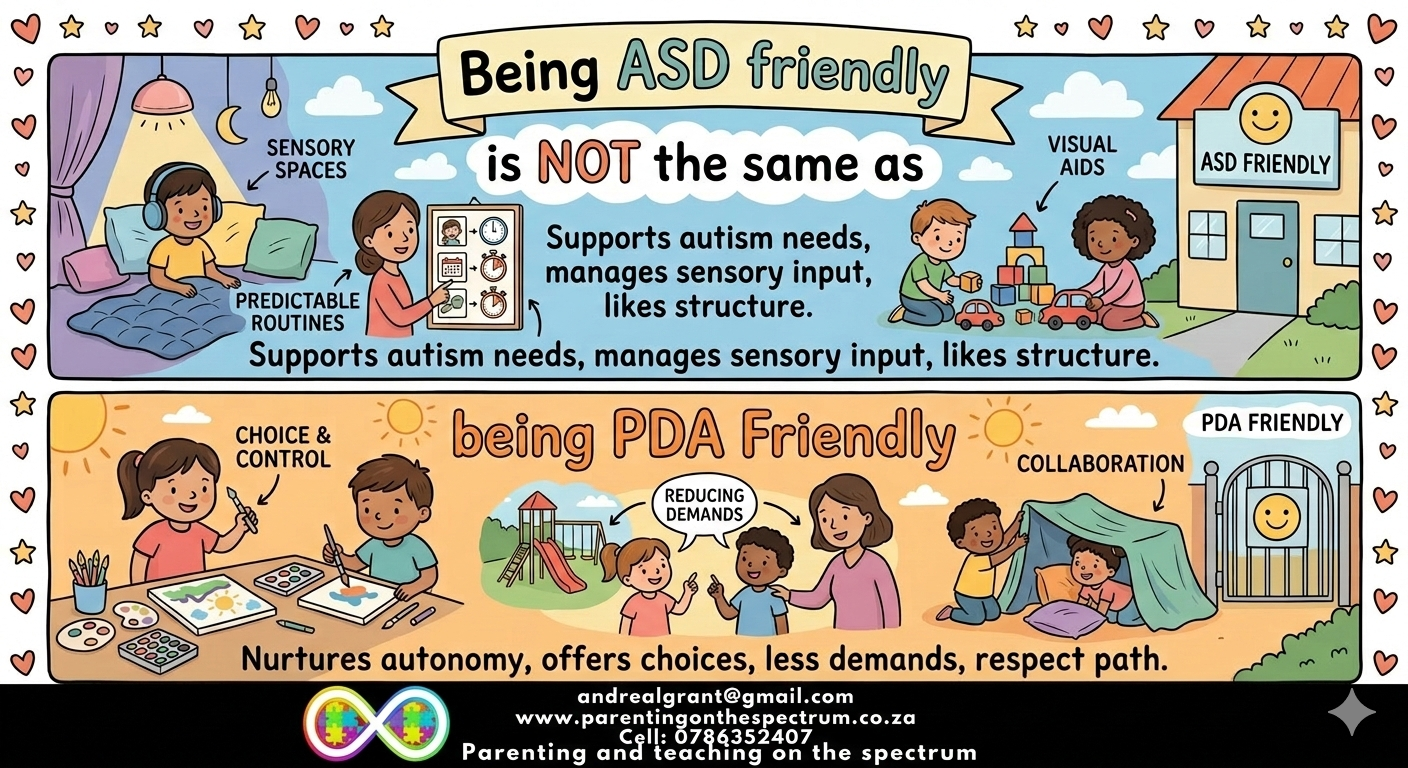
Being ASD friendly is NOT being PDA friendly: What Parents Need to Know About Educational Support by Andrea Grant.
The "Inclusive" Illusion: When Your School Fees Are High, But the Anxiety Is Higher.
Let’s talk about the Great South African Private School Promise. You know the one. It’s the glossy brochure featuring a child wearing noise-canceling headphones, smiling serenely at a wooden puzzle. The one that promises "small classes," "specialized educators," and a "nurturing environment."
So, you mortgage your house, sell a kidney, and pay the equivalent of a small luxury SUV’s monthly installment in school fees. You think, “Finally! A place that gets it!” Then, three months in, you get the phone call. Your child is "refusing to transition." They are "defiant." They are "uncooperative." And suddenly, that "inclusive" sanctuary starts feeling a lot like a high-pressure cooker where the only thing being "nurtured" is your child's total nervous system collapse.
The Elephant in the Staffroom: PDA
Here is the uncomfortable truth I’m hearing from fellow parents and the families I’m lucky enough to coach: many educators are brilliantly trained in the "classic" presentations of the spectrum. They’ve got the visual schedules down to an art form. They understand sensory processing. But very, very few are trained in the high-anxiety, autonomy-driven profile that is Pervasive Demand Avoidance (PDA). For a "PDAer," a standard classroom request—even a polite one—isn't just an instruction; it’s a perceived threat to their safety. When an untrained teacher tries to "firm up" or use a "first-then" reward system, they aren't helping; they are throwing gasoline on a neurobiological fire.
From Boutique Schooling to Burnout
The result? We pay for expertise but receive standard "compliance-based" teaching wrapped in a prettier package.I’ve been there. I have lived the nightmare of two clinic hospitalizations because the "school burnout" became so severe it turned into a medical emergency. I’ve lived the months of school avoidance where the mere sight of anything academic or a uniform triggered a meltdown. It is frightening, it is isolating, and it is—quite frankly—infuriating when you’re paying for a "specialized" service that doesn't actually specialize in your child’s brain.
The Teenager, The Triggers, and The "They"
Fast forward to today. My eldest is now a 15-year-old non-binary teenager who uses they/them pronouns. They are a legend, but they are still a PDAer. Does this mean our house is a 24/7 zen garden of peace? Absolutely not. Do they still get sensory overload? Of course. Do we still have meltdowns? You bet.
The difference is that we stopped trying to "fix" the PDA and started accommodating it. My teen now knows their triggers. They know when to remove themselves from a situation before the explosion happens. I’ve traded the "because I said so" parenting for low-demand strategies. It’s less "General Andrea" and more "highly-skilled hostage negotiator," but it works.
Bridging the Gap
It is essential that parents and caregivers know the distinction between "Classic Autism" and the unique PDA profile. If your "inclusive" school is treated like a battleground, it’s not because your child is "naughty"—it’s because the environment is mismatched with their biology.
I am doing everything I can as a professional and a mom to bridge this gap. You need a team that actually understands that your child isn't won'ting—they are can'ting.
This journey is many things—exhausting, expensive, and occasionally absurd—but it should not be one you do alone.Need a hand navigating the PDA storm? Whether you need a home consult, a school advocate, or just someone who won't judge you for having cereal for dinner for the third night in a row, I’m here. Let’s connect and get your family the resources you actually need.